
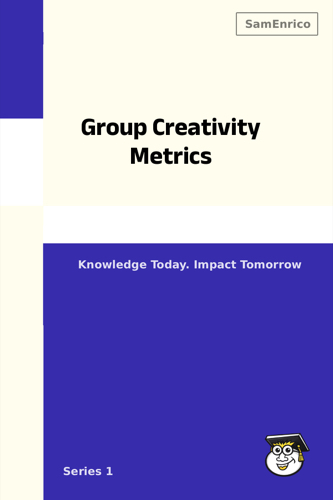
Non-FictionSelf-HelpInnovation Metrics
Group Creativity Metrics Audiobook
Measure novelty, quantity, and feasibility of team
Measure novelty, quantity, and feasibility of team generated ideas.
Formats
Free sample
Chapter 1: The Quantity Fallacy--–- The sticky notes covered every inch of the conference room wall. Fourteen people, six hours, three pizzas, and exactly 847 ideas. The facilitator had called it "the most productive brainstorm of the year." The VP of Innovation had tweeted a photo of the color-coded wall. The team had gone home exhausted but proud.Six weeks later, not a single one of those 847 ideas had been implemented.Not one.The CFO had killed the top three because they "didn't fit the budget cycle." The engineering lead had vetoed the next ten because "we don't have the architecture for that." The legal team had flagged five more as compliance risks. The rest had simply evaporated.
No one could remember what most of them were. The sticky notes had been recycled. The whiteboard had been erased. The tweet had been forgotten.This happens every day. In every industry.
In every conference room where well-intentioned teams confuse activity with progress.The problem is not that teams lack creativity. The problem is not that teams lack effort. The problem is that teams lack measurement. They generate ideas the way a child throws spaghetti at the wall—hoping something sticks, with no way to predict what will stick or why.This book fixes that. But before we can measure creativity, we have to understand what we are measuring.
And that means confronting the most dangerous myth in innovation.The Myth That Quantity Is Enough The first thing most teams do when they want to be "creative" is generate more ideas. More sticky notes. More whiteboard scribbles. More Slack messages. The assumption is simple: if you generate enough ideas, statistically speaking, some of them will be good.This assumption is not wrong.
But it is dangerously incomplete.Let's start with what the research actually says. In a landmark study of productivity and creativity, researcher Dean Keith Simonton analyzed the careers of 2,036 scientists and inventors across history. He found that the most prolific creators—the ones who produced the highest quantity of work—were also the most likely to produce a breakthrough. Thomas Edison held 1,093 patents. Einstein published more than 300 papers.
Shakespeare wrote 37 plays and 154 sonnets. The sheer volume of their output increased the statistical likelihood that somewhere in that pile of work, a masterpiece would emerge.This is the Quantity Breeds Quality effect, and it is real. In controlled laboratory studies, researchers…
This is the end of the free sample. Get the Audiobook to keep going. Buy now
About this book
Details
- Author
- Mello Ricarda
- Publisher
- SamEnrico
- Language
- English
- Genre
- Non-Fiction, Self-Help, Innovation Metrics
- Released
- 2026-06-10
- Pages (approx.)
- 140
- Available as
- eBook, Audiobook

Listen in the VoxFlicks app
Audiobooks and audio dramas wherever you go. Sign in with your SamEnrico account and press play.
More by Mello Ricarda
 Napoleon Bonaparte Rise GuideMello Ricarda$11.99
 Five Minute Bedtime ResetMello Ricarda$11.99
 Cocaine Withdrawal Medical GuideMello Ricarda$11.99
 Delegate Quadrant TrainingMello Ricarda$11.99
 Teen Validation GuideMello Ricarda$11.99
 Pomodoro for Remote WorkMello Ricarda$11.99
 Blue Zone Community Design GuideMello Ricarda$11.99
 The Cannon’s Kiss: How a Woman’s Love Ignited the Art of Siege WarfareMello Ricarda$11.99
 The Golden Ledger: The Visionary Economists of the Mali EmpireMello Ricarda$11.99
 Service Providers Guide to Auto PaintingMello Ricarda$11.99
 Price War Avoidance StrategyMello Ricarda$12.99
 ITIN Application for BankersMello Ricarda$12.99
You may also like
 Hong Kong Handover 1997Dunn Johnnie$11.99
 Zumba For Postnatal Recovery CourseNeal Christian$11.99
 Zumba for BeginnersLadner Nikia$11.99
 YouTube Comment Mining GuideHumes Pandora$12.99
 Worry Box MeditationCarlin Rudy$11.99
 Workplace Stress MeditationNguyen Lynn$11.99
 Workplace Stress and Sleep RepairHawley Ivory$11.99
 Workplace Perfectionism CureDelaney Jeffry$11.99
 Workplace Injustice Anger GuideWallen Isabelle$11.99
 Work Addiction and Burnout LinkGreenwood Ester$11.99
 Women in Yoga and WellnessBeattie Galina$11.99
 Women in Stand Up ComedyChun Evangeline$11.99