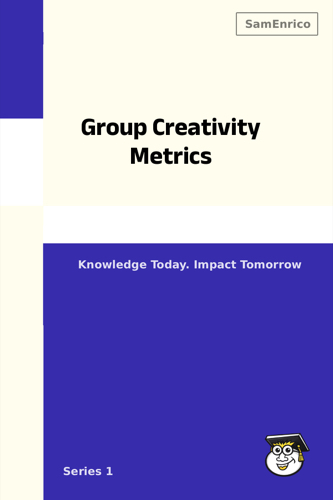
Group Creativity Metrics eBook
Measure novelty, quantity, and feasibility of team
Measure novelty, quantity, and feasibility of team generated ideas.
Formats
Free sample
Chapter 1: The Quantity Fallacy--–- The sticky notes covered every inch of the conference room wall. Fourteen people, six hours, three pizzas, and exactly 847 ideas. The facilitator had called it "the most productive brainstorm of the year." The VP of Innovation had tweeted a photo of the color-coded wall. The team had gone home exhausted but proud.Six weeks later, not a single one of those 847 ideas had been implemented.Not one.The CFO had killed the top three because they "didn't fit the budget cycle." The engineering lead had vetoed the next ten because "we don't have the architecture for that." The legal team had flagged five more as compliance risks. The rest had simply evaporated.
No one could remember what most of them were. The sticky notes had been recycled. The whiteboard had been erased. The tweet had been forgotten.This happens every day. In every industry.
In every conference room where well-intentioned teams confuse activity with progress.The problem is not that teams lack creativity. The problem is not that teams lack effort. The problem is that teams lack measurement. They generate ideas the way a child throws spaghetti at the wall—hoping something sticks, with no way to predict what will stick or why.This book fixes that. But before we can measure creativity, we have to understand what we are measuring.
And that means confronting the most dangerous myth in innovation.The Myth That Quantity Is Enough The first thing most teams do when they want to be "creative" is generate more ideas. More sticky notes. More whiteboard scribbles. More Slack messages. The assumption is simple: if you generate enough ideas, statistically speaking, some of them will be good.This assumption is not wrong.
But it is dangerously incomplete.Let's start with what the research actually says. In a landmark study of productivity and creativity, researcher Dean Keith Simonton analyzed the careers of 2,036 scientists and inventors across history. He found that the most prolific creators—the ones who produced the highest quantity of work—were also the most likely to produce a breakthrough. Thomas Edison held 1,093 patents. Einstein published more than 300 papers.
Shakespeare wrote 37 plays and 154 sonnets. The sheer volume of their output increased the statistical likelihood that somewhere in that pile of work, a masterpiece would emerge.This is the Quantity Breeds Quality effect, and it is real. In controlled laboratory studies, researchers have consistently found that the top five percent of breakthrough ideas only appear after the first fifty to one hundred ideas are exhausted. The first ideas are obvious. The next ideas are familiar.
The ideas that come after fatigue sets in—those are the ones that connect remote associations, challenge hidden assumptions, and produce genuine novelty.So why is quantity dangerously incomplete?Because it says nothing about what kind of quantity you are generating. A thousand ideas about wheels are useless if you need a sail. One hundred ideas that all cluster in the same cognitive neighborhood are functionally identical to one idea repeated one hundred times. Quantity without variety is just noise.And worse: quantity without safety is theater. If your team is afraid to speak, the only ideas that survive are the safe ones.
You can generate a thousand safe ideas and never come close to a breakthrough. The quantity will look impressive. The novelty will be zero.This is the Quantity Fallacy: the mistaken belief that generating more ideas is the same thing as generating better ideas. It is not. Quantity is a necessary condition for breakthrough creativity, but it is not sufficient.
You also need variety (different kinds of ideas) and safety (the psychological conditions that allow weird ideas to survive).The rest of this chapter—and much of this book—will show you how to measure all three. But first, we need a baseline. Because before you can improve variety or safety, you need to know how fast your team is currently generating ideas. You need to measure Ideaflow.What Is Ideaflow? And Why It Matters Ideaflow is the most foundational metric in this book.
It is defined simply as:Ideaflow = Number of distinct ideas generated ÷ (Number of people × Minutes of generation)Expressed in units of ideas per person per minute.Why measure in per-person-per-minute terms? Because raw idea counts are misleading. A team of twelve people meeting for ninety minutes will naturally generate more raw ideas than a team of four people meeting for thirty minutes. But that tells you nothing about efficiency or creative velocity. Ideaflow normalizes for team size and time, giving you a comparable benchmark across sessions, teams, and organizations.Here is what the data suggests as rough benchmarks, based on studies of design teams, R&D groups, and startup brainstorming sessions:Ideaflow Score Performance Level Characteristics Less than 5Critical Teams are stuck, fearful, or poorly facilitated.
Obvious answers are not even being surfaced.5 to 8Below average Teams are generating, but slowly. There is likely social loafing or fixation on a single approach.8 to 12Strong Healthy creative velocity. Teams are exhausting obvious answers and beginning to explore.12 to 15Exceptional Very rare. Usually requires expert facilitation and high psychological safety.More than 15Unsustainable Probably an artifact of poor counting (counting variations of the same idea as distinct).To be clear: these are benchmarks, not laws. A team working on a highly constrained technical problem (for example, "How do we reduce latency by two milliseconds?") may naturally have lower Ideaflow than a team working on an open-ended strategic question (for example, "How might we delight our customers?").
The goal is not to chase a number. The goal is to establish your team's baseline so that you can detect changes.The Two-Minute Subject Line Test How do you measure your team's Ideaflow without running a three-hour offsite? Use the Two-Minute Subject Line Test.Here is the protocol.First, gather your team in a room, physical or virtual.Second, present a single, clear problem statement. For testing purposes, use a neutral problem that everyone can understand. I recommend: "How might we improve the first five minutes of a new employee's first day?"Third, say these exact words: "You have two minutes.
Write down as many distinct solutions to this problem as you would write email subject lines. Do not write paragraphs. Do not explain. Just short subject lines. Go."Fourth, start a timer for two minutes.
Do not let anyone speak during the two minutes. Silence is essential.Fifth, when the timer ends, collect the responses. Count the total number of distinct ideas generated. Do not count near-duplicates. For example, "mentor" and "assign a mentor" count as one idea.Sixth, calculate: total distinct ideas divided by the quantity (number of people multiplied by two).That is your team's Ideaflow baseline.Why does this test work?
Because email subject lines are a familiar, low-stakes format. They force concision. They bypass perfectionism. And two minutes is short enough to prevent overthinking but long enough to exhaust the first wave of obvious answers.Run this test three times over two weeks, using different neutral problem statements each time. Average the results.
That is your team's current creative velocity.Now you have a number. What do you do with it?The Social Loafing Trap…
This is the end of the free sample. Get the eBook to keep going. Buy now
About this book
Details
- Author
- Mello Ricarda
- Publisher
- SamEnrico
- Language
- English
- Genre
- Non-Fiction, Self-Help, Innovation Metrics
- Released
- 2026-06-10
- Pages (approx.)
- 140
- Available as
- eBook, Audiobook

Read better in the ZLOADR app
Your eBooks on your phone or tablet. Sign in with your SamEnrico account and start reading.
More by Mello Ricarda
 Napoleon Bonaparte Rise GuideMello Ricarda$11.99
 Five Minute Bedtime ResetMello Ricarda$11.99
 Cocaine Withdrawal Medical GuideMello Ricarda$11.99
 Delegate Quadrant TrainingMello Ricarda$11.99
 Teen Validation GuideMello Ricarda$11.99
 Pomodoro for Remote WorkMello Ricarda$11.99
 Blue Zone Community Design GuideMello Ricarda$11.99
 The Cannon’s Kiss: How a Woman’s Love Ignited the Art of Siege WarfareMello Ricarda$11.99
 The Golden Ledger: The Visionary Economists of the Mali EmpireMello Ricarda$11.99
 Service Providers Guide to Auto PaintingMello Ricarda$11.99
 Price War Avoidance StrategyMello Ricarda$12.99
 ITIN Application for BankersMello Ricarda$12.99