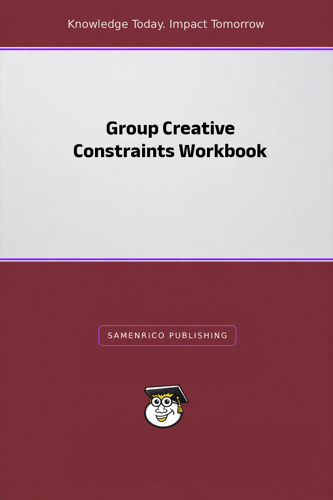
Group Creative Constraints Workbook
Uses artificial limitations to paradoxically boost
by Custer Man
Uses artificial limitations to paradoxically boost team creative output.
Formats
About this book
Free sample
Chapter 1: The Generosity Trap--The most generous thing you can do for your team is to take things away.This sounds wrong. Everything you have been taught about creativity says the opposite. Give people freedom. Give them resources. Give them time.
Give them space to explore. Remove obstacles, remove bureaucracy, remove friction. The blank check, the open deadline, the unlimited budget – these are supposed to be the ingredients of breakthrough thinking.They are not. They are poison.I have watched this poison work its way through hundreds of teams. A marketing department with a seven-figure budget produces the same campaign three years in a row, just with better production value.
A product team with unlimited timeline spends eighteen months building something that users reject in eighteen seconds. A leadership team with complete strategic freedom generates forty-seven pages of options and zero decisions. These teams are not lacking intelligence, talent, or motivation. They are lacking constraints.This chapter introduces the core paradox of this book: artificial limitations boost team creativity more reliably than unlimited freedom. The reason is not complicated, but it is counterintuitive.
Unlimited options do not liberate the brain – they paralyze it. When a team can do anything, they tend to do nothing. Or worse, they do the safest, most predictable thing. The one that no one will get fired for suggesting.The teams that produce genuinely novel work are not the ones with the most resources. They are the ones with the most interesting limitations.
A ten-dollar budget. A twenty-minute deadline. A silent meeting. A rule that the first prototype must be ugly. These sound like handicaps.
They are actually engines.This chapter covers three foundational concepts that appear throughout the book. First, the psychology of scarcity – why having less leads to thinking better. Second, the three failures of unlimited freedom – analysis paralysis, social loafing, and evaluation apprehension. Third, the constraint mindset – how to stop seeing limitations as obstacles and start seeing them as invitations.By the end of this chapter, you will understand why your most productive team sessions were probably the ones where something went wrong.…
This is the end of the free sample. Get the eBook to keep going. Buy now
Contents
- Chapter 1
- Chapter 2
- Chapter 3
- Chapter 4
- Chapter 5
- Chapter 6
- Chapter 7
- Chapter 8
- Chapter 9
- Chapter 10
- Chapter 11
- Chapter 12
Details
- Author
- Custer Man
- Publisher
- SamEnrico
- Language
- English
- Genre
- Non-Fiction, Self-Help, Creative Constraints
- Released
- 2026-06-07
- Pages (approx.)
- 157
- Available as
- eBook, Audiobook

Read better in the ZLOADR app
Your eBooks on your phone or tablet. Sign in with your SamEnrico account and start reading.
More by Custer Man
 Gambling Recovery StoriesCuster Man$11.99
 Irish Labor Migration PatternsCuster Man$11.99
 Weight Loss Body MeasurementCuster Man$11.99
 Change Resistance Anger PatternCuster Man$11.99
 The Last Broadcast: How a Radio Station Outlasted the Cold WarCuster Man$11.99
 The Abyss Beneath: The Forgotten Dive of the Challenger and the Birth of Deep-Sea ScienceCuster Man$11.99
 Understanding Chromosome 8, Monosomy 8p23 1Custer Man$17.99
 Matomo Google Analytics AlternativeCuster Man$12.99
 Media and Entertainment BuyersCuster Man$12.99
 How to Start a Consular office Business (Beginners Guide)Custer Man$11.99
 Systems Project CoordinatorCuster Man$11.99