
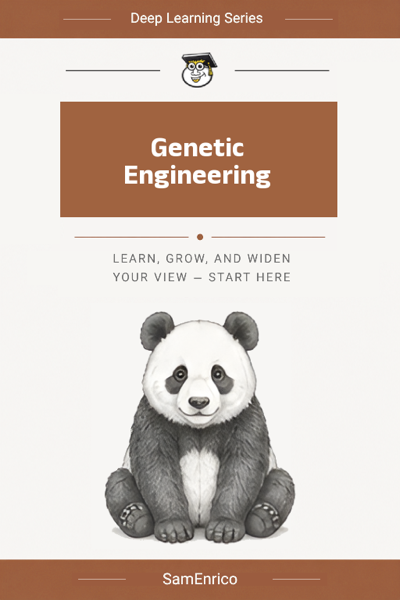
Non-FictionInformativeEducational
Genetic Engineering eBook
A Coursebook on Genetic Engineering
A Coursebook on Genetic Engineering
Formats
Free sample
Chapter 1: The God Problem...--–- The scientist’s hands were trembling. Not from cold, not from fear—though fear was there, coiled in his chest like a sleeping snake. Paul Berg, a biochemist at Stanford, stared at the petri dish in his lab at the Asilomar Conference Center in February 1975. Around him, 140 of the world’s leading molecular biologists had gathered not to celebrate their discoveries but to consider a terrifying question: should they stop?The question was not academic. Four years earlier, Berg himself had performed an experiment that would forever change the relationship between humanity and the natural world.
He had taken DNA from a cancer-causing virus—SV40, a simian virus known to cause tumors in rodents—and spliced it into the DNA of a common bacterium, Escherichia coli. The resulting hybrid was unlike anything evolution had ever produced: a living organism carrying genes from two completely different species, separated by billions of years of evolutionary history.Berg had not published the experiment. He had stopped. And then he had called his colleagues together to ask whether any of them should continue.The Asilomar Conference, held at a retreat center on California’s Monterey Peninsula, was unprecedented in the history of science. Never before had researchers voluntarily halted their own work, convened an international gathering, and drafted rules to govern themselves before any government had passed a single law.
The conference produced a set of safety guidelines, a moratorium on certain high-risk experiments, and a framework for what would become the modern system of biosafety levels—BSL-1 through BSL-4, the airtight suits and negative-pressure labs we now associate with Ebola and anthrax.But the deeper question, the one that haunted Berg and his colleagues, was never fully answered. It was a question older than science, older than medicine, older perhaps than humanity itself: Just because we can, does that mean we should?This is the God problem. And this book is about how we learned to rewrite the code of life—and why we still cannot decide whether that makes us gods or monsters or something in between.The Central Dogma: Nature’s Engineering Manual Before we can understand how to rewrite the blueprint of life, we must first understand what the blueprint is and how it works. Every living organism on Earth—from the smallest bacterium to the largest sequoia, from the simplest fungus to the most complex human brain—operates on the same fundamental information system. This system is so elegant, so universal, that biologists sometimes call it the central dogma.The central dogma is not a religious statement.
It is a description of information flow. In its simplest form: DNA makes RNA makes protein.Let us break that down.DNA (deoxyribonucleic acid) is the master blueprint. It is a long, double-stranded molecule shaped like a twisted ladder—the famous double helix discovered by James Watson and Francis Crick in 1953, with crucial contributions from Rosalind Franklin and Maurice Wilkins. The rungs of the ladder are made of four chemical bases: adenine (A), thymine (T), guanine (G), and cytosine (C). A always pairs with T, and G always pairs with C.
This pairing rule is the foundation of heredity, of evolution, of life itself.The human genome—the complete set of DNA in a human cell—contains approximately 3 billion base pairs. If you stretched it out end to end, it would reach about two meters. Yet it fits inside a microscopic nucleus because DNA is wound around proteins called histones, then coiled, then looped, then folded like the world’s most intricate origami.RNA (ribonucleic acid) is the messenger. It is single-stranded and uses uracil (U) instead of thymine. When a gene needs to be expressed—when a cell needs to make a specific protein—an enzyme called RNA polymerase reads the DNA sequence and produces a complementary RNA copy.
This process is called transcription.Proteins are the workers. They are long chains of amino acids folded into specific three-dimensional shapes. There are 20 standard amino acids, and the sequence of bases in DNA—read in groups of three called codons—specifies which amino acid goes where. A protein might be an enzyme that catalyzes a chemical reaction, a structural component that gives a cell its shape, a hormone that carries a signal from one part of the body to another, or an antibody that fights infection. The process of building a protein from an RNA template is called translation.So the central dogma is an engineering manual.
DNA is the blueprint. RNA is the photocopy sent to the workshop. Proteins are the machines built from the instructions.Why does this matter for genetic engineering? Because the central dogma tells us where we can intervene. If we can read the DNA sequence, we can identify the genes responsible for traits—good traits (drought resistance in crops) and bad traits (genetic diseases in humans).
If we can cut DNA, we can remove problematic genes. If we can paste DNA, we can insert beneficial genes. If we can synthesize DNA from scratch, we can create entirely new genes that have never existed in nature.The engineering of life begins with the central dogma. And the central dogma begins with a simple truth: all life is information.The Birth of Recombinant DNA: Cohen and Boyer’s Deli Napkin Every revolution has its origin story. For genetic engineering, the origin story unfolds not in a gleaming laboratory but in a deli in Honolulu, Hawaii, in 1972.Herbert Boyer, a biochemist at the University of California, San Francisco, was attending a conference on bacterial plasmids—small, circular DNA molecules that replicate independently of the bacterial chromosome.
Stanley Cohen, a geneticist at Stanford, was also at the conference. They met for lunch at a deli near Waikiki Beach. Over sandwiches and coffee, they sketched an experiment on a napkin.The idea was audacious. Boyer had recently discovered a restriction enzyme—a molecular scissors—called Eco RI. This enzyme cut DNA at a specific sequence: GAATTC.
Crucially, it cut in a staggered way, leaving overhanging ends (called "sticky ends") that could base-pair with any other DNA cut by the same enzyme. Cohen had developed methods for isolating plasmids and reintroducing them into bacteria. What if they combined these tools?What if they cut a plasmid with Eco RI, cut a foreign gene—say, a frog gene—with the same enzyme, and then stuck them together? Would the resulting hybrid DNA replicate inside bacteria? Would the foreign gene be expressed?The experiment worked beyond their wildest expectations.
In 1973, Cohen and Boyer reported that they had successfully spliced a gene from the African clawed frog Xenopus laevis into a plasmid and introduced that plasmid into E. coli. The frog gene replicated along with the bacterial DNA. For the first time in history, genes from two entirely different kingdoms of life—animal and bacterium—had been combined in a single living organism.This was recombinant DNA. And it changed everything.Suddenly, scientists could clone any gene they wanted.
They could produce human proteins in bacteria—insulin, growth hormone, blood clotting factors. They could study gene function by moving genes from one organism to another. They could create animal models…
This is the end of the free sample. Get the eBook to keep going. Buy now
About this book
Details
- Author
- Ladner Eneida
- Publisher
- SamEnrico
- Language
- English
- Genre
- Non-Fiction, Informative, Educational
- Released
- 2026-06-02
- Pages (approx.)
- 160
- Available as
- eBook, Audiobook

Read better in the ZLOADR app
Your eBooks on your phone or tablet. Sign in with your SamEnrico account and start reading.
More by Ladner Eneida
 Forgiveness Breath PracticeLadner Eneida$11.99
 DoorDash Dasher RatingsLadner Eneida$11.99
 The Breath Anchor for PanicLadner Eneida$11.99
 Non threatening Posture GuideLadner Eneida$11.99
 The Remote Work Health Insurance GuideLadner Eneida$11.99
 The Gold Rush Heist: How a Gang Outwitted the Wild WestLadner Eneida$11.99
 Non Resident LLC Formation AgentsLadner Eneida$12.99
 Loyalty Program PreferencesLadner Eneida$12.99
 Understanding LsaLadner Eneida$17.99
 How to Become a Draw-bench-operator HelperLadner Eneida$11.99
You may also like
 Hong Kong Handover 1997Dunn Johnnie$11.99
 Zumba For Postnatal Recovery CourseNeal Christian$11.99
 Zumba for BeginnersLadner Nikia$11.99
 YouTube Comment Mining GuideHumes Pandora$12.99
 Worry Box MeditationCarlin Rudy$11.99
 Workplace Stress MeditationNguyen Lynn$11.99
 Workplace Stress and Sleep RepairHawley Ivory$11.99
 Workplace Perfectionism CureDelaney Jeffry$11.99
 Workplace Injustice Anger GuideWallen Isabelle$11.99
 Work Addiction and Burnout LinkGreenwood Ester$11.99
 Women in Yoga and WellnessBeattie Galina$11.99
 Women in Stand Up ComedyChun Evangeline$11.99