
Non-FictionSelf-HelpWorkspace Design
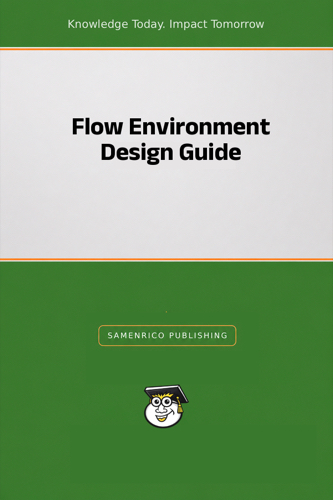
Flow Environment Design Guide eBook
Create physical spaces that invite deep concentrat
Create physical spaces that invite deep concentration using this guide.
Formats
Free sample
Chapter 1: The Distraction Autopsy--–- The email arrives at 9:14 AM. You are writing a report. You tell yourself you will glance at the sender and return to work. Forty-seven minutes later, you have read thirteen unrelated articles, replied to a message about a social event next month, and completely forgotten what the report was about. You close the laptop at 5:00 PM exhausted, ashamed, and certain of one thing: you lack discipline.What if the opposite were true?What if the problem was never your willpower but the room you were sitting in?This chapter performs a single task: it proves that your environment is not neutral.
It is either a fortress for your attention or an engine designed to destroy it. By the time you finish reading, you will never blame yourself for distraction again. You will blame the architecture.The question that opens this chapter is not rhetorical. Imagine you were paid to steal someone's focus. Your client wants a knowledge worker—a writer, a programmer, an accountant—to be unable to concentrate for more than ninety seconds at a time.
You are given a budget of zero dollars and full control over their physical workspace. What do you do?You would put their desk in a hallway. You would cover every surface with unrelated objects: old mail, unpaid bills, a phone face-up, a stack of books they meant to read last year. You would position their chair so their back faced an open door, forcing their brain to remain vigilant for threats approaching from behind. You would ensure the lighting was fluorescent and flickering, the temperature slightly uncomfortable, the air stale.
You would put a window behind their monitor so every passing shadow registered as movement in peripheral vision. You would place their smartphone exactly six inches from their keyboard, screen up, notifications on.Congratulations. You have just described the average home office, corporate cubicle, or student dormitory.The average knowledge worker does not have a discipline problem. They have a design problem. And until they recognize that distinction, every productivity technique they try—Pomodoro timers, digital detoxes, elaborate to-do lists—will fail.
Not because the techniques are wrong, but because they are fighting the room. And the room always wins.The Cognitive Load Map: Seeing What You Have Been Ignoring Before you can redesign your environment, you must diagnose it. This chapter introduces the first and most important diagnostic tool in this book: the Cognitive Load Map.Take a sheet of paper. Draw your current workspace from a bird's-eye view. Include every object, every surface, every device, every piece of furniture.
Do not censor yourself. If there is a stack of unread mail on the corner of your desk, draw it. If there is a phone charger plugged into the wall, draw it. If there is a window that faces a busy street, a wall with a calendar from 2022, a pet bed in your peripheral vision—draw it all.Now label each object with one of three categories:Red: This object actively demands attention. Smartphones.
Notification lights. Open chat applications on a secondary screen. A door that people walk through.Yellow: This object does not demand attention, but it does not help focus either. Decorations, old papers, extra stationery, books not relevant to the current task.Green: This object directly supports the current task and only the current task. The document you are writing.
The tool you are using. Nothing else.Here is what research from the field of environmental psychology reveals about the average Cognitive Load Map. In a study published in the Journal of Experimental Psychology in 2011, Mc Mains and Kastner demonstrated that visual clutter—objects unrelated to the current task—reduces productivity by up to thirty-two percent. Not because you consciously look at the clutter. Because your brain cannot help but process it.
Every object in your peripheral vision requires a micro-suppression event: a tiny burst of neural energy to say "ignore that, ignore that, ignore that." By the time you have accumulated forty or fifty objects in your visual field, your brain is exhausted before you have typed a single sentence.The Cognitive Load Map reveals the hidden tax you have been paying. Most readers complete this exercise and discover that eighty to ninety percent of the objects in their workspace are Red or Yellow. Less than ten percent are Green. That means you are spending ninety percent of your cognitive budget on suppression before any actual work begins.You are not lazy. You are overburdened.The Thirty-Two Percent Tax Let that number land: thirty-two percent.If you work a standard eight-hour day, visual clutter alone steals approximately two and a half hours of productive capacity before you factor in digital notifications, interruptions, poor lighting, bad acoustics, or any of the other environmental assaults we will address in later chapters.
Two and a half hours. Every day. That is twelve and a half hours per week. That is six hundred and fifty hours per year.Six hundred and fifty hours. That is more than twenty-seven full days.
That is nearly a month of your life, every year, stolen by the objects sitting on your desk right now.And visual clutter is only the beginning. In the chapters that follow, we will examine acoustic clutter (conversations leaking through walls, HVAC noise, street sounds), digital clutter (notifications, secondary screens, the phone that lives six inches from your keyboard), and kinetic clutter (people walking past your peripheral vision, pets moving through the room, the oscillating fan that catches your eye every twelve seconds).But you do not need to solve all of those problems today. You need to solve one problem today: the belief that you are the failure.The Attention Autopsy: Your First Fifteen-Minute Move This book is not a collection of abstract theories. It is a sequence of fifteen-minute moves. Each chapter ends with a single action you can complete in fifteen minutes or less that moves you from passive occupant to active architect.
Chapter One's move is the Attention Autopsy.Open a new document or take out a fresh sheet of paper. For one full workday—tomorrow, not today, because today you are reading—set a timer for every hour. When the timer goes off, write down two things:What you were supposed to be doing.What you were actually doing.That is it. Do not judge yourself. Do not try to change your behavior.
Simply observe and record. At the end of the day, look at your log. For every entry where "actually doing" differs from "supposed to be doing," ask one question: what physical trigger preceded the shift?You will notice patterns. "I was writing, then I checked my phone." The physical trigger was the phone's presence. "I was coding, then I looked out the window at the delivery truck." The physical trigger was movement in peripheral vision.
"I was reading, then I got up to get coffee." The physical trigger was the empty mug on your desk reminding you of thirst.What you will not find in the Attention Autopsy is a single entry that says "I lack discipline." Because discipline is not a physical cause. It is a story you…
This is the end of the free sample. Get the eBook to keep going. Buy now
About this book
Details
- Author
- Toledo Theresia
- Publisher
- SamEnrico
- Language
- English
- Genre
- Non-Fiction, Self-Help, Workspace Design
- Released
- 2026-06-06
- Pages (approx.)
- 118
- Available as
- eBook, Audiobook

Read better in the ZLOADR app
Your eBooks on your phone or tablet. Sign in with your SamEnrico account and start reading.
More by Toledo Theresia
 The SMART Criteria ExplainedToledo Theresia$11.99
 Facilitating Creative SessionsToledo Theresia$11.99
 Challenge Seeking Growth GuideToledo Theresia$11.99
 Self Esteem for ExtrovertsToledo Theresia$11.99
 Financial Stress And FriendshipsToledo Theresia$11.99
 Outsourcing for Marketing AgenciesToledo Theresia$11.99
 The Olmec Astronomers: Decoding the Stars of the First Mesoamerican CivilizationToledo Theresia$11.99
 Pill Mill Highway: The Deadly Route of Opioid FraudToledo Theresia$11.99
 How to Produce PumpsToledo Theresia$11.99
 The Essential Guide to EnkaToledo Theresia$11.99
 Rough-stalked Meadowgrass: Poa Trivialis Forage HarvestingToledo Theresia$11.99
 How to Produce Electronic PublicationsToledo Theresia$11.99
You may also like
 Hong Kong Handover 1997Dunn Johnnie$11.99
 Zumba For Postnatal Recovery CourseNeal Christian$11.99
 Zumba for BeginnersLadner Nikia$11.99
 YouTube Comment Mining GuideHumes Pandora$12.99
 Worry Box MeditationCarlin Rudy$11.99
 Workplace Stress MeditationNguyen Lynn$11.99
 Workplace Stress and Sleep RepairHawley Ivory$11.99
 Workplace Perfectionism CureDelaney Jeffry$11.99
 Workplace Injustice Anger GuideWallen Isabelle$11.99
 Work Addiction and Burnout LinkGreenwood Ester$11.99
 Women in Yoga and WellnessBeattie Galina$11.99
 Women in Stand Up ComedyChun Evangeline$11.99