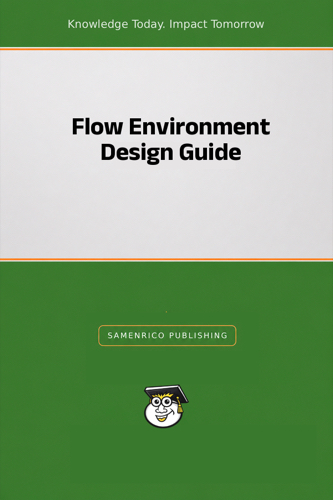
Flow Environment Design Guide
Create physical spaces that invite deep concentrat
Create physical spaces that invite deep concentration using this guide.
Formats
About this book
Free sample
Chapter 1: The Distraction Autopsy--–- The email arrives at 9:14 AM. You are writing a report. You tell yourself you will glance at the sender and return to work. Forty-seven minutes later, you have read thirteen unrelated articles, replied to a message about a social event next month, and completely forgotten what the report was about. You close the laptop at 5:00 PM exhausted, ashamed, and certain of one thing: you lack discipline.What if the opposite were true?What if the problem was never your willpower but the room you were sitting in?This chapter performs a single task: it proves that your environment is not neutral.
It is either a fortress for your attention or an engine designed to destroy it. By the time you finish reading, you will never blame yourself for distraction again. You will blame the architecture.The question that opens this chapter is not rhetorical. Imagine you were paid to steal someone's focus. Your client wants a knowledge worker—a writer, a programmer, an accountant—to be unable to concentrate for more than ninety seconds at a time.
You are given a budget of zero dollars and full control over their physical workspace. What do you do?You would put their desk in a hallway. You would cover every surface with unrelated objects: old mail, unpaid bills, a phone face-up, a stack of books they meant to read last year. You would position their chair so their back faced an open door, forcing their brain to remain vigilant for threats approaching from behind. You would ensure the lighting was fluorescent and flickering, the temperature slightly uncomfortable, the air stale.
You would put a window behind their monitor so every passing shadow registered as movement in peripheral vision. You would place their smartphone exactly six inches from their keyboard, screen up, notifications on.Congratulations. You have just described the average home office, corporate cubicle, or student dormitory.The average knowledge worker does not have a discipline problem. They have a design problem. And until they recognize that distinction, every productivity technique they try—Pomodoro timers, digital detoxes, elaborate to-do lists—will…
This is the end of the free sample. Get the eBook to keep going. Buy now
Contents
- Chapter 1
- Chapter 2
- Chapter 3
- Chapter 4
- Chapter 5
- Chapter 6
- Chapter 7
- Chapter 8
- Chapter 9
- Chapter 10
- Chapter 11
- Chapter 12
Details
- Author
- Toledo Theresia
- Publisher
- SamEnrico
- Language
- English
- Genre
- Non-Fiction, Self-Help, Workspace Design
- Released
- 2026-06-06
- Pages (approx.)
- 118
- Available as
- eBook, Audiobook

Read better in the ZLOADR app
Your eBooks on your phone or tablet. Sign in with your SamEnrico account and start reading.
More by Toledo Theresia
 The SMART Criteria ExplainedToledo Theresia$11.99
 Facilitating Creative SessionsToledo Theresia$11.99
 Challenge Seeking Growth GuideToledo Theresia$11.99
 Self Esteem for ExtrovertsToledo Theresia$11.99
 Financial Stress And FriendshipsToledo Theresia$11.99
 Outsourcing for Marketing AgenciesToledo Theresia$11.99
 The Olmec Astronomers: Decoding the Stars of the First Mesoamerican CivilizationToledo Theresia$11.99
 Pill Mill Highway: The Deadly Route of Opioid FraudToledo Theresia$11.99
 How to Produce PumpsToledo Theresia$11.99
 The Essential Guide to EnkaToledo Theresia$11.99
 Rough-stalked Meadowgrass: Poa Trivialis Forage HarvestingToledo Theresia$11.99
 How to Produce Electronic PublicationsToledo Theresia$11.99