
Non-FictionBusiness BriefFloriculture
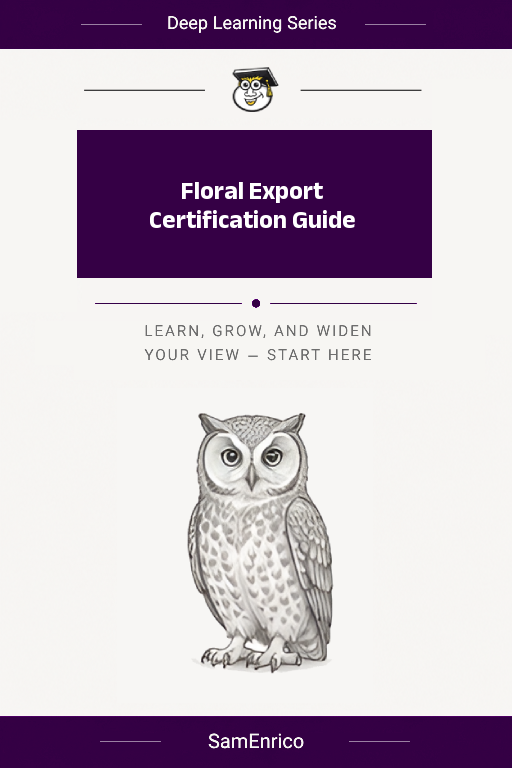
Floral Export Certification Guide Audiobook
Details Florverde, Fair Flowers Fair Plants, and R
by Moya Darron
Details Florverde, Fair Flowers Fair Plants, and Rainforest Alliance for cut flower exporters entering European and US markets.
Formats
Free sample
Chapter 1: The Invisible Gatekeepers--The first time a cut flower exporter loses a container shipment at Dutch customs, the lesson arrives not as a warning but as a disaster. Forty thousand stems of premium roses, grown at considerable expense, harvested at the perfect moment, cooled to precisely two degrees Celsius, and flown across the Atlantic—all of it condemned. Not for pests. Not for disease. Not for quality.
Condemned because the paperwork did not include a certification code that had been mandatory for only seventy-two hours. The buyer, a mid-sized wholesaler in Aalsmeer, walked away without penalty. The exporter, a family-owned farm in the highlands of Ecuador, swallowed a loss of nearly sixty thousand dollars. The flowers, still beautiful, still fragrant, became compost.This scenario is not hypothetical. It happens every year, to farms large and small, across every major cut flower exporting country.
And the root cause is almost never a failure of agricultural practice. It is a failure to understand a fundamental shift that has transformed the international flower trade over the past two decades: the shift from voluntary sustainability claims to mandatory certification requirements enforced by invisible gatekeepers—retailers, auction houses, regulators, and ultimately consumers themselves.The purpose of this chapter is to establish, from the very first page, a clear and urgent case for why sustainability certifications are no longer optional for exporters targeting the European and United States markets. We will examine the historical evolution from private retailer codes to third-party ecolabels, analyze the current market share of certified flowers in both regions, quantify the risks of non-certification, debunk persistent myths, and provide a practical framework for assessing whether your existing markets already require certification. By the end of this chapter, you will understand that certification is not a marketing gimmick or a feel-good add-on. It is a license to operate.
The gatekeepers are invisible only until they block your path. After that, they are unmistakable.The Great Transition: From Retailer Codes to Third-Party Labels To understand where the cut flower industry stands today, one must look back to the late 1990s and early 2000s. During this period, a handful of large European and American retailers began to develop internal codes of conduct for their fresh produce suppliers, including flowers. These codes were proprietary, inconsistent, and often confidential. A farm selling to Tesco in the United Kingdom might receive a fifty-page document listing prohibited pesticides, maximum working…
This is the end of the free sample. Get the Audiobook to keep going. Buy now
About this book
Details
- Author
- Moya Darron
- Publisher
- SamEnrico
- Language
- English
- Genre
- Non-Fiction, Business Brief, Floriculture
- Released
- 2026-05-30
- Pages (approx.)
- 157
- Available as
- eBook, Audiobook

Listen in the VoxFlicks app
Audiobooks and audio dramas wherever you go. Sign in with your SamEnrico account and press play.
More by Moya Darron
 TikTok Live MonetizationMoya Darron$11.99
 Cross Border Supply Chain WorkbookMoya Darron$11.99
 The Teen Disability Confidence GuideMoya Darron$11.99
 The Food Addiction and Anxiety GuideMoya Darron$11.99
 Imposter Syndrome Self CompassionMoya Darron$11.99
 The Hollow Hill: A Warrior’s Pact with the FaeMoya Darron$11.99
 Construction Project CoordinatorMoya Darron$11.99
 GA4 User Explorer ReportMoya Darron$12.99
 Understanding Primary Biliary CirrhosisMoya Darron$17.99
You may also like
 Hong Kong Handover 1997Dunn Johnnie$11.99
 Zumba For Postnatal Recovery CourseNeal Christian$11.99
 Zumba for BeginnersLadner Nikia$11.99
 YouTube Comment Mining GuideHumes Pandora$12.99
 Worry Box MeditationCarlin Rudy$11.99
 Workplace Stress MeditationNguyen Lynn$11.99
 Workplace Stress and Sleep RepairHawley Ivory$11.99
 Workplace Perfectionism CureDelaney Jeffry$11.99
 Workplace Injustice Anger GuideWallen Isabelle$11.99
 Work Addiction and Burnout LinkGreenwood Ester$11.99
 Women in Yoga and WellnessBeattie Galina$11.99
 Women in Stand Up ComedyChun Evangeline$11.99