
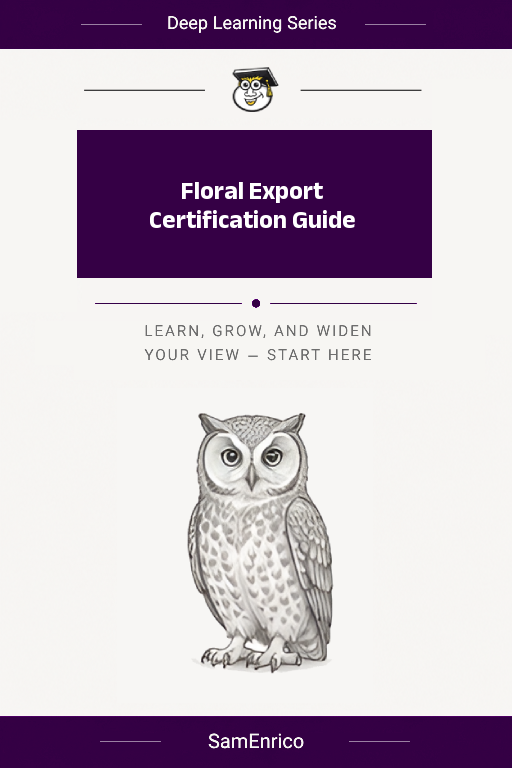
Non-FictionBusiness BriefFloriculture
Floral Export Certification Guide eBook
Details Florverde, Fair Flowers Fair Plants, and R
by Moya Darron
Details Florverde, Fair Flowers Fair Plants, and Rainforest Alliance for cut flower exporters entering European and US markets.
Formats
Free sample
Chapter 1: The Invisible Gatekeepers--The first time a cut flower exporter loses a container shipment at Dutch customs, the lesson arrives not as a warning but as a disaster. Forty thousand stems of premium roses, grown at considerable expense, harvested at the perfect moment, cooled to precisely two degrees Celsius, and flown across the Atlantic—all of it condemned. Not for pests. Not for disease. Not for quality.
Condemned because the paperwork did not include a certification code that had been mandatory for only seventy-two hours. The buyer, a mid-sized wholesaler in Aalsmeer, walked away without penalty. The exporter, a family-owned farm in the highlands of Ecuador, swallowed a loss of nearly sixty thousand dollars. The flowers, still beautiful, still fragrant, became compost.This scenario is not hypothetical. It happens every year, to farms large and small, across every major cut flower exporting country.
And the root cause is almost never a failure of agricultural practice. It is a failure to understand a fundamental shift that has transformed the international flower trade over the past two decades: the shift from voluntary sustainability claims to mandatory certification requirements enforced by invisible gatekeepers—retailers, auction houses, regulators, and ultimately consumers themselves.The purpose of this chapter is to establish, from the very first page, a clear and urgent case for why sustainability certifications are no longer optional for exporters targeting the European and United States markets. We will examine the historical evolution from private retailer codes to third-party ecolabels, analyze the current market share of certified flowers in both regions, quantify the risks of non-certification, debunk persistent myths, and provide a practical framework for assessing whether your existing markets already require certification. By the end of this chapter, you will understand that certification is not a marketing gimmick or a feel-good add-on. It is a license to operate.
The gatekeepers are invisible only until they block your path. After that, they are unmistakable.The Great Transition: From Retailer Codes to Third-Party Labels To understand where the cut flower industry stands today, one must look back to the late 1990s and early 2000s. During this period, a handful of large European and American retailers began to develop internal codes of conduct for their fresh produce suppliers, including flowers. These codes were proprietary, inconsistent, and often confidential. A farm selling to Tesco in the United Kingdom might receive a fifty-page document listing prohibited pesticides, maximum working hours, and water discharge standards.
The same farm, selling to Walmart in the United States, would receive a different document with different thresholds, different audit protocols, and different enforcement mechanisms. The burden on exporters was enormous and largely hidden from public view.Consider the case of a Colombian rose grower in 2005. This farm might have held contracts with three separate European retailers, each requiring its own internal audit, its own documentation format, and its own corrective action plan. The farm would pay for each audit separately. It would maintain three distinct filing systems.
It would train its staff on three different sets of rules. And if any one of those retailers decided to change its code of conduct—which happened frequently, often without advance notice—the farm would scramble to comply or risk losing the contract. The system was not designed to help farmers improve. It was designed to protect retailers from liability.This system was inefficient for retailers and punishing for exporters. But it did have one virtue: it kept the burden hidden from consumers.
Shoppers at Tesco or Walmart saw no label on the bouquet. They had no way of knowing whether the flowers met any particular environmental or social standard. The code of conduct was strictly a business-to-business instrument, invisible to the person who ultimately paid for the product.The turning point arrived around 2010. Several converging forces pushed the industry toward consumer-facing labels. First, non-governmental organizations like the Rainforest Alliance and Fairtrade International had demonstrated that consumers would pay a premium for certified products in other sectors—coffee, chocolate, bananas.
Why not flowers? The logic was compelling: if a shopper would pay more for a bag of coffee that protected rainforests, that same shopper would pay more for a bouquet that protected workers and ecosystems. Second, Dutch auction houses, led by Flora Holland (now Royal Flora Holland), began to see certification as a way to differentiate product lots and maintain price stability in an increasingly commoditized market. Third, a series of investigative reports exposed labor abuses on flower farms in Kenya, Ethiopia, and Colombia, creating reputational risk for retailers who had done little more than sign a piece of paper promising ethical sourcing.The result was a rapid proliferation of third-party certification schemes explicitly designed for the cut flower sector. Florverde Sustainable Flowers, originally created in Colombia in 1996 as a domestic standard, expanded its reach across the Americas and began courting international recognition.
Fair Flowers Fair Plants, launched in 2007 as a European meta-standard, gave retailers a single label that aggregated multiple underlying certifications. The Rainforest Alliance, already established in other agricultural sectors, published its first dedicated cut flower standard and began licensing the iconic green frog to compliant farms. The gatekeepers were no longer invisible behind closed-door retailer codes. They were stamped on every bouquet.Today, the landscape has stabilized around these three major players, along with a handful of smaller or regionally focused schemes. But the key development is not the number of certifications.
It is their function. Certifications are no longer just tools for risk management or brand differentiation. They have become de facto market access requirements. In Europe, a flower without a label is a flower that many buyers will not touch. In the United States, the same dynamic is rapidly taking hold.
The invisible gatekeepers have become visible, and they are not going away.The Numbers That Matter: Certified Flower Market Share in Europe and the United States Let us begin with Europe, because Europe is where the certification mandate is strongest and most mature. According to industry data from the Floriculture Sustainability Initiative (FSI) and Union Fleurs, the international association of flower trade, certified flowers now represent an estimated 50 to 75 percent of the European cut flower market. The wide range reflects differences among countries, retail channels, and product types. In the Netherlands, which serves as the continent's primary distribution hub and auction center, the penetration of certified flowers is closer to 70 percent. In Germany, the largest single consumer market, it exceeds 65 percent.
In the United Kingdom, which has its own parallel systems but largely follows European trends, it is approximately 55 percent. In Southern Europe—Italy, Spain, Greece—penetration is lower, but rising rapidly as multinational retailers expand their sustainability commitments.These figures are not static. They are rising by roughly three to five percentage points per year. The primary drivers are supermarket commitments. Aldi, Lidl, Tesco, Sainsbury's, and the German cooperative Edeka have all announced public targets for sourcing certified flowers.
Aldi, for example, committed in 2021 that 100 percent of its cut flowers would come from certified sustainable sources by 2025. That deadline has now passed, and Aldi has publicly reported that it achieved 92 percent compliance in 2024, with the remaining eight percent under active transition. Lidl made a…
This is the end of the free sample. Get the eBook to keep going. Buy now
About this book
Details
- Author
- Moya Darron
- Publisher
- SamEnrico
- Language
- English
- Genre
- Non-Fiction, Business Brief, Floriculture
- Released
- 2026-05-30
- Pages (approx.)
- 157
- Available as
- eBook, Audiobook

Read better in the ZLOADR app
Your eBooks on your phone or tablet. Sign in with your SamEnrico account and start reading.
More by Moya Darron
 TikTok Live MonetizationMoya Darron$11.99
 Cross Border Supply Chain WorkbookMoya Darron$11.99
 The Teen Disability Confidence GuideMoya Darron$11.99
 The Food Addiction and Anxiety GuideMoya Darron$11.99
 Imposter Syndrome Self CompassionMoya Darron$11.99
 The Hollow Hill: A Warrior’s Pact with the FaeMoya Darron$11.99
 Construction Project CoordinatorMoya Darron$11.99
 GA4 User Explorer ReportMoya Darron$12.99
 Understanding Primary Biliary CirrhosisMoya Darron$17.99
You may also like
 Hong Kong Handover 1997Dunn Johnnie$11.99
 Zumba For Postnatal Recovery CourseNeal Christian$11.99
 Zumba for BeginnersLadner Nikia$11.99
 YouTube Comment Mining GuideHumes Pandora$12.99
 Worry Box MeditationCarlin Rudy$11.99
 Workplace Stress MeditationNguyen Lynn$11.99
 Workplace Stress and Sleep RepairHawley Ivory$11.99
 Workplace Perfectionism CureDelaney Jeffry$11.99
 Workplace Injustice Anger GuideWallen Isabelle$11.99
 Work Addiction and Burnout LinkGreenwood Ester$11.99
 Women in Yoga and WellnessBeattie Galina$11.99
 Women in Stand Up ComedyChun Evangeline$11.99