
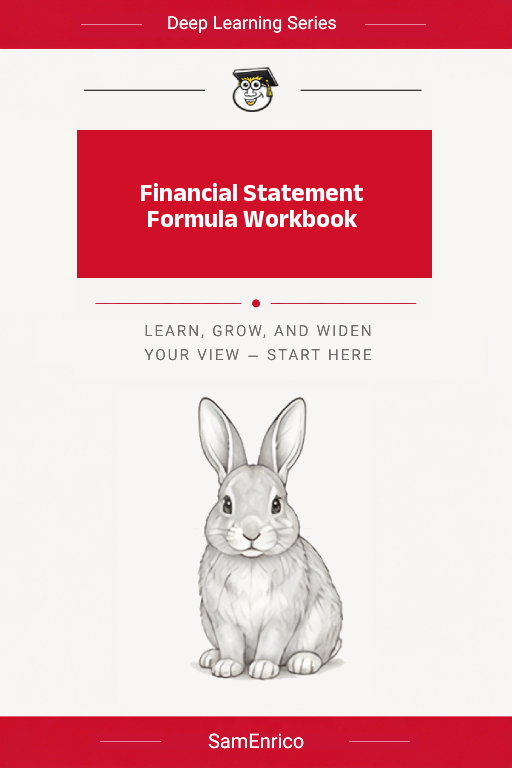
Non-FictionWorkbookApplied Learning
Financial Statement Formula Workbook eBook
Apply formulas to real income statements, balance
Apply formulas to real income statements, balance sheets, and cash flow statements. Includes practice exercises with answer keys for self-assessment.
Formats
Free sample
Chapter 1: The Unbreakable Mirror--–- Imagine tearing a company’s financial report in half. On one side of the tear, you hold a list of everything the company owns—its buildings, its cash, its inventory, the money customers owe it. On the other side, you hold a list of everything the company owes—its bank loans, its unpaid bills to suppliers, and the portion of the business that truly belongs to its owners. Now here is the secret that 90 percent of business students never truly internalize: those two torn halves are always, always equal. Not sometimes.
Not approximately. Always.This is not a coincidence. It is not a goal that companies aspire to achieve. It is the unbreakable mirror of accounting: Assets = Liabilities + Equity. Call it the accounting equation.
Call it the balance sheet identity. Call it the only reason you can trust any financial statement at all. This chapter will not simply teach you that formula. It will rewire how you look at every business transaction, every balance sheet, and every investment opportunity for the rest of your career.Why does this matter for a workbook titled Financial Statement Formula Workbook? Because every other formula in this book—every ratio, every liquidity metric, every profitability calculation—is built on top of this foundation.
If you do not master the accounting equation, you will memorize formulas but never understand why they work. If you do master it, you will see through financial statements the way a radiologist sees through skin and muscle.The One Equation That Rules All Business The accounting equation is deceptively simple. Write it down:Assets = Liabilities + Equity Now let us define each term with surgical precision.Assets are economic resources that a company controls because of past events, from which future benefits are expected to flow. In plain English: things the company owns or has a right to collect. Cash in the bank.
Inventory on shelves. Machinery on factory floors. Buildings. Patents. Money owed by customers (accounts receivable).Liabilities are obligations of the company arising from past events, the settlement of which is expected to result in an outflow of resources.
In plain English: debts and obligations the company must pay. Bank loans. Unpaid bills to suppliers (accounts payable). Wages owed to employees. Taxes owed to the government.Equity is the residual interest in the assets after subtracting liabilities.
In plain English: what would be left for the owners if the company sold all its assets and paid all its debts. It includes money invested by owners (common stock) and profits that have been kept in the business instead of distributed as dividends (retained earnings).Here is the radical implication: equity is not a separate pile of money. Equity is a mathematical leftover. If you know assets and liabilities, equity is simply assets minus liabilities. The equation could just as easily be written as Equity = Assets – Liabilities.
But accountants write it as Assets = Liabilities + Equity because that format keeps assets (what you control) on the left and claims against those assets (what you owe plus what belongs to owners) on the right.Every single transaction in the history of commerce respects this equation. Not because of a law, but because of logic. Let us prove it.The Dynamic System: How Transactions Change the Equation Most beginners treat the accounting equation as a static snapshot. They memorize it for an exam and move on. That is a catastrophic mistake.
The accounting equation is a dynamic system. Every transaction changes at least two accounts, and the equation must balance before and after.Consider this. You start a company. You deposit 10,000ofyourownmoneyintoabusinessbankaccount.Whatchanges?Assets(cash)increaseby10,000 of your own money into a business bank account. What changes?
Assets (cash) increase by 10,000ofyourownmoneyintoabusinessbankaccount.Whatchanges?Assets(cash)increaseby10,000. Equity (common stock) increases by $10,000 because you now own that portion of the business. The equation: before (0 = 0 + 0), after (10,000 = 0 + 10,000). Balanced.Now you borrow 5,000fromabank.Assets(cash)increaseby5,000 from a bank. Assets (cash) increase by 5,000fromabank.Assets(cash)increaseby5,000.
Liabilities (loans payable) increase by 5,000.Afterbothtransactions:Assets=5,000. After both transactions: Assets = 5,000.Afterbothtransactions:Assets=15,000. Liabilities = 5,000.Equity=5,000. Equity = 5,000.Equity=10,000. 15,000 = 5,000 + 10,000.
Balanced.Now you buy equipment for 8,000cash.Assetschangeintwoways:cashdecreasesby8,000 cash. Assets change in two ways: cash decreases by 8,000cash.Assetschangeintwoways:cashdecreasesby8,000, but equipment (another asset) increases by $8,000. Total assets unchanged. Liabilities and equity unchanged. Equation still balanced.Now you purchase 2,000ofinventoryoncredit(promisingtopaythesupplierlater).Assets(inventory)increaseby2,000 of inventory on credit (promising to pay the supplier later).
Assets (inventory) increase by 2,000ofinventoryoncredit(promisingtopaythesupplierlater).Assets(inventory)increaseby2,000. Liabilities (accounts payable) increase by $2,000. Balanced.Now you sell half that inventory for 1,500cash.Thistransactionhasmultipleeffectsbecauseyouarerecognizingrevenueandthecostofgoodssold.Assets:cashincreasesby1,500 cash. This transaction has multiple effects because you are recognizing revenue and the cost of goods sold. Assets: cash increases by 1,500cash.Thistransactionhasmultipleeffectsbecauseyouarerecognizingrevenueandthecostofgoodssold.Assets:cashincreasesby1,500; inventory decreases by 1,000(halfthe1,000 (half the 1,000(halfthe2,000).
Net change to assets: +500.Equity:retainedearningsincreasesbytheprofitof500. Equity: retained earnings increases by the profit of 500.Equity:retainedearningsincreasesbytheprofitof500 (1,500revenueminus1,500 revenue minus 1,500revenueminus1,000 cost). Balanced.This is the magic. Every single transaction, no matter how complex, maintains the equality. The expanded accounting equation—which includes revenues, expenses, and dividends—makes this explicit:Assets = Liabilities + (Beginning Equity + Revenues – Expenses – Dividends)Revenues increase equity.
Expenses decrease equity. Dividends decrease equity. The equation always balances.The Expanded Equation: Tracking Profit Through Equity Beginners often ask: "If equity is just a leftover, how do we track whether the company is making money?" The answer lies in the expanded equation.Consider a company with no transactions except selling a product. You sell a 100productthatcostyou100 product that cost you 100productthatcostyou60 to buy. The customer pays cash.
Your assets: cash increases by 100;inventorydecreasesby100; inventory decreases by 100;inventorydecreasesby60 (the product you sold). Net increase in assets: 40.Yourexpenses(costofgoodssold)increasedby40. Your expenses (cost of goods sold) increased by 40.Yourexpenses(costofgoodssold)increasedby60. Your revenues increased by 100.Neteffectonequity:+100. Net effect on equity: +100.Neteffectonequity:+40 (revenues minus expenses).
The equation holds.This is why the income statement exists. The income statement is simply a detailed explanation of how revenues and expenses changed equity during a period. And the balance sheet is the cumulative result of all those changes over the life of the company.Here is a insight that separates casual learners from professionals: a company can have rising assets and rising liabilities while equity stays flat. That happens when the company borrows money to buy assets. The company looks larger on paper but the owners are not necessarily wealthier.
Alternatively, a company can have flat assets but rising equity if it pays down debt. The equation forces you to trace where value actually accrues.The Balance Sheet: Your Equation in Formal Dress The balance sheet is the accounting equation arranged in a formal financial statement. The left side (or top, depending on formatting) lists assets. The right side (or bottom) lists liabilities followed by equity. The total of assets must equal the total of liabilities plus equity.
If it does not, the financial statements are wrong—not approximately wrong, but categorically wrong.Here is a simplified balance sheet to illustrate:ABC Company Balance Sheet (December 31, 2025)Assets Liabilities & Equity Cash$20,000Accounts Payable$8,000Accounts Receivable$15,000Loans Payable$12,000Inventory$10,000Total Liabilities$20,000Equipment$25,000Common Stock$30,000Retained Earnings$20,000Total Equity$50,000Total Assets$70,000Total Liabilities & Equity$70,000Check the equation: 70,000assets=70,000 assets = 70,000assets=20,000 liabilities + $50,000 equity. Perfect balance.Notice that assets are ordered by liquidity (how quickly they can…
This is the end of the free sample. Get the eBook to keep going. Buy now
About this book
Details
- Author
- Beckham Camelia
- Publisher
- SamEnrico
- Language
- English
- Genre
- Non-Fiction, Workbook, Applied Learning
- Released
- 2026-06-01
- Pages (approx.)
- 159
- Available as
- eBook, Audiobook

Read better in the ZLOADR app
Your eBooks on your phone or tablet. Sign in with your SamEnrico account and start reading.
More by Beckham Camelia
 TM For Caregivers Burnout GuideBeckham Camelia$11.99
 The Joy of RoutineBeckham Camelia$11.99
 Utility Shutoff SeasonsBeckham Camelia$11.99
 Self Esteem for Partners in RecoveryBeckham Camelia$11.99
 EQ for First RespondersBeckham Camelia$11.99
 The Klondike Code: How a Forgotten Gold Rush Math Formula Made MillionsBeckham Camelia$11.99
 Ads ManagerBeckham Camelia$11.99
 Understanding Myelofibrosis-osteosclerosisBeckham Camelia$17.99
 Micron SWOT GuideBeckham Camelia$12.99
 How to Become a Spooling-machine OperatorBeckham Camelia$11.99
You may also like
 Hong Kong Handover 1997Dunn Johnnie$11.99
 Zumba For Postnatal Recovery CourseNeal Christian$11.99
 Zumba for BeginnersLadner Nikia$11.99
 YouTube Comment Mining GuideHumes Pandora$12.99
 Worry Box MeditationCarlin Rudy$11.99
 Workplace Stress MeditationNguyen Lynn$11.99
 Workplace Stress and Sleep RepairHawley Ivory$11.99
 Workplace Perfectionism CureDelaney Jeffry$11.99
 Workplace Injustice Anger GuideWallen Isabelle$11.99
 Work Addiction and Burnout LinkGreenwood Ester$11.99
 Women in Yoga and WellnessBeattie Galina$11.99
 Women in Stand Up ComedyChun Evangeline$11.99