
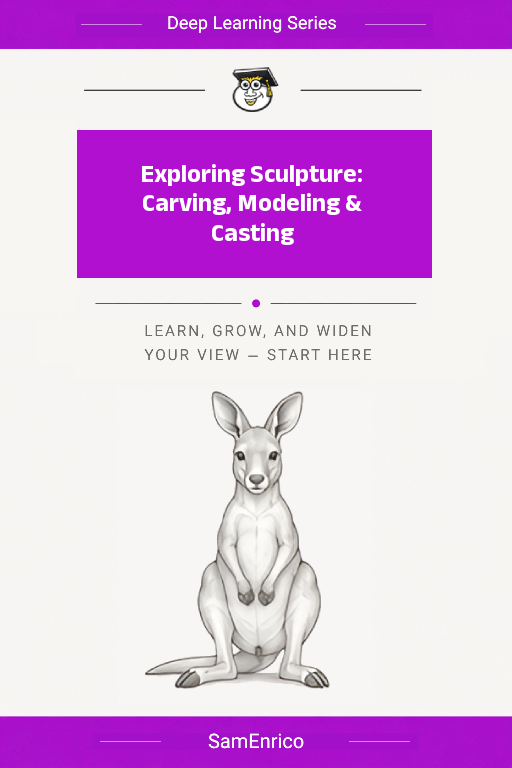
Non-FictionInformativeEducational
Exploring Sculpture: Carving, Modeling & Casting
This publication, published by SamEnrico, covers E
This publication, published by SamEnrico, covers Exploring Sculpture: Carving, Modeling & Casting
Formats
About this book
Free sample
Chapter 1: Seeing in Three Dimensions--–- Most people look at a sculpture and see only the surface: the smooth curve of a marble thigh, the rough texture of a bronze patina, the polished gleam of a wooden bowl. But to make sculpture—to truly understand it—you must learn to see what lies beneath the surface and beyond the obvious. You must train your eyes to perceive mass where others see only shape, to feel volume where others see only outline, and to inhabit the negative space that others ignore entirely. This chapter is not about technique. It is not about tools or materials or safety protocols, though those will come in due time.
This chapter is about retraining your perception—fundamentally and permanently—so that you begin to think, see, and feel like a sculptor.The difference between a two-dimensional artist and a sculptor is not merely one of materials. A painter works with illusion. A sculptor works with truth—or at least with the physical fact of objects occupying real space. When you draw a cube on paper, you are creating the illusion of three dimensions using perspective, shading, and line weight. When you carve a cube from a block of stone, you are revealing a form that already existed within the material.
You cannot fake a curve in marble. You cannot hide a clumsy transition in bronze. Sculpture demands honesty, and honesty begins with learning to see the world as it actually is: a continuous field of interlocking masses, volumes, and voids.The Four Pillars of Sculptural Form Before you can make a sculpture, you must understand what a sculpture is. This seems obvious, but ask ten people to define sculpture and you will receive ten different answers. For our purposes, we will build our understanding on four foundational concepts: mass, volume, negative space, and kinesthetics.
These are the pillars upon which every successful sculpture rests, whether carved from a mountain or assembled from discarded bicycle parts.Mass is the simplest of these concepts, yet the most misunderstood by beginners. Mass refers to the physical bulk of an…
This is the end of the free sample. Get the eBook to keep going. Buy now
Contents
- Chapter 1
- Chapter 2
- Chapter 3
- Chapter 4
- Chapter 5
- Chapter 6
- Chapter 7
- Chapter 8
- Chapter 9
- Chapter 10
- Chapter 11
- Chapter 12
Details
- Author
- Blackburn Bernardina
- Publisher
- SamEnrico
- Language
- English
- Genre
- Non-Fiction, Informative, Educational
- Released
- 2026-06-02
- Pages (approx.)
- 122
- Available as
- eBook, Audiobook

Read better in the ZLOADR app
Your eBooks on your phone or tablet. Sign in with your SamEnrico account and start reading.
More by Blackburn Bernardina
 The Startup Unit EconomicsBlackburn Bernardina$11.99
 Staging Crime Scene DetectionBlackburn Bernardina$11.99
 Nonprofit Talent MigrationBlackburn Bernardina$11.99
 Mind Palace Blueprint Construction GuideBlackburn Bernardina$11.99
 Social Media Imposter FixBlackburn Bernardina$11.99
 Repeat Listening EffectivenessBlackburn Bernardina$11.99
 Focus For Real Estate AgentsBlackburn Bernardina$11.99
 Digital Calendar BlockingBlackburn Bernardina$11.99
 The Calculus of the Cosmos: The Timbuktu Mathematicians and the Birth of Modern ScienceBlackburn Bernardina$11.99
 The Battle of the Coral Sea: Carrier Duel in the PacificBlackburn Bernardina$11.99
 How to Produce Drafting CompassesBlackburn Bernardina$11.99
 Cashew Nuts: Apple & Nut HarvestingBlackburn Bernardina$11.99
You may also like
 Hong Kong Handover 1997Dunn Johnnie$11.99
 Zumba For Postnatal Recovery CourseNeal Christian$11.99
 Zumba for BeginnersLadner Nikia$11.99
 YouTube Comment Mining GuideHumes Pandora$12.99
 Worry Box MeditationCarlin Rudy$11.99
 Workplace Stress MeditationNguyen Lynn$11.99
 Workplace Stress and Sleep RepairHawley Ivory$11.99
 Workplace Perfectionism CureDelaney Jeffry$11.99
 Workplace Injustice Anger GuideWallen Isabelle$11.99
 Work Addiction and Burnout LinkGreenwood Ester$11.99
 Women in Yoga and WellnessBeattie Galina$11.99
 Women in Stand Up ComedyChun Evangeline$11.99