
Non-FictionInformativeEducational
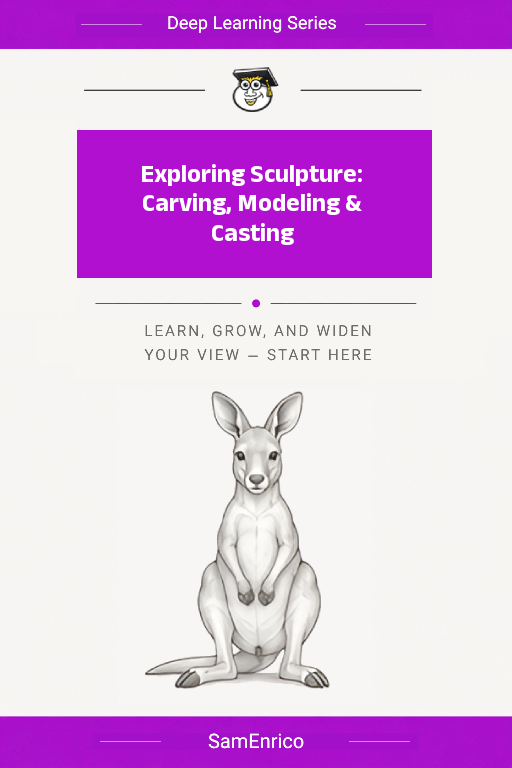
Exploring Sculpture: Carving, Modeling & Casting eBook
This publication, published by SamEnrico, covers E
This publication, published by SamEnrico, covers Exploring Sculpture: Carving, Modeling & Casting
Formats
Free sample
Chapter 1: Seeing in Three Dimensions--–- Most people look at a sculpture and see only the surface: the smooth curve of a marble thigh, the rough texture of a bronze patina, the polished gleam of a wooden bowl. But to make sculpture—to truly understand it—you must learn to see what lies beneath the surface and beyond the obvious. You must train your eyes to perceive mass where others see only shape, to feel volume where others see only outline, and to inhabit the negative space that others ignore entirely. This chapter is not about technique. It is not about tools or materials or safety protocols, though those will come in due time.
This chapter is about retraining your perception—fundamentally and permanently—so that you begin to think, see, and feel like a sculptor.The difference between a two-dimensional artist and a sculptor is not merely one of materials. A painter works with illusion. A sculptor works with truth—or at least with the physical fact of objects occupying real space. When you draw a cube on paper, you are creating the illusion of three dimensions using perspective, shading, and line weight. When you carve a cube from a block of stone, you are revealing a form that already existed within the material.
You cannot fake a curve in marble. You cannot hide a clumsy transition in bronze. Sculpture demands honesty, and honesty begins with learning to see the world as it actually is: a continuous field of interlocking masses, volumes, and voids.The Four Pillars of Sculptural Form Before you can make a sculpture, you must understand what a sculpture is. This seems obvious, but ask ten people to define sculpture and you will receive ten different answers. For our purposes, we will build our understanding on four foundational concepts: mass, volume, negative space, and kinesthetics.
These are the pillars upon which every successful sculpture rests, whether carved from a mountain or assembled from discarded bicycle parts.Mass is the simplest of these concepts, yet the most misunderstood by beginners. Mass refers to the physical bulk of an object—the sheer amount of material present, its density, its weight. A sculpture of a figure carved from dense mahogany has a different mass than the same figure cast in hollow fiberglass, even if the external dimensions are identical. Mass communicates heft, solidity, permanence. When you look at Michelangelo's David, you feel the mass of the marble before you register the anatomical detail.
The stone weighs seventeen tons. That weight is part of the meaning of the work. A David cast in plastic would be an entirely different object, no matter how faithful the replica.Volume is related to mass but distinct. Volume refers to the space an object occupies—its three-dimensional extension in the world. A balloon has volume but very little mass.
A lead brick has both. As a sculptor, you must learn to feel volume in your hands before you ever touch your material. Close your eyes and imagine holding a tennis ball. Now imagine holding a basketball. Now imagine holding a balloon of the same size as the basketball.
Your hands know the difference between these volumes, even though your eyes see similar spheres. This haptic imagination—the ability to feel form without touching it—is the sculptor's secret weapon. You will develop it through practice, but you must first acknowledge that it exists and that it can be trained.Negative space is the most counterintuitive of the four pillars. Beginners see only the object—the figure, the face, the abstract shape. Advanced sculptors see the spaces between and around the object as equally important.
Consider a wire armature for a clay sculpture. The wires themselves have positive mass and volume. But the empty gaps between the wires—the negative spaces—are just as essential to the final form because they will be filled with clay. Consider a carved stone ring. The hole in the center is not merely an absence; it is a carefully shaped volume of air bounded by stone.
Henry Moore, one of the greatest sculptors of the twentieth century, built his reputation on his mastery of negative space. His reclining figures are pierced by holes that are shaped, refined, and balanced as carefully as the limbs themselves. When you learn to see negative space as form rather than emptiness, you will have crossed the threshold from amateur to serious sculptor.Kinesthetics is the most sophisticated of the four concepts, and it separates those who make sculpture from those who merely admire it. Kinesthetics refers to how a viewer's eye—and, by extension, their body—moves around and through a sculpture. A successful sculpture guides the viewer's gaze along a path.
It creates rhythms, pauses, accelerations. It invites you to circle it, to approach and retreat, to see it from above and below. Think of a spiral staircase carved from a single tree trunk. Your eye naturally follows the spiral upward. Your body imagines climbing those stairs.
That invitation to movement is the sculpture's kinesthetic power. Even a static bust on a pedestal has kinesthetic properties: the angle of the head, the direction of the gaze, the sweep of the hair all suggest pathways for the eye to follow. As you design your sculptures, you must ask yourself: Where do I want the viewer to look first? Where second? Where last?
What detours will I offer along the way?From Two Dimensions to Three Every sculptor must learn to draw. This is not negotiable. The myth of the sculptor who never sketches, who simply attacks the stone or clay with pure intuition, is just that—a myth. Even the most spontaneous-looking sculptures are built upon hundreds of drawings, studies, and maquettes. Drawing is not an end in itself for the sculptor.
It is a planning tool, a problem-solving device, a way to fail on paper rather than in expensive marble.The key difference between drawing for painting and drawing for sculpture lies in what you choose to represent. A painter draws outlines—the edges of forms, the boundaries between figure and ground. A sculptor draws volumes. When you sketch a portrait bust, do not draw the nose as a line. Draw it as a wedge of clay emerging from the face.
When you sketch a figure, do not draw the contour of the arm. Draw the cylinder of the upper arm, the sphere of the elbow, the flattened box of the forearm. This is called block-in drawing, and it is the single most useful skill you will learn in this book.Block-in drawing is exactly what it sounds like: you break down complex forms into their simplest geometric components—cubes, spheres, cylinders, cones, and pyramids—and you draw those blocks rather than the surface details. A human head becomes an egg for the cranium, a wedge for the jaw, a cylinder for the neck, two small spheres for the eyes. A horse becomes a series of interlocking boxes and cylinders.
A tree becomes a cone for the foliage, a tapered cylinder for the trunk, and multiple smaller cylinders for the branches.Why does this matter for sculpture? Because you will build your armatures…
This is the end of the free sample. Get the eBook to keep going. Buy now
About this book
Details
- Author
- Blackburn Bernardina
- Publisher
- SamEnrico
- Language
- English
- Genre
- Non-Fiction, Informative, Educational
- Released
- 2026-06-02
- Pages (approx.)
- 122
- Available as
- eBook, Audiobook

Read better in the ZLOADR app
Your eBooks on your phone or tablet. Sign in with your SamEnrico account and start reading.
More by Blackburn Bernardina
 The Startup Unit EconomicsBlackburn Bernardina$11.99
 Staging Crime Scene DetectionBlackburn Bernardina$11.99
 Nonprofit Talent MigrationBlackburn Bernardina$11.99
 Mind Palace Blueprint Construction GuideBlackburn Bernardina$11.99
 Social Media Imposter FixBlackburn Bernardina$11.99
 Repeat Listening EffectivenessBlackburn Bernardina$11.99
 Focus For Real Estate AgentsBlackburn Bernardina$11.99
 Digital Calendar BlockingBlackburn Bernardina$11.99
 The Calculus of the Cosmos: The Timbuktu Mathematicians and the Birth of Modern ScienceBlackburn Bernardina$11.99
 The Battle of the Coral Sea: Carrier Duel in the PacificBlackburn Bernardina$11.99
 How to Produce Drafting CompassesBlackburn Bernardina$11.99
 Cashew Nuts: Apple & Nut HarvestingBlackburn Bernardina$11.99
You may also like
 Hong Kong Handover 1997Dunn Johnnie$11.99
 Zumba For Postnatal Recovery CourseNeal Christian$11.99
 Zumba for BeginnersLadner Nikia$11.99
 YouTube Comment Mining GuideHumes Pandora$12.99
 Worry Box MeditationCarlin Rudy$11.99
 Workplace Stress MeditationNguyen Lynn$11.99
 Workplace Stress and Sleep RepairHawley Ivory$11.99
 Workplace Perfectionism CureDelaney Jeffry$11.99
 Workplace Injustice Anger GuideWallen Isabelle$11.99
 Work Addiction and Burnout LinkGreenwood Ester$11.99
 Women in Yoga and WellnessBeattie Galina$11.99
 Women in Stand Up ComedyChun Evangeline$11.99