
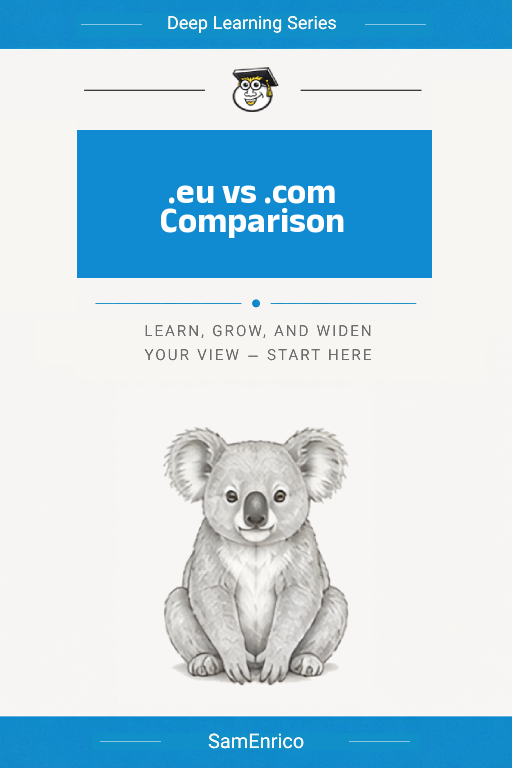
.eu vs .com Comparison Audiobook
Weighs .eu against .com for European businesses in
Weighs .eu against .com for European businesses including regional trust, GDPR compliance, and market positioning.
Formats
Free sample
Chapter 1: The Address Bar Lie...--–- Every time a European customer types a web address, they make a judgment in less than three seconds. They do not read your privacy policy. They do not check your SSL certificate’s expiration date. They do not Google your company’s legal registration. They look at the domain name, and their brain decides: trust or leave.
That decision happens before a single pixel of your website loads. Most business owners believe the lie that a domain is just a technical necessity—a string of characters pointing to a server. That lie has cost European companies millions in lost sales, unnecessary compliance headaches, and legal battles they never saw coming.The truth is brutally simple: your domain extension is a psychological weapon, a legal contract, and a trust signal all wrapped into one. And for European businesses in the post-Brexit, post-GDPR era, the choice between .eu and .com has never been more consequential. This chapter dismantles the address bar lie and rebuilds it as a strategic asset.
By the time you finish, you will never look at a domain name the same way again.The Three-Second Judgment Neuroscience research on digital trust shows that website visitors form a first impression in 50 milliseconds—that is 0.05 seconds. But the domain extension judgment happens even faster. It is automatic, subconscious, and rooted in decades of internet conditioning. The .com extension has been the default since 1985. It is the digital equivalent of a firm handshake in a business suit.
But here is the problem: that handshake belongs to American jurisdiction.For a customer in Munich, Lyon, or Milan, a .com address triggers an ancient neurological shortcut. Their brain asks: Is this familiar? Yes. Is this safe? Probably.
Does this belong to my world? No. That final question is the crack in the armor. Familiarity is not the same as trust. Trust requires belonging.
And .com does not belong to Europe.The .eu extension, by contrast, triggers a different cascade. It is less familiar but more aligned. The European customer’s brain asks: Is this familiar? Somewhat. Is this safe?
The registry is bound by my laws. Does this belong to my world? Yes—this business has gone through the trouble of verifying an EU presence. The trade-off is between raw familiarity (which favors .com) and jurisdictional alignment (which favors .eu). There is no universal winner.
The winner depends entirely on where your customer sits and what they value.Consider two identical e-commerce stores selling organic baby…
This is the end of the free sample. Get the Audiobook to keep going. Buy now
About this book
Details
- Author
- Seward Laronda
- Publisher
- SamEnrico
- Language
- English
- Genre
- Non-Fiction, First 30 Days, EU Comparison
- Released
- 2026-06-01
- Pages (approx.)
- 123
- Available as
- eBook, Audiobook

Listen in the VoxFlicks app
Audiobooks and audio dramas wherever you go. Sign in with your SamEnrico account and press play.
More by Seward Laronda
 The Expectation Reset GuideSeward Laronda$11.99
 Smoking and ED GuideSeward Laronda$11.99
 MDD Subtypes ExplainedSeward Laronda$11.99
 The Working Memory for Chess GuideSeward Laronda$11.99
 Emergency Placement NightsSeward Laronda$11.99
 The Lost Tapes of the Apollo 11 Mission: Unearthed Secrets from the MoonSeward Laronda$11.99
 The Breeder's Guide to Randall Lineback CattleSeward Laronda$11.99
 CTO Interview Questions GuideSeward Laronda$12.99
 Opseu CourierSeward Laronda$11.99
 How to Become a Log PeelerSeward Laronda$11.99