
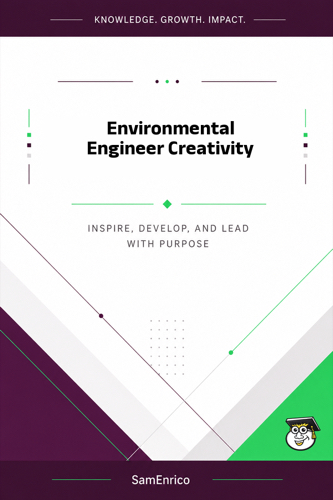
Environmental Engineer Creativity
Design sustainable solutions using this practical
Design sustainable solutions using this practical workbook for green thinkers.
Formats
About this book
Free sample
Chapter 1: Beyond the Spreadsheet--–- Every environmental engineer I have ever met carries a quiet wound. They entered this field because they wanted to fix things—to clean the water, to clear the air, to design a future that didn't feel like a slow-motion catastrophe. They mastered the math. They learned the regulations. They can calculate pipe diameters in their sleep and model pollutant dispersion with elegant precision.
And yet, somewhere along the way, something stopped working. Not the equations. The equations are fine. What stopped working was the assumption that technical solutions alone could solve problems that are not, at their core, technical.This chapter is about that wound and what to do with it. It is about the gap between what we were trained to do and what the world actually needs.
It is about why logic—brilliant, rigorous, essential logic—is not enough. And it is about what happens when environmental engineers learn to see themselves not as problem-fixers but as system-shifters, not as regulators of pollution but as facilitators of regeneration.The Problem That Has No Formula Climate change, biodiversity collapse, plastic pollution, water scarcity—these are not puzzles. A puzzle has a correct answer. You can solve a Rubik's cube. You can finish a crossword.
The answer is either right or wrong, and once you find it, the puzzle is done. Environmental problems are different. They are what design theorists call wicked problems—a term coined in the 1970s by Horst Rittel and Melvin Webber, who understood that some challenges defy the logic of traditional engineering.A wicked problem has ten uncomfortable characteristics, but three matter most for environmental engineers. First, wicked problems have no definitive formulation. The way you describe the problem—the very language you use—already contains assumptions about what kind of solution will work.
If you describe stormwater as "a drainage problem," you will build drains. If you describe it as "a missed opportunity for groundwater recharge," you will build infiltration basins. Both are true. Neither is complete. Second, wicked problems have no stopping rule.
You never "solve" poverty or climate change. You only make progress. Third, every wicked problem is a symptom of another…
This is the end of the free sample. Get the eBook to keep going. Buy now
Contents
- Chapter 1
- Chapter 2
- Chapter 3
- Chapter 4
- Chapter 5
- Chapter 6
- Chapter 7
- Chapter 8
- Chapter 9
- Chapter 10
- Chapter 11
- Chapter 12
Details
- Author
- Fluker Arletha
- Publisher
- SamEnrico
- Language
- English
- Genre
- Non-Fiction, Self-Help, Environmental Innovation
- Released
- 2026-06-06
- Pages (approx.)
- 142
- Available as
- eBook, Audiobook

Read better in the ZLOADR app
Your eBooks on your phone or tablet. Sign in with your SamEnrico account and start reading.
More by Fluker Arletha
 Mindful Technology Use GuideFluker Arletha$11.99
 Pet Loss During DivorceFluker Arletha$11.99
 Complicated Grief After Friendship LossFluker Arletha$11.99
 The Cesar Chavez Farmworker LeaderFluker Arletha$11.99
 Shadows of the Yamato: The Hidden War of the WajinFluker Arletha$11.99
 Strategic Sourcing EfficiencyFluker Arletha$12.99
 AI Accounting Comparison GuideFluker Arletha$12.99
 CoachFluker Arletha$11.99
 Understanding Stoll–kieny–dott SyndromeFluker Arletha$17.99
 Ultimate Handbook Guide to Agra : (India) Travel GuideFluker Arletha$11.99