
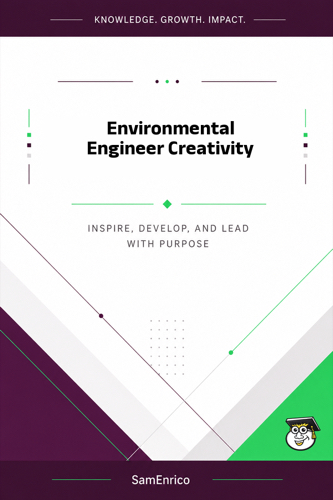
Environmental Engineer Creativity eBook
Design sustainable solutions using this practical
Design sustainable solutions using this practical workbook for green thinkers.
Formats
Free sample
Chapter 1: Beyond the Spreadsheet--–- Every environmental engineer I have ever met carries a quiet wound. They entered this field because they wanted to fix things—to clean the water, to clear the air, to design a future that didn't feel like a slow-motion catastrophe. They mastered the math. They learned the regulations. They can calculate pipe diameters in their sleep and model pollutant dispersion with elegant precision.
And yet, somewhere along the way, something stopped working. Not the equations. The equations are fine. What stopped working was the assumption that technical solutions alone could solve problems that are not, at their core, technical.This chapter is about that wound and what to do with it. It is about the gap between what we were trained to do and what the world actually needs.
It is about why logic—brilliant, rigorous, essential logic—is not enough. And it is about what happens when environmental engineers learn to see themselves not as problem-fixers but as system-shifters, not as regulators of pollution but as facilitators of regeneration.The Problem That Has No Formula Climate change, biodiversity collapse, plastic pollution, water scarcity—these are not puzzles. A puzzle has a correct answer. You can solve a Rubik's cube. You can finish a crossword.
The answer is either right or wrong, and once you find it, the puzzle is done. Environmental problems are different. They are what design theorists call wicked problems—a term coined in the 1970s by Horst Rittel and Melvin Webber, who understood that some challenges defy the logic of traditional engineering.A wicked problem has ten uncomfortable characteristics, but three matter most for environmental engineers. First, wicked problems have no definitive formulation. The way you describe the problem—the very language you use—already contains assumptions about what kind of solution will work.
If you describe stormwater as "a drainage problem," you will build drains. If you describe it as "a missed opportunity for groundwater recharge," you will build infiltration basins. Both are true. Neither is complete. Second, wicked problems have no stopping rule.
You never "solve" poverty or climate change. You only make progress. Third, every wicked problem is a symptom of another problem. Flooding is a symptom of land-use decisions. Land-use decisions are a symptom of economic incentives.
Economic incentives are a symptom of political priorities. You can trace the causal chain forever, and at every level, the problem looks different.This is why the traditional engineering toolkit feels inadequate. Traditional engineering was designed for tame problems: build a bridge that doesn't collapse, design a treatment plant that meets effluent limits, calculate the structural load of a dam. These are important skills. But they do not prepare you for a world where the problem shifts every time you try to solve it.The Myth of the Neutral Technician There is a seductive fantasy that runs through engineering education: the engineer as neutral technician.
You are given a problem—clean this water, reduce that emission, design this system—and you apply your expertise to find the most efficient solution. The problem is given. The constraints are clear. Your job is optimization.This fantasy is dangerous because it is almost never true.Every environmental problem comes embedded in a web of competing values, political pressures, economic interests, and cultural histories. The moment you define a problem, you have already taken a side.
If you define the problem as "too much nitrogen in the river," you have decided that the solution is to reduce nitrogen. But perhaps the real problem is "agricultural subsidies that incentivize over-fertilization," or "a food system that separates crop production from livestock farming," or "a regulatory framework that treats nitrogen as waste rather than a resource." Each framing leads to a different solution, and each solution benefits different stakeholders.The neutral technician is a myth because there is no neutral place to stand. The choice of problem definition is always a choice about values. And values cannot be derived from equations.I learned this lesson in a visceral way early in my career. I was working on a water quality project in a rural community that had high levels of nitrate contamination in their wells.
The agricultural extension agents defined the problem as "farmers need better nutrient management training." The public health officials defined it as "residents need immediate access to bottled water." The farmers defined it as "regulations are forcing us to choose between our livelihood and our neighbors' health." Each definition was technically accurate. Each led to a completely different set of interventions. And none of them, on its own, would have solved anything.What finally worked—slowly, imperfectly, collaboratively—was not a technical solution at all. It was a process of reframing. We stopped asking "How do we reduce nitrates?" and started asking "How might we turn agricultural waste into a resource that farmers want to manage?" That single shift opened possibilities that had been invisible before: cover cropping systems that improved soil health while reducing runoff, anaerobic digesters that turned manure into energy, rotational grazing patterns that mimicked natural herd movements.
The technical solutions emerged only after the problem had been reframed. (We will dive deep into the art of reframing in Chapter 2, where you will learn the "How Might We" method and practice it on real-world cases.)Regenerative Design: Beyond "Less Bad"The dominant paradigm of environmental engineering has been, for decades, a paradigm of harm reduction. We ask: how can we make this process less polluting? How can we make this building less energy-intensive? How can we make this product less wasteful?
This is a noble goal. Less bad is better than more bad. But less bad is not the same as good.Regenerative design offers a different question. Instead of asking "How do we minimize harm?" it asks "How might human systems actively restore ecological health?" Instead of designing for sustainability—which literally means "the ability to sustain" the current system—it designs for renewal, for flourishing, for net-positive impact.This is not a semantic distinction. It is a fundamental shift in mindset.Consider a conventional stormwater system.
Rain falls on a parking lot, picks up oil and heavy metals, flows into a drain, travels through pipes, and eventually discharges into a river. A less-bad approach might add a treatment wetland at the end—expensive, but it filters some pollutants. A regenerative approach asks a different question: how might this parking lot function like a forest floor? A forest doesn't have stormwater drains because the soil absorbs rain, filters it biologically, and slowly releases clean water to streams and aquifers. A regenerative parking lot uses permeable pavement, bioswales, and rain gardens to capture and treat water exactly where it falls.
It doesn't just reduce harm. It creates habitat, recharges groundwater, and cools the surrounding air through evapotranspiration. It performs multiple functions simultaneously.The difference between less-bad and regenerative is the difference between a filter on a smokestack and a factory that produces no smoke in the first place. One manages symptoms. The other redesigns the system.The Iceberg Model: Seeing Beneath the Surface One of the most useful tools for understanding why environmental problems persist is the Iceberg Model.
Imagine an iceberg floating in the ocean. Above the waterline, visible to everyone, are events: a fish kill, a flood…
This is the end of the free sample. Get the eBook to keep going. Buy now
About this book
Details
- Author
- Fluker Arletha
- Publisher
- SamEnrico
- Language
- English
- Genre
- Non-Fiction, Self-Help, Environmental Innovation
- Released
- 2026-06-06
- Pages (approx.)
- 142
- Available as
- eBook, Audiobook

Read better in the ZLOADR app
Your eBooks on your phone or tablet. Sign in with your SamEnrico account and start reading.
More by Fluker Arletha
 Mindful Technology Use GuideFluker Arletha$11.99
 Pet Loss During DivorceFluker Arletha$11.99
 Complicated Grief After Friendship LossFluker Arletha$11.99
 The Cesar Chavez Farmworker LeaderFluker Arletha$11.99
 Shadows of the Yamato: The Hidden War of the WajinFluker Arletha$11.99
 Strategic Sourcing EfficiencyFluker Arletha$12.99
 AI Accounting Comparison GuideFluker Arletha$12.99
 CoachFluker Arletha$11.99
 Understanding Stoll–kieny–dott SyndromeFluker Arletha$17.99
 Ultimate Handbook Guide to Agra : (India) Travel GuideFluker Arletha$11.99