
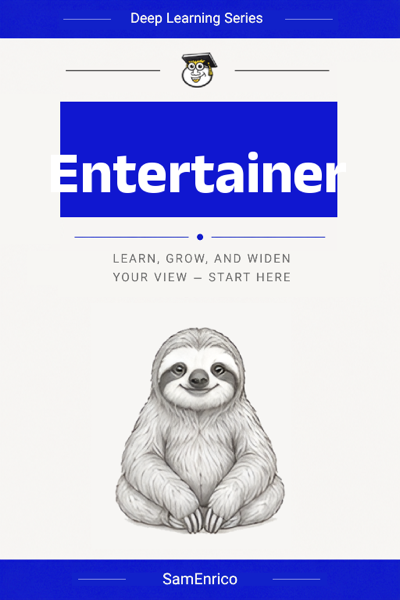
Entertainer eBook
A Coursebook on Entertainer
A Coursebook on Entertainer
Formats
Free sample
Chapter 1: The Three Selves--Every entertainer wakes up to the same quiet terror, usually somewhere between three and five in the morning. It arrives without knocking, settles at the foot of the bed, and whispers a question that has no easy answer: Who am I when no one is watching?For most professions, this question is merely philosophical. A plumber does not wonder whether he exists when there are no pipes to fix. An accountant does not question her identity during the two weeks a year she is not preparing taxes. But the entertainer occupies a strange and unsteady ground.
You are trained to become someone else on command. You are paid to produce feeling that may not be yours. You are celebrated for a face that is often a mask. And over time, the boundary between the mask and the face begins to blur.This chapter is not about technique. It is not about auditions or agents or the history of vaudeville.
Those will come. This chapter is about something more fundamental and more easily ignored: the architecture of the performing self. Before you can market yourself, before you can survive rejection, before you can build a turn that leaves audiences wanting more, you must understand the three versions of yourself that will live in constant negotiation for the rest of your career.They are the Artist, the Performer, and the Entertainer. And the difference between a thirty-year career and a three-year burnout often comes down to knowing which one is driving the bus.The Myth of the Born Performer Let us begin by destroying a useful lie. The lie is this: some people are born to be on stage, and the rest are not.
It is a lie because it is comforting—it allows those who have succeeded to believe they were destined, and those who have failed to believe they were not. But it is also a lie because it obscures the actual machinery of performance.No one is born an entertainer. A infant does not emerge from the womb with comedic timing. A toddler does not naturally understand the difference between projecting to the back of a house and whispering into a microphone. What looks like natural talent is almost always a combination of early exposure, unusual sensitivity to social cues, and a particular kind of psychological wiring that can be cultivated or crushed depending on circumstance.The myth persists because it serves the industry.
Casting directors love the idea of the natural because it absolves them of having to articulate what they are looking for. Audiences love the idea of the natural because it preserves the magic—the sense that what they are watching could not possibly be manufactured. And many performers love the idea of the natural because it allows them to avoid the uncomfortable truth that their craft requires constant, deliberate, often tedious work.So let us set the myth aside. You are not a born performer. Neither was Laurence Olivier, neither was Meryl Streep, neither was Richard Pryor.
They became what they became through a combination of hunger, observation, repetition, and a slowly developed understanding of the relationship between their interior world and the exterior signal they sent to an audience.The question is not whether you were born with it. The question is whether you are willing to build it.The Artist: The Solitary Creator The first self is the Artist. This is the version of you that creates for its own sake. The Artist writes the song in the bedroom at two in the morning, not because anyone will hear it but because the song demands to be written. The Artist paints the scene, composes the joke, choreographs the movement, scribbles the monologue on a napkin.
The Artist’s primary relationship is not with the audience but with the material.Here is what you need to understand about the Artist: this self does not require applause. In fact, applause can sometimes corrupt the Artist, because the Artist’s satisfaction comes from the act of creation itself—the moment when something that did not exist before suddenly exists, and it is good. The Artist is the part of you that would still make art on a deserted island, even knowing no one would ever see it.Most successful entertainers have a strong Artist somewhere inside them. But many working entertainers have learned to suppress the Artist, because the Artist is inefficient. The Artist wants to perfect.
The market wants to ship. The Artist wants to explore every branch of every possibility. The casting director wants a decision in thirty seconds. The Artist is your soul. The Artist is also, in the short term, your worst enemy if you cannot learn to manage her.I want to tell you about a comedian I know named Marcus.
Marcus is brilliant. He writes jokes that bend language in ways that make other comedians put down their notebooks in despair. He can take a premise that seems exhausted and find a corner of it no one had thought to examine. But Marcus has a problem: he cannot stop editing. He will rewrite a single punchline forty-seven times.
He will abandon a perfectly good five-minute set because he has identified a logical inconsistency in the third beat of the second joke that no audience member in human history would ever notice. Marcus’s Artist is so powerful that it has become a cage. He creates constantly. He performs rarely. He has been doing open mics for eleven years and has never been booked for a paid gig because he will not stop tinkering long enough to put a finished product in front of an audience.The Artist needs protection.
But the Artist also needs a leash.The Performer: The Faithful Interpreter The second self is the Performer. This is the version of you that takes existing material and brings it to life. The Performer is the actor who picks up a script written by someone else and finds a way to make the words feel as though they are being discovered in real time. The Performer is the musician who plays a composition exactly as written but inflects it with a timing and a touch that no notation could capture.Unlike the Artist, the Performer is not primarily concerned with creation. The Performer is concerned with transmission.
The Performer stands between the material and the audience and asks: how do I deliver this thing in a way that honors its intention while also making it mine?The Performer is the workhorse of the entertainment industry. Most working actors are Performers more than they are Artists. They show up, they learn the lines, they hit the marks, they find the emotional truth of the scene, and they go home. They do not need to reinvent the play every night. They need to be reliable, repeatable, and present.The danger of the Performer is not perfectionism, as it is with the Artist.
The danger of the Performer is hollowness. Because the Performer is trained to step into someone else’s shoes, it is possible for the Performer to lose track of which shoes are her own. I have watched brilliant…
This is the end of the free sample. Get the eBook to keep going. Buy now
About this book
Details
- Author
- Breedlove Jarrod
- Publisher
- SamEnrico
- Language
- English
- Genre
- Non-Fiction, Informative, Educational
- Released
- 2026-06-02
- Pages (approx.)
- 149
- Available as
- eBook, Audiobook

Read better in the ZLOADR app
Your eBooks on your phone or tablet. Sign in with your SamEnrico account and start reading.
More by Breedlove Jarrod
 CBT For OCD Therapist GuideBreedlove Jarrod$11.99
 Tabata Protocol Workout HandbookBreedlove Jarrod$11.99
 Body Language For Hotel And Hospitality WorkbookBreedlove Jarrod$11.99
 SCAMPER Business GuideBreedlove Jarrod$11.99
 Survey Data Anomaly Alerts with AIBreedlove Jarrod$11.99
 Echoes of the Last Broadcast: The Mysterious Signals from the TitanicBreedlove Jarrod$11.99
 The Lost Tomb of Queen Tiye: Egypt's Forgotten MatriarchBreedlove Jarrod$11.99
 Rejected Without Publications ReapplyBreedlove Jarrod$12.99
 Romanian Master Degree GuideBreedlove Jarrod$12.99
 Understanding CandidiasisBreedlove Jarrod$17.99
 How to Start a Construction of Non-recreational Inflatable Rafts Business (Beginners Guide)Breedlove Jarrod$11.99