
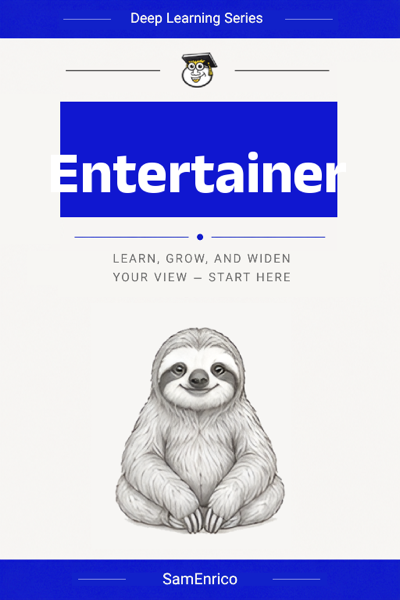
Entertainer Audiobook
A Coursebook on Entertainer
A Coursebook on Entertainer
Formats
Free sample
Chapter 1: The Three Selves--Every entertainer wakes up to the same quiet terror, usually somewhere between three and five in the morning. It arrives without knocking, settles at the foot of the bed, and whispers a question that has no easy answer: Who am I when no one is watching?For most professions, this question is merely philosophical. A plumber does not wonder whether he exists when there are no pipes to fix. An accountant does not question her identity during the two weeks a year she is not preparing taxes. But the entertainer occupies a strange and unsteady ground.
You are trained to become someone else on command. You are paid to produce feeling that may not be yours. You are celebrated for a face that is often a mask. And over time, the boundary between the mask and the face begins to blur.This chapter is not about technique. It is not about auditions or agents or the history of vaudeville.
Those will come. This chapter is about something more fundamental and more easily ignored: the architecture of the performing self. Before you can market yourself, before you can survive rejection, before you can build a turn that leaves audiences wanting more, you must understand the three versions of yourself that will live in constant negotiation for the rest of your career.They are the Artist, the Performer, and the Entertainer. And the difference between a thirty-year career and a three-year burnout often comes down to knowing which one is driving the bus.The Myth of the Born Performer Let us begin by destroying a useful lie. The lie is this: some people are born to be on stage, and the rest are not.
It is a lie because it is comforting—it allows those who have succeeded to believe they were destined, and those who have failed to believe they were not. But it is also a lie because it obscures the actual machinery of performance.No one is born an entertainer. A infant does not emerge from the womb with comedic timing. A toddler does not naturally understand the difference between projecting to the back of a house and whispering into a microphone. What looks like natural talent is almost always a combination of early exposure, unusual sensitivity to social cues, and a particular kind of psychological wiring that can be cultivated or crushed depending on circumstance.The myth persists…
This is the end of the free sample. Get the Audiobook to keep going. Buy now
About this book
Details
- Author
- Breedlove Jarrod
- Publisher
- SamEnrico
- Language
- English
- Genre
- Non-Fiction, Informative, Educational
- Released
- 2026-06-02
- Pages (approx.)
- 149
- Available as
- eBook, Audiobook

Listen in the VoxFlicks app
Audiobooks and audio dramas wherever you go. Sign in with your SamEnrico account and press play.
More by Breedlove Jarrod
 CBT For OCD Therapist GuideBreedlove Jarrod$11.99
 Tabata Protocol Workout HandbookBreedlove Jarrod$11.99
 Body Language For Hotel And Hospitality WorkbookBreedlove Jarrod$11.99
 SCAMPER Business GuideBreedlove Jarrod$11.99
 Survey Data Anomaly Alerts with AIBreedlove Jarrod$11.99
 Echoes of the Last Broadcast: The Mysterious Signals from the TitanicBreedlove Jarrod$11.99
 The Lost Tomb of Queen Tiye: Egypt's Forgotten MatriarchBreedlove Jarrod$11.99
 Rejected Without Publications ReapplyBreedlove Jarrod$12.99
 Romanian Master Degree GuideBreedlove Jarrod$12.99
 Understanding CandidiasisBreedlove Jarrod$17.99
 How to Start a Construction of Non-recreational Inflatable Rafts Business (Beginners Guide)Breedlove Jarrod$11.99