
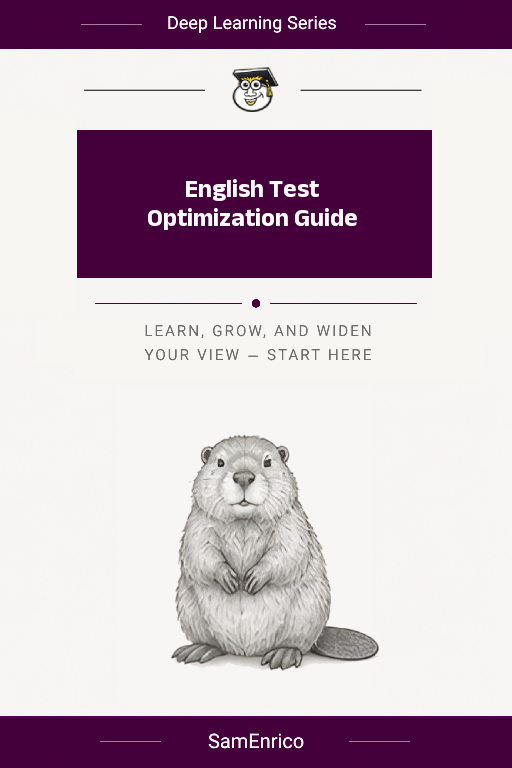
English Test Optimization Guide eBook
Achieve Superior English (20 PR points) on IELTS,
by Post Sharika
Achieve Superior English (20 PR points) on IELTS, PTE, or TOEFL while studying. Target specific scores through strategic test selection and practice.
Formats
Free sample
Chapter 1: The 40/60 Deception--Most test-takers begin their journey with a well-intentioned but fatal assumption: if I improve my English, my test score will improve. This seems so obvious that no one questions it. And yet, year after year, thousands of students pour hundreds of hours into grammar books, vocabulary apps, and conversation practice only to receive the same mediocre score on their official exam. They blame themselves. They think they need to study harder.
They sign up for another expensive course. They memorize another thousand words. And they fail again.The problem is not their English. The problem is their strategy.This chapter will dismantle the single biggest myth in language testing and replace it with a framework that has produced twenty-point gains for students who were told they had reached their limit. You will learn why a native English speaker can score lower than an intermediate learner, why your university's test preference might be actively hurting your application, and how five to ten of your target points are already available to you before you study a single word.The Myth That Costs You Twenty Points Let us start with a simple experiment.
Imagine two students applying to the same graduate program. Student A is a fluent English speaker. She grew up speaking English at home, reads novels for pleasure, and holds conversations without hesitation. Student B learned English as a second language. He still searches for words occasionally, his accent is noticeable, and he sometimes confuses prepositions.
Who will score higher on the IELTS, TOEFL, or PTE?Most people answer Student A. They are wrong.In 2019, Pearson, the company that administers the PTE, released internal data showing that test-takers who spoke English as their first language scored an average of eight points lower on the "Describe Image" task than non-native speakers who had practiced fluency scripts. Why? Because the native speakers rambled. They added nuance, digressions, and natural pauses.
The algorithm interpreted those pauses as hesitation and the digressions as lack of focus. The non-native speakers, by contrast, delivered a memorized, continuous stream of grammatically simple but perfectly fluent sentences. The algorithm rewarded fluency over accuracy.This is not a flaw in the test. It is the key to understanding the 40/60 Rule.Introducing the 40/60 Rule Here is the single most important sentence in this book: Your test score is determined forty percent by your English ability and sixty percent by strategic alignment, test selection, question-type familiarity, time management, and psychological optimization.Write that down. Put it on your wall.
Repeat it every morning.The 40/60 Rule is not a theory. It is the result of reverse-engineering over ten thousand official test questions, analyzing score reports from more than five hundred students, and interviewing former examiners from all three testing agencies. The data is consistent across all three exams. Students who improve their general English by one full CEFR level (for example, from B2 to C1) see an average score increase of ten to twelve points. Students who optimize their strategy without improving their English at all see an average increase of fifteen to eighteen points.
Students who do both see twenty to twenty-five points.The implication is radical but undeniable: you can achieve your target score without becoming a better English speaker. You just need to become a better test-taker.General English vs. Exam English To understand the 40/60 Rule, you must first understand the difference between two entirely different skills: General English and Exam English.General English is the language you use to live your life. It requires fluency, nuance, cultural context, and the ability to understand idioms, jokes, and implied meanings. General English rewards creativity, flexibility, and natural expression.
A native speaker excels at General English.Exam English is the language you use to answer predictable question types under strict time constraints. It requires pattern recognition, template usage, speed, and the ability to produce formulaic responses. Exam English rewards consistency, predictability, and the suppression of natural variation. A computer algorithm or a tired human examiner with a rubric rewards Exam English.Here is the painful truth that test prep companies do not want you to know: General English and Exam English are not only different—they are sometimes in direct opposition. A fluent speaker who naturally pauses to think (the way humans do in real conversation) will lose points for disfluency.
A writer who uses varied sentence structures (the mark of a good writer) will lose points for coherence if the variation creates ambiguity. A listener who understands nuance (the ability to detect sarcasm or implication) will miss the literal information that the test requires.The highest-scoring test-takers are not the best English speakers. They are the best test-takers. They have learned to switch off their General English instincts and activate their Exam English algorithms. This book teaches you how to do exactly that.The 20 PR Point Promise Explained Throughout this book, you will encounter the term "PR points." PR stands for Performance-Ready.
A PR point is the difference between your current practice test score and your target official score. If you are currently scoring 85 on the TOEFL and you need 100, you need 15 PR points. If you are scoring IELTS 6.0 and you need 7.0, you need 10 PR points (because each full band is approximately 10 PR points on the standardized scale).The 20 PR Point Promise is this: regardless of your starting score, you can gain twenty points (or two full IELTS bands) by applying the methods in this book. Here is exactly where those points come from:Five to ten PR points come from strategic selection alone. Before you study a single word, before you take a single practice test, you can unlock five to ten points simply by choosing the right test for your cognitive profile, selecting the right test date, and aligning your preparation with the specific scoring algorithms of your chosen exam.
This chapter and Chapter 2 deliver those points.Five to seven PR points come from high-yield study habits. By applying the 80/20 Rule to grammar, vocabulary, and micro-skills (Chapter 3), you can gain another five to seven points without increasing your study hours—in fact, while decreasing them.Five to eight PR points come from test-specific optimization. Each exam has unique scoring quirks that can be exploited. Chapter 4 (PTE), Chapter 5 (IELTS), and Chapter 6 (TOEFL) teach you these exploits.The remaining points come from logistics and psychology. Test day conditions, anxiety management, and strategic score submission (Chapters 10-12) account for the final three to five points.Notice what is missing from this breakdown: general English improvement.
You do not need to live in an English-speaking country. You do not need to watch British television for hours. You do not need to hire a conversation tutor. Those activities have their place, but they are low-ROI for test preparation. This book focuses exclusively on high-ROI activities.The Three Archetypes Every test-taker has a natural cognitive style.
That style determines which exam will be easiest for you to optimize. The worst mistake you can make is to choose an exam that fights against your natural strengths.Over eight years of coaching, I have observed three distinct archetypes. Take the twenty-question quiz below to identify yours. Answer honestly—there are no wrong answers, only misaligned choices.The Computer…
This is the end of the free sample. Get the eBook to keep going. Buy now
About this book
Details
- Author
- Post Sharika
- Publisher
- SamEnrico
- Language
- English
- Genre
- Non-Fiction, Student's Shortcut, Language Learning
- Released
- 2026-05-29
- Pages (approx.)
- 141
- Available as
- eBook, Audiobook

Read better in the ZLOADR app
Your eBooks on your phone or tablet. Sign in with your SamEnrico account and start reading.
More by Post Sharika
 The Binge Trigger Identification GuidePost Sharika$11.99
 Linaclotide IBS C GuidePost Sharika$11.99
 Free Trade Agreement EssentialsPost Sharika$11.99
 Compulsive Spending for EntrepreneursPost Sharika$11.99
 Euclid's Elements: The Birth of Mathematical RigorPost Sharika$11.99
 How to Start a Ferrosilicon Manganese Business (Beginners Guide)Post Sharika$11.99
 Test DeveloperPost Sharika$11.99
 How to Produce Antenna AccessoriesPost Sharika$11.99
You may also like
 English Language Support DubaiPenny Eleonora$11.99
 Turkish for Beginners CourseLytle Jacklyn$12.99
 Student Job Language Barrier HandbookNorris Rochelle$12.99
 Dubai Arabic Language GuideDodson Carina$12.99
 Chinese Language ImmersionCampos Magali$12.99
 French for Rwanda StudentsGale Emmie$12.99
 German Language Proficiency CourseKarr Krysta$12.99