
Non-FictionInformativeEducational
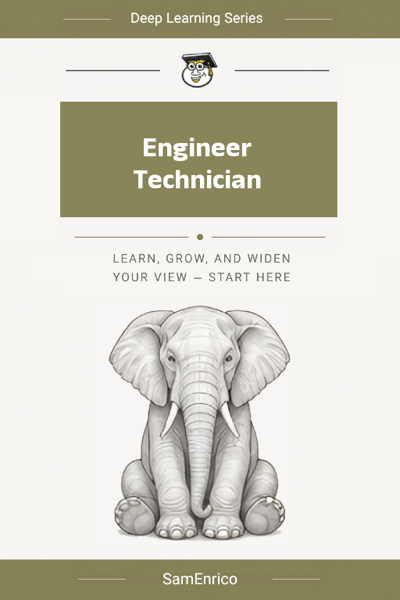
Engineer Technician eBook
A Coursebook on Engineer Technician
by Jung Reid
A Coursebook on Engineer Technician
Formats
Free sample
Chapter 1: The Last Line of Defense--– The morning shift had just started at the Apex Manufacturing plant when the conveyor line stopped. Red lights flashed on the control panel. The production manager, frantic, shouted into his radio: “Where’s the technician?” Within minutes, a woman in a worn canvas tool belt arrived, knelt beside the control cabinet, pulled out a multimeter, and began systematically testing circuits. Nine minutes later, she identified a failed proximity sensor, replaced it from her stock, and the line resumed. The plant saved $47,000 in downtime that hour.
That woman was an engineering technician – the last line of defense between a functioning factory and a costly shutdown. This book is about becoming her.The Invisible Profession That Runs the World Engineering technicians are the most overlooked yet essential professionals in modern industry. Engineers design. Scientists discover. Managers plan.
But technicians execute, maintain, troubleshoot, and repair. Without technicians, the most brilliant engineering design remains a drawing on a screen. The most sophisticated chemical process remains a simulation. The most powerful electrical grid goes dark.Consider what surrounds you right now. The device you are reading this on – whether a laptop, tablet, or phone – was designed by electrical engineers, but it was built, tested, and repaired by technicians.
The chair you sit on: mechanical engineers designed its ergonomics, but technicians calibrated the injection molding machines that formed its frame. The lights illuminating this page: power engineers designed the grid, but technicians maintain the transformers and substations. Every manufactured object, every processed chemical, every delivered kilowatt of electricity passes through the hands of engineering technicians somewhere along its journey from concept to customer.Yet ask the average person what an engineering technician does, and you will likely receive a blank stare. This invisibility is both the profession’s challenge and its secret advantage. It is a challenge because young people rarely aspire to become something they have never heard of.
It is an advantage because those who enter the field face less competition than they would in oversaturated professions like law or general management, while earning solid middle-class wages with high job security.The Bureau of Labor Statistics projects that employment of engineering technicians will grow steadily over the next decade, with particularly strong demand in renewable energy, automation, and medical device manufacturing. The median annual wage for engineering technicians across all specializations is approximately 65,000,withexperiencedtechniciansinoilandgasoraerospaceearningwellover65,000, with experienced technicians in oil and gas or aerospace earning well over 65,000,withexperiencedtechniciansinoilandgasoraerospaceearningwellover85,000. More importantly, the job cannot be outsourced. You cannot ship a broken motor to another country for troubleshooting. You cannot Zoom-call a repair.
The work is inherently local, hands-on, and resistant to automation.Engineering vs. Technology vs. Technicianship: The Critical Distinction One of the first sources of confusion for newcomers is the relationship between engineers, engineering technologists, and engineering technicians. These three roles form a hierarchy of abstraction versus application, and understanding where you fit is essential for career planning.Engineers work primarily in the realm of theory, design, and analysis. They ask “why” and “what is possible.” An engineer might derive the equations describing how a bridge will deflect under load, design the chemical reaction pathway for a new pharmaceutical, or develop the control algorithm for a robotic arm.
Engineers typically hold a four-year bachelor’s degree (B.S. in Engineering) and often pursue professional licensure (PE – Professional Engineer). Their work is primarily office-based, using simulation software, mathematical models, and computer-aided design tools. They rarely touch the physical equipment they design.Engineering Technologists occupy the middle ground. They ask “how” to turn an engineer’s design into a manufacturable product or executable process.
A technologist might take an engineer’s circuit schematic and determine how to lay it out on a printed circuit board for efficient assembly, or take a chemical reactor design and specify the piping, valve, and instrumentation details needed for construction. Technologists typically hold a four-year Bachelor of Science in Engineering Technology (B.S.E.T.) degree, which emphasizes application over derivation. They spend more time in labs and less time in pure mathematics than engineers.Engineering Technicians are the hands-on implementers and troubleshooters. They ask “what is wrong right now and how do I fix it?” Technicians install, calibrate, operate, maintain, and repair the equipment that engineers and technologists design. A technician will wire a motor starter, replace a failed hydraulic seal, program a PLC, or diagnose a temperature sensor drift.
Technicians typically hold a two-year associate degree or a certificate from a technical college, though many learn through apprenticeships or military training. Their workplace is the factory floor, the power substation, the laboratory, or the field service truck.To use an analogy: If engineering is architecture, technicians are carpentry. An architect designs a beautiful building on paper, but carpenters cut the wood, drive the nails, and fix the squeaky floor when the building settles. Neither can succeed without the other.Crucially, these roles are not strictly hierarchical in the sense that technicians “report to” engineers in all organizations. In many industrial settings, technicians work alongside engineers as peers with different expertise.
A senior technician often knows more about the actual behavior of a machine than the engineer who designed it, because the technician has seen it fail in twenty different ways over ten years. Wise engineers listen carefully to their technicians.The Many Faces of the Engineering Technician: Specializations Engineering technicians are not a monolithic group. The field fractures into several major specializations, each with its own tools, knowledge base, and work environments. Most technicians develop expertise in one or two of these areas over their careers.Mechanical Engineering Technicians These technicians work with moving parts, machines, and mechanical systems. They assist mechanical engineers in designing, testing, and manufacturing tools, engines, and machines.
Daily tasks include setting up and operating machine tools (lathes, mills, grinders), conducting vibration analysis on rotating equipment, measuring parts with precision instruments (micrometers, calipers), and performing failure analysis on broken components. Mechanical technicians are found in automotive plants, aerospace manufacturing, machine shops, and maintenance departments of any factory.Essential skills: Blueprint reading, GD&T interpretation, manual machining, welding basics, bearing and seal replacement, alignment techniques (laser and dial indicator), and preventive maintenance scheduling.Electrical and Electronics Engineering Technicians This is one of the largest and fastest-growing specializations. Electrical technicians work with power systems (motors, generators, transformers, switchgear), while electronics technicians work with lower-voltage circuits (sensors, controllers, communications equipment). In practice, the boundaries blur constantly. An industrial technician might troubleshoot a 480V motor starter one hour and a 24V sensor the next.Daily tasks include wiring control panels, programming variable frequency drives (VFDs), troubleshooting PLC inputs and outputs, replacing failed circuit boards, soldering and desoldering components, and using oscilloscopes to diagnose signal integrity problems.
Electrical technicians are employed everywhere electricity is used: power plants, substations, factories, hospitals, data centers, and renewable energy installations (solar farms, wind turbines).Essential skills: Ohm’s Law and Kirchhoff’s Laws, AC/DC theory, three-phase power, motor control circuits, VFD configuration, PLC ladder logic, safety lockout/tagout, and the ability to read electrical schematics.Industrial Engineering Technicians These technicians focus on manufacturing processes and efficiency. They work alongside industrial engineers to optimize production lines, reduce waste, improve quality, and ensure worker safety. Daily…
This is the end of the free sample. Get the eBook to keep going. Buy now
About this book
Details
- Author
- Jung Reid
- Publisher
- SamEnrico
- Language
- English
- Genre
- Non-Fiction, Informative, Educational
- Released
- 2026-05-06
- Pages (approx.)
- 160
- Available as
- eBook, Audiobook

Read better in the ZLOADR app
Your eBooks on your phone or tablet. Sign in with your SamEnrico account and start reading.
More by Jung Reid
 Mindfulness Student GuideJung Reid$11.99
 Nicotine Blood Test Reduction GuideJung Reid$11.99
 Mindfulness for Smoking CessationJung Reid$11.99
 Financial Stress and Natural DisasterJung Reid$11.99
 The Siege of Xanadu: Kublai Khan’s Unbreakable FortressJung Reid$11.99
 How to Produce Auto Detailing ServicesJung Reid$11.99
 Panel Data Analysis WorkbookJung Reid$12.99
 How to Start a Ferro Nickel Business (Beginners Guide)Jung Reid$11.99
You may also like
 Hong Kong Handover 1997Dunn Johnnie$11.99
 Zumba For Postnatal Recovery CourseNeal Christian$11.99
 Zumba for BeginnersLadner Nikia$11.99
 YouTube Comment Mining GuideHumes Pandora$12.99
 Worry Box MeditationCarlin Rudy$11.99
 Workplace Stress MeditationNguyen Lynn$11.99
 Workplace Stress and Sleep RepairHawley Ivory$11.99
 Workplace Perfectionism CureDelaney Jeffry$11.99
 Workplace Injustice Anger GuideWallen Isabelle$11.99
 Work Addiction and Burnout LinkGreenwood Ester$11.99
 Women in Yoga and WellnessBeattie Galina$11.99
 Women in Stand Up ComedyChun Evangeline$11.99