
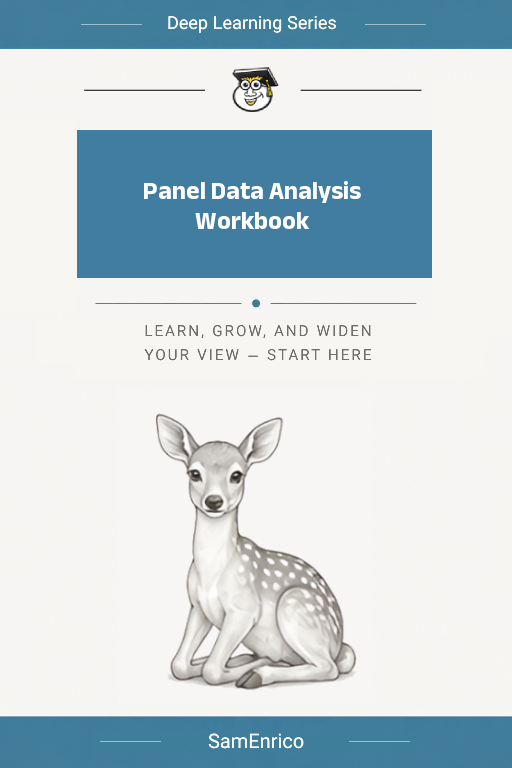
Non-FictionStudent's ShortcutPanel Econometrics
Panel Data Analysis Workbook
Manage fixed effects and random effects models usi
by Jung Reid
Manage fixed effects and random effects models using Excel pivot tables. Analyze longitudinal economics exam datasets with entity and time controls.
Formats
About this book
Free sample
Chapter 1: The Spreadsheet Lie--–- On a Tuesday afternoon in 2019, an economist named Elena presented her analysis to a school board. She had spent three weeks cleaning data, running regressions, and building beautiful charts. Her conclusion was clear: a new after-school tutoring program had failed. The evidence showed that students who attended more tutoring sessions actually scored lower on their economics exams. The board thanked her, canceled the program, and saved $200,000.Six months later, a statistician from the state department reviewed her work.
The problem was not the data. The problem was not the program. The problem was that Elena had committed the single most common mistake in all of data analysis: she had pooled every student, every year, and every exam score into one big pile and run a simple regression. She had treated 500 different students observed over 8 years as if they were 4,000 independent, unrelated observations.They were not.Student A, who scored 85 on every exam regardless of how much she studied, is not the same as Student B, who scores 65 on every exam despite studying twice as many hours. Student A has something unmeasured—innate ability, better elementary school preparation, a quiet home library—that Student B lacks.
By ignoring these entity-specific differences, Elena’s regression mistook a permanent gap between students for a negative effect of tutoring. In truth, within each individual student, more tutoring hours were associated with higher scores. But the between-student differences overwhelmed the within-student signal.Elena had never learned the fundamental lesson of panel data analysis: you must separate who a student is from what changes within that student over time.This chapter teaches you how to avoid Elena’s mistake. You will learn why ordinary regression (Pooled Ordinary Least Squares) lies when applied to panel data, how to distinguish between variation across entities and variation within entities, and how to set up Excel properly before any modeling begins. By the end of this chapter, you will have the conceptual foundation and the practical Excel skills to move from naive pooling to panel-aware thinking.
More importantly, you will internalize the first principle of what this book calls the Pivot Table Mindset: always visualize your…
This is the end of the free sample. Get the eBook to keep going. Buy now
Contents
- Chapter 1
- Chapter 2
- Chapter 3
- Chapter 4
- Chapter 5
- Chapter 6
- Chapter 7
- Chapter 8
- Chapter 9
- Chapter 10
- Chapter 11
- Chapter 12
Details
- Author
- Jung Reid
- Publisher
- SamEnrico
- Language
- English
- Genre
- Non-Fiction, Student's Shortcut, Panel Econometrics
- Released
- 2026-06-01
- Pages (approx.)
- 160
- Available as
- eBook, Audiobook

Read better in the ZLOADR app
Your eBooks on your phone or tablet. Sign in with your SamEnrico account and start reading.
More by Jung Reid
 Mindfulness Student GuideJung Reid$11.99
 Nicotine Blood Test Reduction GuideJung Reid$11.99
 Mindfulness for Smoking CessationJung Reid$11.99
 Financial Stress and Natural DisasterJung Reid$11.99
 The Siege of Xanadu: Kublai Khan’s Unbreakable FortressJung Reid$11.99
 How to Produce Auto Detailing ServicesJung Reid$11.99
 How to Start a Ferro Nickel Business (Beginners Guide)Jung Reid$11.99
 Engineer TechnicianJung Reid$11.99
You may also like
 Hong Kong Handover 1997Dunn Johnnie$11.99
 Zumba For Postnatal Recovery CourseNeal Christian$11.99
 Zumba for BeginnersLadner Nikia$11.99
 YouTube Comment Mining GuideHumes Pandora$12.99
 Worry Box MeditationCarlin Rudy$11.99
 Workplace Stress MeditationNguyen Lynn$11.99
 Workplace Stress and Sleep RepairHawley Ivory$11.99
 Workplace Perfectionism CureDelaney Jeffry$11.99
 Workplace Injustice Anger GuideWallen Isabelle$11.99
 Work Addiction and Burnout LinkGreenwood Ester$11.99
 Women in Yoga and WellnessBeattie Galina$11.99
 Women in Stand Up ComedyChun Evangeline$11.99