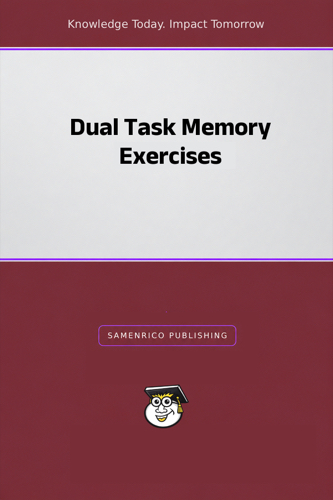
Dual Task Memory Exercises
Improves multitasking ability through structured p
by Begley Lissa
Improves multitasking ability through structured practice routines.
Formats
About this book
Free sample
Chapter 1: The Multitasking Delusion--–- Close your laptop. Put down your phone. Stop stirring your coffee. Now try to remember what you were just thinking about thirty seconds ago. If you are like most people, that mental trail has already gone cold, replaced by the ping of a notification, the hum of a refrigerator, or the simple act of reading these words.
This is not a failure of character. It is a failure of a persistent and damaging myth—the belief that your brain can process two high-demand tasks at the same time with the same efficiency as it processes one.Welcome to the first chapter of Dual Task Memory Exercises, a twelve-week program designed not to teach you how to multitask, but to train your brain and body to perform together under conditions of shared attention. Before we reach a single drill or tracking log, we must dismantle the single greatest obstacle to your cognitive growth: the multitasking delusion.The Bottleneck That Cannot Be Widened For decades, popular productivity culture has celebrated the ability to juggle emails during conference calls, draft reports while listening to podcasts, and scroll social media while watching television. This cultural script suggests that multitasking is a skill to be cultivated—a mark of intelligence, efficiency, and modern adaptability. The neuroscience of attention tells a very different story.Your brain does not process two attention-demanding tasks simultaneously.
Instead, it engages in what cognitive psychologists call rapid task-switching. When you believe you are walking while talking on the phone, your prefrontal cortex is actually alternating attention between gait control and conversational comprehension at speeds measured in milliseconds. This switching carries a cost: each transition requires the brain to disengage from one task, suppress its associated rules and memories, activate the neural networks for the second task, and reorient attention. That sequence takes time and metabolic energy.The bottleneck theory, first rigorously demonstrated by Harold Pashler in the 1990s and repeatedly confirmed through functional neuroimaging, states that the central nervous system contains a single serial processing channel for response selection. When two tasks both demand a response—say, stepping…
This is the end of the free sample. Get the eBook to keep going. Buy now
Contents
- Chapter 1
- Chapter 2
- Chapter 3
- Chapter 4
- Chapter 5
- Chapter 6
- Chapter 7
- Chapter 8
- Chapter 9
- Chapter 10
- Chapter 11
- Chapter 12
Details
- Author
- Begley Lissa
- Publisher
- SamEnrico
- Language
- English
- Genre
- Non-Fiction, Self-Help, Motor Learning
- Released
- 2026-06-06
- Pages (approx.)
- 146
- Available as
- eBook, Audiobook

Read better in the ZLOADR app
Your eBooks on your phone or tablet. Sign in with your SamEnrico account and start reading.
More by Begley Lissa
 Civilian London Blitz ChildBegley Lissa$11.99
 Musk Neuralink AmbitionsBegley Lissa$11.99
 Meal Prep QR Code SystemBegley Lissa$11.99
 Sheppard Defense FundraisingBegley Lissa$11.99
 Personal Brand Color PaletteBegley Lissa$11.99
 SSDLC Maturity ReportBegley Lissa$11.99
 Giving Negative Feedback GuideBegley Lissa$11.99
 The Golden Recipes of Timbuktu: Culinary Alchemy and the Science of SpiceBegley Lissa$11.99
 The Piano That Brought Them Together: A Love Story in Classical HarmonyBegley Lissa$11.99
 How to Trade Frozen Concentrated Orange JuiceBegley Lissa$11.99
 How to Produce Rubber StockBegley Lissa$11.99
 How to Become a Pump-servicer SupervisorBegley Lissa$11.99