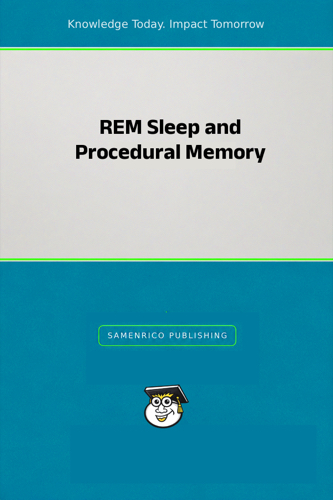
REM Sleep and Procedural Memory
Shows how dreaming helps motor skill learning and
Shows how dreaming helps motor skill learning and creative problem solving.
Formats
About this book
Free sample
Chapter 1: The Silent Rehearsal--–- The first time I truly understood that sleep was not a pause but a performance, I was watching a three-year-old girl named Maya learn to catch a ball. Her father stood ten feet away, tossing a soft blue beanbag underhand. Maya’s arms jerked like a marionette’s. She missed. Again.
Again. Her timing was off, her hands closed too early, her eyes tracked the beanbag a half-second behind its true path. After thirty attempts, she caught exactly two—a 7 percent success rate. Exhausted, she lay down on the living room rug and fell asleep within two minutes.Ninety minutes later, she woke up, rubbed her eyes, and reached for the beanbag before her father could even ask. The first toss came.
She caught it. The second. She caught it. Over the next twenty throws, she caught fifteen. Her success rate had jumped from 7 percent to 75 percent without a single additional minute of practice.
She had not consciously rehearsed. She had not analyzed her mistakes. She had simply slept.What happened inside Maya’s brain during those ninety minutes is the subject of this book, and it is one of the most extraordinary and underappreciated processes in all of human biology. Her brain—specifically during a phase of sleep called REM (Rapid Eye Movement)—had replayed the motor sequence of catching that beanbag at roughly seven times normal speed, strengthening the correct neural pathways and weakening the incorrect ones. It had extracted the pattern from the chaos of her failed attempts, automated the timing of her hand closure, and recalibrated her visual-motor prediction.
In ninety minutes of sleep, she accomplished what an additional ninety minutes of practice could not have achieved—because practice without sleep is like writing on water.This chapter will dismantle the most dangerous myth about learning: that skill acquisition happens only when you are awake and trying. The truth is that your brain is a dual-processor machine. The conscious processor works during the day, making errors, gathering data, and attempting sequences. The unconscious processor works at night, specifically during REM sleep, consolidating, optimizing…
This is the end of the free sample. Get the eBook to keep going. Buy now
Contents
- Chapter 1
- Chapter 2
- Chapter 3
- Chapter 4
- Chapter 5
- Chapter 6
- Chapter 7
- Chapter 8
- Chapter 9
- Chapter 10
- Chapter 11
- Chapter 12
Details
- Author
- Applegate Dalia
- Publisher
- SamEnrico
- Language
- English
- Genre
- Non-Fiction, Self-Help, Motor Learning
- Released
- 2026-06-05
- Pages (approx.)
- 149
- Available as
- eBook, Audiobook

Read better in the ZLOADR app
Your eBooks on your phone or tablet. Sign in with your SamEnrico account and start reading.
More by Applegate Dalia
 Expository Essay AI PromptsApplegate Dalia$11.99
 Baking Mindfulness PracticeApplegate Dalia$11.99
 Road Rage And Off Road PersonalityApplegate Dalia$11.99
 Divorce and Career RecoveryApplegate Dalia$11.99
 Understanding Pili Torti OnychodysplasiaApplegate Dalia$17.99
 VA Hiring Mistakes to AvoidApplegate Dalia$12.99
 JEE Revision Spaced Repetition GuideApplegate Dalia$12.99
 How to Start a Cheese Business (Beginners Guide)Applegate Dalia$11.99