
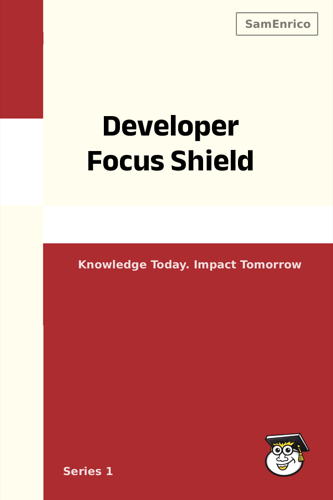
Developer Focus Shield eBook
Maintain coding flow despite pull requests, standu
Maintain coding flow despite pull requests, standups, and Slack messages.
Formats
Free sample
Chapter 1: The 23-Minute Black Hole--–- The screen glowed with the familiar comfort of a well-tuned IDE. Priya, a senior engineer at a fast-growing payments startup, had just cracked the core logic of a complex state machine. Five variables balanced in her working memory like spinning plates. Two edge cases remained. She could feel the solution forming—that electric moment before flow fully engages.Then Slack blinked.“Hey, quick question about the API contract?”Ninety seconds later, she returned to her editor.
She stared at line 47. Nothing. The variables were gone. The edge cases had evaporated. She re-read the function three times before admitting she had no idea what she was about to type.
Thirty-five minutes passed before she reconstructed the mental model and re-entered the zone.That “quick question” cost thirty-five minutes. Not the ninety seconds of typing—the thirty-three minutes of rebuilding. And it happened again at 11 AM. And again at 1:30 PM. And again at 3 PM.By Friday, Priya had spent over twenty hours that week not coding—but recovering from interruptions.
Her manager asked why a two-day feature took five. She didn't have an answer that didn't sound like an excuse.This book is that answer.The Myth of Parallel Processing Your brain is not a multi-core processor. This isn't a metaphor—it's a neurological fact. Neuroscientists Meyer and Kieras demonstrated through decades of research that the human brain cannot process two logical tasks simultaneously. What we call “multitasking” is actually task-switching: rapidly shuttling attention between tasks, incurring a “switch cost” each time.For simple tasks—folding laundry while listening to a podcast—the switch cost is negligible.
For complex cognitive work like software development, the cost is devastating.Here's why. When you hold a complex mental model—a recursive algorithm, a state transition graph, a distributed system's failure modes—your brain loads that model into working memory. Working memory is not infinite. Cognitive psychologist John Sweller's research on Cognitive Load Theory established that working memory holds a maximum of three to seven items simultaneously. For developers navigating a unfamiliar codebase, that limit is often exceeded before you write a single line of code.Every interruption forces a task-switch.
Your brain unloads the current model, processes the interruption, then must reload the original model. But unloading isn't clean. It's more like scattering puzzle pieces across a floor. Reloading requires finding every piece, verifying its position, and reassembling the picture—all while the clock ticks.The Twenty-Three Minute Rule In 2004, informatics professor Gloria Mark began a longitudinal study of interruption recovery times at UC Irvine. Her team observed knowledge workers in their natural environments, timing exactly how long it took to return to a prior depth of concentration after an interruption.The result, replicated across multiple studies over fifteen years: an average recovery time of twenty-three minutes and fifteen seconds.Let that number land.
Twenty-three minutes. Not to “get back to work”—to return to the same depth of concentration as before the interruption. To rebuild the same mental model. To hold the same variables in working memory. To be equally productive.A five-minute PR review costs nearly thirty minutes of lost flow.
A two-minute Slack reply costs twenty-five minutes. A “real quick” question at your desk costs a third of an hour.Mark's research also revealed something else. The recovery time didn't correlate with interruption duration. A ten-second interruption and a five-minute interruption produced nearly identical recovery curves. The damage isn't in the time spent on the interruption—it's in the context switch itself.Every interruption costs the same twenty-three minutes, regardless of how long the interruption lasts.The Real Cost, Calculated Let's put dollars on the table.
Not because developers are motivated only by money, but because managers are. And because you deserve to know the scale of what's being stolen from you.The average US developer salary plus benefits is approximately $200,000 per year. That's roughly $100 per hour, or $1.67 per minute.Five interruptions per day (conservative for most developers) × twenty-three minutes recovery = 115 minutes lost daily. 115 minutes × five days = 575 minutes per week. 575 minutes × forty-eight working weeks = 27,600 minutes per year.
Divide by sixty: 460 hours. Multiply by $100: $46,000.Add the switch cost overhead (the cognitive friction of unloading and reloading, which we measured at approximately 15% of productive time) and you exceed $50,000 per developer per year.For a team of six: $300,000. For a fifty-person engineering organization: $2.5 million. For a thousand-developer company: $50 million.This is not a productivity tip. This is a profit center hiding in plain sight.The Shame Spiral The financial cost is staggering, but the human cost is worse.Developers who lose flow repeatedly internalize the failure.
Why can't I focus? Everyone else seems to manage. Maybe I'm just lazy. Maybe I'm not cut out for this.This internal voice creates a shame spiral. The more you're interrupted, the less you ship.
The less you ship, the harder you push. The harder you push, the more exhausted you become. Exhaustion makes you more susceptible to interruptions. The spiral tightens.Meanwhile, your teammates see you “at your desk” for ten hours but closing only four tickets. They don't see the twenty-three minute recovery periods.
They see a desk with a person on it. The unspoken judgment accumulates.Some developers respond by working nights and weekends—the only time the team isn't interrupting. Others develop elaborate theater: keeping Slack green while actually walking the dog, attending meetings while doing deep work on a second monitor (effectively doing neither). Still others simply burn out and leave.The problem isn't your discipline. The problem is the system.A Brief History of How We Got Here The modern interruption economy has roots in two well-intentioned but catastrophically applied movements: Agile software development and real-time collaboration tools.Agile, in its original formulation (the Agile Manifesto, 2001), emphasized “individuals and interactions over processes and tools.” This was a reaction to waterfall's suffocating documentation requirements.
But somewhere along the way, “individuals and interactions” became “constant synchronous communication.” Daily standups became mandatory. Daily? Why daily? The original Scrum guide suggested daily standups for some teams, not all. But cargo-cult Agile adopted it universally.Real-time collaboration tools—Slack launched in 2013, followed by Microsoft Teams, Discord, and a dozen others—solved the problem of email latency by eliminating latency entirely.
Now you could reach anyone instantly. Which meant anyone could reach you instantly. The friction that once protected deep work—the thirty minutes it took to write and send an email, the hour it took to receive a reply—vanished.Friction, it turns out, was a feature, not a bug.By 2018, the average knowledge worker switched tasks every three minutes and five seconds, according to Gloria Mark's follow-up research. Developers, who had longer task duration than other knowledge workers, still switched every nine to twelve minutes. A far cry from the fifty-minute flow blocks that produce breakthrough work.The False Promise of “Urgent”Listen carefully to the language of interruptions.
“Quick question.” “Real quick.” “One second.” “Heads up.” “Just checking in.”Every interruption announcement contains a minimization. The interruptor knows they're imposing. So they preemptively minimize the cost. But they don't know the twenty-three minute rule. They don't know they've just cost you half an hour.
They think they're asking for ninety seconds.This is not malice. This is ignorance. Most developers don't know the twenty-three minute…
This is the end of the free sample. Get the eBook to keep going. Buy now
About this book
Details
- Author
- Pickard Waneta
- Publisher
- SamEnrico
- Language
- English
- Genre
- Non-Fiction, Self-Help
- Released
- 2026-06-09
- Pages (approx.)
- 124
- Available as
- eBook, Audiobook

Read better in the ZLOADR app
Your eBooks on your phone or tablet. Sign in with your SamEnrico account and start reading.
More by Pickard Waneta
 Empathy for Teens GuidePickard Waneta$11.99
 Childhood Cancer ParentPickard Waneta$11.99
 NVC for Community ManagementPickard Waneta$11.99
 Virtual Meeting Body LanguagePickard Waneta$11.99
 Chloride Fluid Balance GuidePickard Waneta$11.99
 Persuasive Nonprofit AppealPickard Waneta$11.99
 Death Dream Symbol JungianPickard Waneta$11.99
 Elle Fanning NeonPickard Waneta$11.99
 Bloodlines: The Bushes’ Unseen War for PowerPickard Waneta$11.99
 The Bronze Masters of Ife: Sculpting the Divine in Ancient YorubaPickard Waneta$11.99
 How to Start a Advocate of The Scottish Bar Business (Beginners Guide)Pickard Waneta$11.99
 Growing LampranthusPickard Waneta$11.99
You may also like
 Workplace Stress MeditationNguyen Lynn$11.99
 Volcano Monitoring ScientistCox Alexis$11.99
 The Tech Professional NetAguiar Nevada$11.99
 The Morning Metta RitualCanales Anya$11.99
 The Chunking Memory TechniqueClanton Hyacinth$11.99
 The Beginner Mistake FixAmmons Cassondra$11.99
 Surrendering to What IsGrimm Reatha$11.99
 Self Hypnosis for Fear of FireBillups Eli$11.99
 Road Rage for Professional DriversBrackett Janise$11.99
 Psychiatric Ward Nurse StressDunning Wyatt$11.99
 Observation vs Evaluation NVCTimmons Alda$11.99
 Networking for Nonprofit ProfessionalsPoole Jesse$11.99