
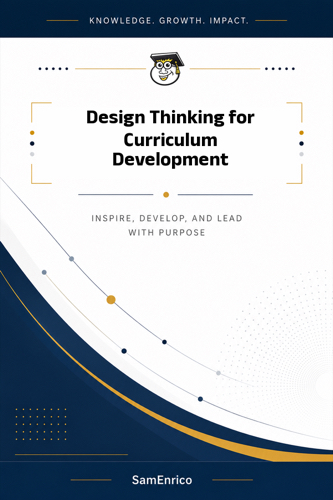
Design Thinking for Curriculum Development
Design courses that meet student needs and learnin
by Barrow Wan
Design courses that meet student needs and learning objectives.
Formats
About this book
Free sample
Chapter 1: The Empathy Lie--–- Every teacher I know has been told to “have empathy” for their students. Administrators preach it. Professional development seminars plaster it on Power Point slides. Mission statements etch it into lobby walls. But here’s the truth no one says out loud: most empathy in education is performative garbage.We nod along when someone says “know your learners,” then we go back to our desks and open the standards document.
We fill out “student interest surveys” in September—nine questions about favorite movies and hobbies—then shove them in a drawer until June. We call that empathy. It is not. It is a ritual. And it is failing your students.This chapter is not about being nicer to kids.
This chapter is about a specific, uncomfortable, high-risk form of empathy that most educators avoid because it is hard and it might break your heart. I am talking about design empathy—the kind that does not just ask “what do my students need to know?” but rather “what is it like to be a student in my room right now, and why might that experience feel unsafe, boring, or humiliating?”I learned this lesson the hard way. Six years ago, I designed what I believed was a brilliant three-week unit on argumentative writing. I had standards-aligned objectives. I had a rubric.
I had a curated selection of “engaging” texts about school dress codes and cell phone bans. I was proud. On day one, I launched into my hook: “By the end of this unit, you will be able to write a persuasive essay that changes someone’s mind.”A student in the back—a quiet boy named Marcus who rarely spoke—raised his hand and asked, “Why would anyone want to change my mind? No one’s ever asked what I think about anything.”The room went silent. Not the good silence.
The silence of twenty-seven students realizing that their teacher had never once asked them what they actually believed. I had designed a unit about persuasion without first understanding whether my students believed they had…
This is the end of the free sample. Get the eBook to keep going. Buy now
Contents
- Chapter 1
- Chapter 2
- Chapter 3
- Chapter 4
- Chapter 5
- Chapter 6
- Chapter 7
- Chapter 8
- Chapter 9
- Chapter 10
- Chapter 11
- Chapter 12
Details
- Author
- Barrow Wan
- Publisher
- SamEnrico
- Language
- English
- Genre
- Non-Fiction, Self-Help
- Released
- 2026-06-09
- Pages (approx.)
- 154
- Available as
- eBook, Audiobook

Read better in the ZLOADR app
Your eBooks on your phone or tablet. Sign in with your SamEnrico account and start reading.
More by Barrow Wan
 Midlife Purpose ResetBarrow Wan$11.99
 The Twelve Step Chip SystemBarrow Wan$11.99
 Post Action ReviewBarrow Wan$11.99
 NVC for Remote TeamsBarrow Wan$11.99
 Journalist Shift SleepBarrow Wan$11.99
 Parent Chore DelegationBarrow Wan$11.99
 Cardiovascular Benefits of QuittingBarrow Wan$11.99
 The River of Blood: The Mysterious Torso Murders of the Congo Free StateBarrow Wan$11.99
 Quetzalcoatl's Feathered Serpent: The Wind God's Forbidden LoveBarrow Wan$11.99
 How to Produce Toy GlidersBarrow Wan$11.99
 How to Produce Inline SkatesBarrow Wan$11.99
 International Student Community SizesBarrow Wan$12.99
You may also like
 Workplace Stress MeditationNguyen Lynn$11.99
 Volcano Monitoring ScientistCox Alexis$11.99
 The Tech Professional NetAguiar Nevada$11.99
 The Morning Metta RitualCanales Anya$11.99
 The Chunking Memory TechniqueClanton Hyacinth$11.99
 The Beginner Mistake FixAmmons Cassondra$11.99
 Surrendering to What IsGrimm Reatha$11.99
 Self Hypnosis for Fear of FireBillups Eli$11.99
 Road Rage for Professional DriversBrackett Janise$11.99
 Psychiatric Ward Nurse StressDunning Wyatt$11.99
 Observation vs Evaluation NVCTimmons Alda$11.99
 Networking for Nonprofit ProfessionalsPoole Jesse$11.99