
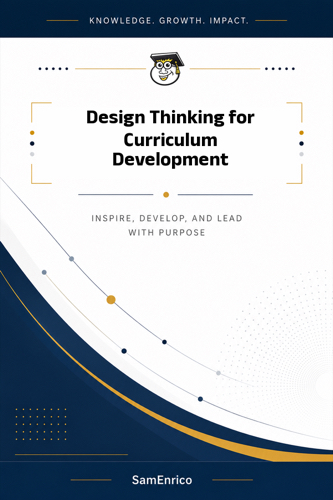
Design Thinking for Curriculum Development eBook
Design courses that meet student needs and learnin
by Barrow Wan
Design courses that meet student needs and learning objectives.
Formats
Free sample
Chapter 1: The Empathy Lie--–- Every teacher I know has been told to “have empathy” for their students. Administrators preach it. Professional development seminars plaster it on Power Point slides. Mission statements etch it into lobby walls. But here’s the truth no one says out loud: most empathy in education is performative garbage.We nod along when someone says “know your learners,” then we go back to our desks and open the standards document.
We fill out “student interest surveys” in September—nine questions about favorite movies and hobbies—then shove them in a drawer until June. We call that empathy. It is not. It is a ritual. And it is failing your students.This chapter is not about being nicer to kids.
This chapter is about a specific, uncomfortable, high-risk form of empathy that most educators avoid because it is hard and it might break your heart. I am talking about design empathy—the kind that does not just ask “what do my students need to know?” but rather “what is it like to be a student in my room right now, and why might that experience feel unsafe, boring, or humiliating?”I learned this lesson the hard way. Six years ago, I designed what I believed was a brilliant three-week unit on argumentative writing. I had standards-aligned objectives. I had a rubric.
I had a curated selection of “engaging” texts about school dress codes and cell phone bans. I was proud. On day one, I launched into my hook: “By the end of this unit, you will be able to write a persuasive essay that changes someone’s mind.”A student in the back—a quiet boy named Marcus who rarely spoke—raised his hand and asked, “Why would anyone want to change my mind? No one’s ever asked what I think about anything.”The room went silent. Not the good silence.
The silence of twenty-seven students realizing that their teacher had never once asked them what they actually believed. I had designed a unit about persuasion without first understanding whether my students believed they had anything worth saying.That was my empathy failure. Not because I was mean. Because I started with the standards.The Fatal Flaw of Standards-First Design Let me say something provocative: Starting with standards is academic malpractice disguised as rigor.I know that sounds extreme. Every teacher training program tells you to begin with the end in mind.
Write your objectives first. Align your assessments to state standards. This is the gospel of backward design. And it is wrong—not because backward design is bad, but because it is incomplete.Here is what happens when you start with standards: You open the document. You see “CCSS.ELA-LITERACY.W.9-10.1: Write arguments to support claims in an analysis of substantive topics or texts.” You think, “Okay, I need to teach argumentative writing.” You build a unit around claim statements, evidence integration, rebuttals, and concluding paragraphs.
You create a rubric. You teach it. Then you give the final assessment and discover that one-third of your students could not write a coherent argument. You blame their prior teachers, their home lives, their phones, their laziness.You never blame the standards. You never blame yourself.
And you certainly never ask the one question that would have saved the unit: What did I not understand about these students before I opened the standards document?This is the fatal flaw of standards-first design. It treats the learner as a container to be filled rather than a human to be understood. It assumes that the sequence of skills in the standards document matches the sequence of readiness in your actual classroom. It does not. It never does.Design thinking flips this sequence.
Before you ask “what should they learn,” you ask “who are they, right now, in this moment, with these fears and these hopes and these damaged relationships with school?” Standards become inputs—important inputs, but inputs nonetheless. They are not the starting line. They are the guardrails.The Two Types of Needs: Cognitive vs. Affective Most educators are trained to assess cognitive needs. We give pre-tests.
We analyze writing samples. We identify gaps in procedural knowledge. This is necessary work. But it is not empathy. It is diagnosis.Cognitive needs answer the question: What does the student not yet know or know how to do?Affective needs answer the question: What does the student need to feel in order to be willing to try?Here is the brutal truth: Affective needs always trump cognitive needs.
Always.You can design the most perfectly scaffolded lesson on quadratic equations, but if a student walks into your room believing that “math is for people who are naturally smart” and that they are not one of those people, your lesson will fail. You can build a beautifully sequenced unit on the Civil War, but if a student’s family immigrated to the United States after 1965 and they have no ancestral connection to the conflict, your “engaging” hook about “your great-great-grandfather’s experience” will alienate them. You can require nightly reading logs, but if a student is working a part-time job to help pay rent and falls asleep at 9:00 PM, your grading policy is punishing survival, not measuring comprehension.Empathy interviews are designed to uncover affective needs first and cognitive needs second. They are not surveys. Surveys ask, “What is your favorite subject?” Empathy interviews ask, “Tell me about a time you felt smart in school.
What made you feel that way?” Surveys ask, “Do you like group work?” Empathy interviews ask, “Walk me through the last time you worked in a group. What was hard about it? What was good about it?”The difference is depth. Surveys gather data. Empathy interviews gather stories.
And stories are where affective needs live.How to Conduct an Empathy Interview (That Actually Works)Let me walk you through the exact protocol I have used with hundreds of teachers. It takes fifteen minutes per student. You do not need to interview every student. You need to interview a representative sample: your struggling students, your silent students, your “behavior problem” students, your overachievers who are secretly falling apart.Step 1: Set the contract. Say this, verbatim: “I am not here to evaluate you or change you.
I am here to learn how to design better lessons. Nothing you say will hurt your grade. If I ask something you do not want to answer, just say ‘pass.’ I will thank you for the honesty, not punish you for it.”Step 2: Ask open questions, then shut up. The best empathy interviewers speak less than 20% of the time. Your job is to prompt and then listen.
Use these stems:“Tell me about a time in this class when you felt…”“What was going through your mind when…”“Help me understand what made that feel…”Step 3: Listen for the emotion behind the words. When a student says, “I don’t like reading,” do not write down “dislikes reading.” Write down the possible emotions: shame, boredom, fear of being seen as slow, physical discomfort with the text font, past trauma of being called on to read aloud. Then ask a follow-up: “When you say you don’t…
This is the end of the free sample. Get the eBook to keep going. Buy now
About this book
Details
- Author
- Barrow Wan
- Publisher
- SamEnrico
- Language
- English
- Genre
- Non-Fiction, Self-Help
- Released
- 2026-06-09
- Pages (approx.)
- 154
- Available as
- eBook, Audiobook

Read better in the ZLOADR app
Your eBooks on your phone or tablet. Sign in with your SamEnrico account and start reading.
More by Barrow Wan
 Midlife Purpose ResetBarrow Wan$11.99
 The Twelve Step Chip SystemBarrow Wan$11.99
 Post Action ReviewBarrow Wan$11.99
 NVC for Remote TeamsBarrow Wan$11.99
 Journalist Shift SleepBarrow Wan$11.99
 Parent Chore DelegationBarrow Wan$11.99
 Cardiovascular Benefits of QuittingBarrow Wan$11.99
 The River of Blood: The Mysterious Torso Murders of the Congo Free StateBarrow Wan$11.99
 Quetzalcoatl's Feathered Serpent: The Wind God's Forbidden LoveBarrow Wan$11.99
 How to Produce Toy GlidersBarrow Wan$11.99
 How to Produce Inline SkatesBarrow Wan$11.99
 International Student Community SizesBarrow Wan$12.99
You may also like
 Hong Kong Handover 1997Dunn Johnnie$11.99
 Zumba For Postnatal Recovery CourseNeal Christian$11.99
 Zumba for BeginnersLadner Nikia$11.99
 YouTube Comment Mining GuideHumes Pandora$12.99
 Worry Box MeditationCarlin Rudy$11.99
 Workplace Stress MeditationNguyen Lynn$11.99
 Workplace Stress and Sleep RepairHawley Ivory$11.99
 Workplace Perfectionism CureDelaney Jeffry$11.99
 Workplace Injustice Anger GuideWallen Isabelle$11.99
 Work Addiction and Burnout LinkGreenwood Ester$11.99
 Women in Yoga and WellnessBeattie Galina$11.99
 Women in Stand Up ComedyChun Evangeline$11.99