
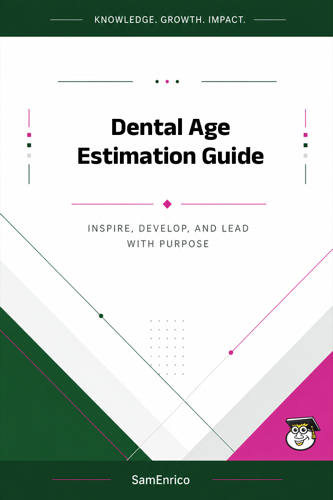
Non-FictionTrue Crime / Age Estimation
Dental Age Estimation Guide Audiobook
undefined
by Gough Otha
undefined
Formats
Free sample
Chapter 1: The Teeth That Tell Time...--–- The body is a chronicler, but few of its record-keepers are as faithful as the teeth. Unlike skin that scars and heals, bones that remodel, or memories that fade, the dentition follows a developmental script so predictable that it has become one of forensic science's most reliable clocks. From the moment the first dental lamina forms in a six-week-old embryo to the final root apex closure of a third molar in early adulthood, teeth inscribe a permanent record of biological time. This chapter establishes why dental age estimation matters, what distinguishes it from other aging methods, and how a multidisciplinary approach transforms isolated techniques into a coherent forensic framework.The opening case of this chapter—and of this book—begins not in a laboratory or a courtroom, but on a beach in Sicily, in the autumn of 2015. A young man’s body washed ashore among dozens of others, victims of a Mediterranean crossing that had ended in disaster.
He carried no identification. His face was unrecognizable. But his teeth were intact. A forensic odontologist from the Italian Red Cross disaster victim identification team extracted a single premolar, sectioned it, and counted the incremental lines in the cementum. The estimate: eighteen years and approximately four months.
That number, produced by a method called cementochronology, allowed authorities to search for missing persons in the appropriate age range. Within weeks, the young man’s family was located in Eritrea. He had left home at seventeen, hoping to reach Germany. He never arrived, but his teeth told authorities who he was and how old he had been when he died.That case illustrates the central argument of this book: dental age estimation is not an academic curiosity. It is a humanitarian tool, a legal instrument, and a scientific discipline that sits at the intersection of anatomy, radiology, biochemistry, and jurisprudence.
When a child arrives at a border without documents, teeth may determine whether that child is processed as a minor or as an adult. When a murderer leaves a skull in a shallow grave, the dentition may narrow the search for the victim’s identity. When a mass disaster overwhelms conventional identification methods, dental age becomes one of the four primary biological indicators—alongside DNA, fingerprints, and physical characteristics—that bring closure to grieving families.But dental age estimation is also contested, imperfect, and ethically fraught. A radiologist’s confident statement…
This is the end of the free sample. Get the Audiobook to keep going. Buy now
About this book
Details
- Author
- Gough Otha
- Publisher
- SamEnrico
- Language
- English
- Genre
- Non-Fiction, True Crime / Age Estimation
- Released
- 2026-06-07
- Pages (approx.)
- 159
- Available as
- eBook, Audiobook

Listen in the VoxFlicks app
Audiobooks and audio dramas wherever you go. Sign in with your SamEnrico account and press play.
More by Gough Otha
 Terminal Illness Family GriefGough Otha$11.99
 The Second Time Mom PPDGough Otha$11.99
 Shopping Addiction JournalingGough Otha$11.99
 Gabapentin for Menopause SleepGough Otha$11.99
 Staircase Visualization InductionGough Otha$11.99
 Nonverbal Cues in CourtroomGough Otha$11.99
 Self Hypnosis for People PleasingGough Otha$11.99
 The Silk Road Queen: How a Hong Kong Triad's First Lady Built an EmpireGough Otha$11.99
 The Shadow Warriors: How Asia's Martial Arts Masters Outwitted the WorldGough Otha$11.99
 How to Produce Pencil Lead and RefillsGough Otha$11.99
 A Collector's Handbook to the Vauxhall SuperGough Otha$11.99
 Alibaba vs Amazon DropshippingGough Otha$12.99
You may also like
 Hong Kong Handover 1997Dunn Johnnie$11.99
 Zumba For Postnatal Recovery CourseNeal Christian$11.99
 Zumba for BeginnersLadner Nikia$11.99
 YouTube Comment Mining GuideHumes Pandora$12.99
 Worry Box MeditationCarlin Rudy$11.99
 Workplace Stress MeditationNguyen Lynn$11.99
 Workplace Stress and Sleep RepairHawley Ivory$11.99
 Workplace Perfectionism CureDelaney Jeffry$11.99
 Workplace Injustice Anger GuideWallen Isabelle$11.99
 Work Addiction and Burnout LinkGreenwood Ester$11.99
 Women in Yoga and WellnessBeattie Galina$11.99
 Women in Stand Up ComedyChun Evangeline$11.99