
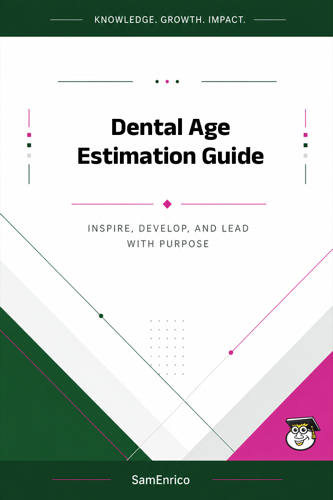
Non-FictionTrue Crime / Age Estimation
Dental Age Estimation Guide eBook
undefined
by Gough Otha
undefined
Formats
Free sample
Chapter 1: The Teeth That Tell Time...--–- The body is a chronicler, but few of its record-keepers are as faithful as the teeth. Unlike skin that scars and heals, bones that remodel, or memories that fade, the dentition follows a developmental script so predictable that it has become one of forensic science's most reliable clocks. From the moment the first dental lamina forms in a six-week-old embryo to the final root apex closure of a third molar in early adulthood, teeth inscribe a permanent record of biological time. This chapter establishes why dental age estimation matters, what distinguishes it from other aging methods, and how a multidisciplinary approach transforms isolated techniques into a coherent forensic framework.The opening case of this chapter—and of this book—begins not in a laboratory or a courtroom, but on a beach in Sicily, in the autumn of 2015. A young man’s body washed ashore among dozens of others, victims of a Mediterranean crossing that had ended in disaster.
He carried no identification. His face was unrecognizable. But his teeth were intact. A forensic odontologist from the Italian Red Cross disaster victim identification team extracted a single premolar, sectioned it, and counted the incremental lines in the cementum. The estimate: eighteen years and approximately four months.
That number, produced by a method called cementochronology, allowed authorities to search for missing persons in the appropriate age range. Within weeks, the young man’s family was located in Eritrea. He had left home at seventeen, hoping to reach Germany. He never arrived, but his teeth told authorities who he was and how old he had been when he died.That case illustrates the central argument of this book: dental age estimation is not an academic curiosity. It is a humanitarian tool, a legal instrument, and a scientific discipline that sits at the intersection of anatomy, radiology, biochemistry, and jurisprudence.
When a child arrives at a border without documents, teeth may determine whether that child is processed as a minor or as an adult. When a murderer leaves a skull in a shallow grave, the dentition may narrow the search for the victim’s identity. When a mass disaster overwhelms conventional identification methods, dental age becomes one of the four primary biological indicators—alongside DNA, fingerprints, and physical characteristics—that bring closure to grieving families.But dental age estimation is also contested, imperfect, and ethically fraught. A radiologist’s confident statement that a young asylum seeker is “approximately eighteen years old” can mean the difference between protective custody and adult detention. A pathologist’s error of two years in a criminal case can send a juvenile to an adult prison.
A biochemist’s failure to account for population variation can misidentify the remains of a soldier killed in combat. This book does not pretend that dental age estimation is infallible. Instead, it provides the tools to understand its strengths, respect its limitations, and apply its methods with rigor and transparency.Three Ages: Chronological, Dental, Skeletal Before any method can be applied, the practitioner must understand a foundational distinction that runs through every chapter of this book. There are three different ways to measure a person’s age, and they do not always align.Chronological age is the simplest concept: the number of years, months, and days since birth, as recorded on a birth certificate or legal document. Chronological age is the gold standard against which all estimation methods are measured.
But in forensic and humanitarian contexts, chronological age is precisely what is unknown, missing, or falsified. The entire discipline of age estimation exists because chronological age cannot be observed directly.Dental age is the age suggested by the developmental or degenerative state of the teeth. In children and adolescents, dental age is determined by mineralization stages: how much of the crown has formed, whether the root is open or closed, whether the tooth has erupted. In adults, dental age is determined by regressive changes: secondary dentin deposition, root translucency, cementum annulations, and biochemical markers such as aspartic acid racemization. Dental age is the central subject of this book.Skeletal age is the age suggested by bone ossification and fusion.
The hand-wrist radiograph, using the Greulich-Pyle atlas or the Tanner-Whitehouse method, remains the most common skeletal age assessment. Other sites include the clavicle (which fuses in the early twenties), the iliac crest (which fuses in the late teens), and the cervical vertebrae (visible on some dental radiographs). Skeletal and dental ages are correlated—both are governed by the same genetic and environmental factors—but they are not identical. Discrepancies of six to twelve months are common; discrepancies of two years or more occur in individuals with endocrine disorders, chronic illness, or severe malnutrition.The relationship between dental and chronological age is the subject of intense debate. In healthy, well-nourished populations, the correlation is strong: a child with advanced dental development is likely to have an earlier chronological birthdate, and vice versa.
But correlation is not causation. A child with delayed dental development may simply be a late bloomer, or may have suffered from malnutrition that affected only the teeth and not the skeleton. This uncertainty cannot be eliminated; it can only be quantified and disclosed.Why Age Estimation Matters: Four Domains of Practice Dental age estimation is not performed in a vacuum. Every request for an age estimate arrives embedded in a specific legal, humanitarian, or scientific context. The method chosen, the precision required, and the reporting standards all depend on that context.
This book organizes its methods around four primary domains.Forensic identification of the deceased is the oldest domain. When human remains are discovered—whether from a homicide, a suicide, an accident, or a natural disaster—the first questions are always: Who is this person? How old were they? Dental age estimation narrows the pool of possible matches. In the 2004 Indian Ocean tsunami, dental age estimates helped identify children whose bodies were otherwise unrecognizable.
In the 9/11 attacks, dental age was one of several indicators used to reassemble fragmented remains into individual victims. In cold cases, dental age estimates from skeletal remains can exclude suspects or confirm witness statements. The stakes are high, but the ethical constraints are relatively low: the deceased cannot be harmed by examination, and destructive methods are permissible when they serve identification.Humanitarian protection of the living is the fastest-growing domain. Unaccompanied minors arriving at borders in Europe, North America, and Australia often lack reliable documents. Age estimation determines whether they are processed as children (entitled to protection, family reunification, and education) or as adults (subject to detention, deportation, or adult criminal proceedings).
The ethical stakes could not be higher. A false positive (estimating a child as an adult) can expose a minor to adult prison, adult detention centers, or deportation to a dangerous country of origin. A false negative (estimating an adult as a child) can allow a dangerous individual access to child protection systems. The margin for error is zero, but the reality is that all age estimation methods have error. This book emphasizes methods that minimize false positives—errors that harm children—even at the cost of increasing false negatives.Criminal and juvenile justice is the third domain.
In many jurisdictions, the age of criminal responsibility is fourteen, sixteen, or eighteen. Determining whether a young offender is above…
This is the end of the free sample. Get the eBook to keep going. Buy now
About this book
Details
- Author
- Gough Otha
- Publisher
- SamEnrico
- Language
- English
- Genre
- Non-Fiction, True Crime / Age Estimation
- Released
- 2026-06-07
- Pages (approx.)
- 159
- Available as
- eBook, Audiobook

Read better in the ZLOADR app
Your eBooks on your phone or tablet. Sign in with your SamEnrico account and start reading.
More by Gough Otha
 Terminal Illness Family GriefGough Otha$11.99
 The Second Time Mom PPDGough Otha$11.99
 Shopping Addiction JournalingGough Otha$11.99
 Gabapentin for Menopause SleepGough Otha$11.99
 Staircase Visualization InductionGough Otha$11.99
 Nonverbal Cues in CourtroomGough Otha$11.99
 Self Hypnosis for People PleasingGough Otha$11.99
 The Silk Road Queen: How a Hong Kong Triad's First Lady Built an EmpireGough Otha$11.99
 The Shadow Warriors: How Asia's Martial Arts Masters Outwitted the WorldGough Otha$11.99
 How to Produce Pencil Lead and RefillsGough Otha$11.99
 A Collector's Handbook to the Vauxhall SuperGough Otha$11.99
 Alibaba vs Amazon DropshippingGough Otha$12.99
You may also like
 Hong Kong Handover 1997Dunn Johnnie$11.99
 Zumba For Postnatal Recovery CourseNeal Christian$11.99
 Zumba for BeginnersLadner Nikia$11.99
 YouTube Comment Mining GuideHumes Pandora$12.99
 Worry Box MeditationCarlin Rudy$11.99
 Workplace Stress MeditationNguyen Lynn$11.99
 Workplace Stress and Sleep RepairHawley Ivory$11.99
 Workplace Perfectionism CureDelaney Jeffry$11.99
 Workplace Injustice Anger GuideWallen Isabelle$11.99
 Work Addiction and Burnout LinkGreenwood Ester$11.99
 Women in Yoga and WellnessBeattie Galina$11.99
 Women in Stand Up ComedyChun Evangeline$11.99