
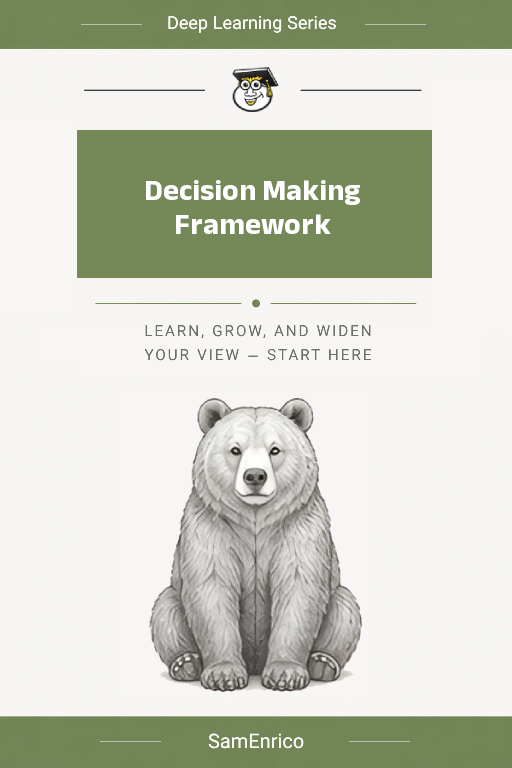
Decision Making Framework
Use consent, consensus, or designated decider mode
by Held Marlin
Use consent, consensus, or designated decider models for co-founder decisions.
Formats
About this book
Free sample
Chapter 1: The Slow Death--–- It begins not with a bang, not with a shouting match, not with a dramatic walkout or a slammed laptop. It begins with a polite, reasonable conversation that goes nowhere. Two co-founders, sitting across from each other in a coffee shop or a garage or a borrowed conference room, agree that they need to make a decision. They agree on the facts. They agree on the stakes.
They even agree on the general direction. And then they stop. Because no one knows who gets to say the final word.That pause—that polite, reasonable, deadly pause—is the moment most startups actually die. Not when the funding runs out. Not when the competitor launches a superior product.
Not even when the key engineer quits. Those are symptoms. The disease is something quieter, something that business schools rarely teach and venture capitalists rarely ask about. The disease is process bankruptcy: the absence of an agreed-upon, written, binding system for making decisions when co-founders disagree.This chapter will show you why democratic decision-making—the default operating system for most founding teams—is actually a slow-acting poison. You will learn the critical difference between trusting someone's competence and trusting their judgment in a specific domain.
You will see, through real-world case studies, how equal partnerships without a tiebreaker inevitably devolve into gridlock, resentment, and eventual collapse. And you will take a diagnostic quiz that will tell you, with uncomfortable accuracy, whether your co-founder relationship is a genuine partnership or a stalemate waiting to happen.But first, a story.The Startup That Died of Politeness In 2016, three friends from a well-known university founded a health-tech company. They had complementary skills: one was the engineer, one was the operator, one was the domain expert in healthcare regulations. They split the equity equally—33.3% each—because that felt fair and because they trusted each other implicitly. They had no formal decision-making process because, in their words, "we're adults who respect each other." They named no CEO.
They wrote no operating agreement beyond the bare legal minimum required to incorporate.For the first eight months, this worked beautifully.…
This is the end of the free sample. Get the eBook to keep going. Buy now
Contents
- Chapter 1
- Chapter 2
- Chapter 3
- Chapter 4
- Chapter 5
- Chapter 6
- Chapter 7
- Chapter 8
- Chapter 9
- Chapter 10
- Chapter 11
- Chapter 12
Details
- Author
- Held Marlin
- Publisher
- SamEnrico
- Language
- English
- Genre
- Non-Fiction, First 30 Days, Decision Models
- Released
- 2026-06-01
- Pages (approx.)
- 152
- Available as
- eBook, Audiobook

Read better in the ZLOADR app
Your eBooks on your phone or tablet. Sign in with your SamEnrico account and start reading.
More by Held Marlin
 Personal Ing For Success StoryHeld Marlin$11.99
 Breath Counting for Test AnxietyHeld Marlin$11.99
 Reddit Personal Finance BragHeld Marlin$11.99
 Loneliness And Travel GuideHeld Marlin$11.99
 PMS Symptom Tracking GuideHeld Marlin$11.99
 The Ballot and the Bomb: How One Election Night Changed Nuclear HistoryHeld Marlin$11.99
 Blood, Sweat, and Lies: The Untold Story of the 1988 Seoul Olympics Doping Cover-UpHeld Marlin$11.99
 Continuous Wave Laser TechnicianHeld Marlin$11.99
 Real Estate Stock GuideHeld Marlin$12.99
 Understanding DysmorphophobiaHeld Marlin$17.99
 How to Become a Sawmill WorkerHeld Marlin$11.99