
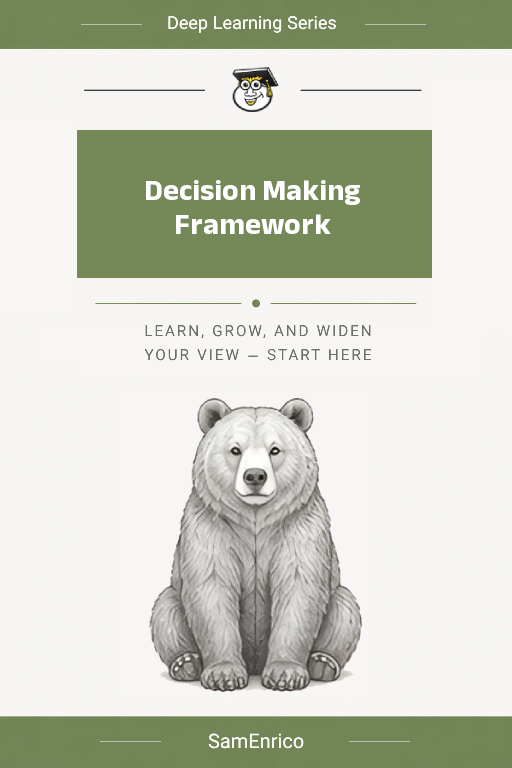
Decision Making Framework eBook
Use consent, consensus, or designated decider mode
by Held Marlin
Use consent, consensus, or designated decider models for co-founder decisions.
Formats
Free sample
Chapter 1: The Slow Death--–- It begins not with a bang, not with a shouting match, not with a dramatic walkout or a slammed laptop. It begins with a polite, reasonable conversation that goes nowhere. Two co-founders, sitting across from each other in a coffee shop or a garage or a borrowed conference room, agree that they need to make a decision. They agree on the facts. They agree on the stakes.
They even agree on the general direction. And then they stop. Because no one knows who gets to say the final word.That pause—that polite, reasonable, deadly pause—is the moment most startups actually die. Not when the funding runs out. Not when the competitor launches a superior product.
Not even when the key engineer quits. Those are symptoms. The disease is something quieter, something that business schools rarely teach and venture capitalists rarely ask about. The disease is process bankruptcy: the absence of an agreed-upon, written, binding system for making decisions when co-founders disagree.This chapter will show you why democratic decision-making—the default operating system for most founding teams—is actually a slow-acting poison. You will learn the critical difference between trusting someone's competence and trusting their judgment in a specific domain.
You will see, through real-world case studies, how equal partnerships without a tiebreaker inevitably devolve into gridlock, resentment, and eventual collapse. And you will take a diagnostic quiz that will tell you, with uncomfortable accuracy, whether your co-founder relationship is a genuine partnership or a stalemate waiting to happen.But first, a story.The Startup That Died of Politeness In 2016, three friends from a well-known university founded a health-tech company. They had complementary skills: one was the engineer, one was the operator, one was the domain expert in healthcare regulations. They split the equity equally—33.3% each—because that felt fair and because they trusted each other implicitly. They had no formal decision-making process because, in their words, "we're adults who respect each other." They named no CEO.
They wrote no operating agreement beyond the bare legal minimum required to incorporate.For the first eight months, this worked beautifully. They were in the garage phase, building the prototype, talking to potential customers, iterating quickly. Decisions were easy because there was no real money at stake and no customers depending on them. When disagreements arose, they talked it out until they reached a consensus—or at least until everyone was too tired to keep arguing. They mistook exhaustion for agreement.Then they raised a seed round.
$1.2 million. Real money. Real expectations. Real customers waiting.The first serious disagreement came over pricing. The engineer wanted a low, penetration price to capture market share quickly.
The operator wanted a moderate price that would allow them to break even within 12 months. The domain expert wanted a high price that signaled quality and left room for negotiation with enterprise clients. Each had data. Each had logic. Each had a legitimate point of view.They debated for three weeks.
Not constantly—they had other work to do—but in recurring meetings that grew longer and more frustrating. They tried a majority vote, but no one wanted to be the odd one out. They tried to find a compromise, but every compromise felt like a worse version of each original position. They tried to appoint one person to decide, but no one wanted to give up that power and no one wanted to be seen as a dictator.The pricing decision, which should have taken one afternoon, took 22 days. By the time they launched, a competitor had already captured the segment of the market they were targeting.
The startup limped along for another year, burning through their seed round on engineering salaries while their revenue stagnated. When the money ran out, they blamed the market, the timing, the product. But the real cause of death was process bankruptcy. They had never answered the question: Who decides when we can't agree?I have seen this pattern repeat itself dozens of times. The details change—the industry, the personalities, the specific point of disagreement—but the underlying pathology is always the same.
Co-founders assume that because they trust each other, they don't need rules. This is like assuming that because you love your spouse, you don't need a prenuptial agreement. Love and trust do not eliminate the need for structure. In fact, they make structure more important, because the stakes are higher and the emotional cost of conflict is greater.The Three Owners Problem In his book The Hard Thing About Hard Things, Ben Horowitz tells a story that every founder should memorize. Early in Google's history, Eric Schmidt realized that the company's three founders—Larry Page, Sergey Brin, and himself—were locked in an unwinnable dynamic.
Any two could outvote the third, but that just created shifting coalitions and permanent resentment. Decisions took forever because each founder knew that if they lost today's vote, they could try to regroup and reverse it tomorrow. There was no finality. There was no closure.Schmidt's solution was to eliminate the three-owner problem by designating a single final decision-maker for each major domain. This was not authoritarianism.
It was clarity. Page would decide on product direction. Brin would decide on technical architecture. Schmidt would decide on business operations and external partnerships. Each could argue passionately during the debate phase, but once the designated decider spoke, the debate ended and execution began.This principle—sometimes called the "tiebreaker rule" or the "decider protocol"—is one of the most empirically validated findings in organizational psychology.
Groups with an odd number of members still deadlock if no one has final authority. Groups with an even number are even worse because ties are possible. The only reliable escape from gridlock is to pre-assign decision rights.But here is where most co-founders get it wrong. They hear "designate a decider" and they think it means "make someone the boss." They worry about hurt feelings, about ego, about the appearance of hierarchy in a flat organization. So they avoid the conversation entirely.
Or they have it once, verbally, and never write anything down. Or they agree to a tiebreaker rule but then violate it the first time it produces an outcome they don't like.All of these are forms of process bankruptcy. And all of them are preventable.Organizational Trust vs. Decisional Trust To understand why otherwise functional co-founder relationships break down around decision-making, you need to understand a distinction that most entrepreneurs have never consciously considered. I call it the difference between Organizational Trust and Decisional Trust.Organizational Trust is what you feel when you believe your co-founder is competent, hardworking, ethical, and committed to the company's success.
It is trust in the person. It is what allows you to sleep at night knowing that your co-founder isn't embezzling money or lying to investors or secretly interviewing for other jobs. Organizational Trust is essential. But it is not sufficient.Decisional Trust is something else entirely. It is trust in your co-founder's judgment in a specific domain under conditions of uncertainty.
You can have high Organizational Trust in someone—you know they are smart and well-intentioned—and still have low Decisional Trust in their…
This is the end of the free sample. Get the eBook to keep going. Buy now
About this book
Details
- Author
- Held Marlin
- Publisher
- SamEnrico
- Language
- English
- Genre
- Non-Fiction, First 30 Days, Decision Models
- Released
- 2026-06-01
- Pages (approx.)
- 152
- Available as
- eBook, Audiobook

Read better in the ZLOADR app
Your eBooks on your phone or tablet. Sign in with your SamEnrico account and start reading.
More by Held Marlin
 Personal Ing For Success StoryHeld Marlin$11.99
 Breath Counting for Test AnxietyHeld Marlin$11.99
 Reddit Personal Finance BragHeld Marlin$11.99
 Loneliness And Travel GuideHeld Marlin$11.99
 PMS Symptom Tracking GuideHeld Marlin$11.99
 The Ballot and the Bomb: How One Election Night Changed Nuclear HistoryHeld Marlin$11.99
 Blood, Sweat, and Lies: The Untold Story of the 1988 Seoul Olympics Doping Cover-UpHeld Marlin$11.99
 Continuous Wave Laser TechnicianHeld Marlin$11.99
 Real Estate Stock GuideHeld Marlin$12.99
 Understanding DysmorphophobiaHeld Marlin$17.99
 How to Become a Sawmill WorkerHeld Marlin$11.99