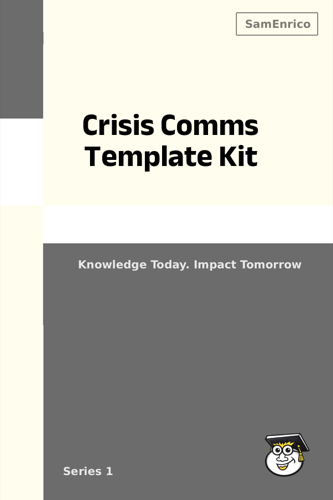
Crisis Comms Template Kit
Fill-in-the-blank messages for employee exposure,
Fill-in-the-blank messages for employee exposure, shutdown, and reopening.
Formats
About this book
Free sample
Chapter 1: The 47-Minute Massacre...--The email arrived at 9:14 AM on a Tuesday. Sarah, the operations director of a 200-person logistics company, read it twice before the color drained from her face. One of her warehouse supervisors had tested positive for a highly contagious respiratory virus. He had worked three full shifts while symptomatic, standing shoulder-to-shoulder with forty-seven other employees. The email included a two-paragraph legal disclaimer, a suggestion to "monitor the situation," and a phone number for HR.
It did not include instructions, reassurance, or a timeline.By 9:47 AM—thirty-three minutes later—the warehouse floor had emptied. Not because Sarah had ordered a shutdown, but because employees had texted each other. By 10:12 AM, a screenshot of the email was on Reddit. By 10:45 AM, a regional news outlet had called for comment. By 11:30 AM, three employees had driven themselves to the emergency room in a panic, convinced they were already symptomatic.
By noon, Sarah's CEO was on a conference call with their largest client, who had heard about "a major outbreak" from a friend of a friend. The friend of a friend had never worked for the company. The story had mutated four times in three hours.Sarah had done nothing wrong. She had followed the protocol. She had notified the team.
But she had not notified them correctly. She had not notified them quickly enough. And she had not notified them with the right words. The cost of that failure: two lost clients, a workers' compensation claim from an employee who was never actually exposed, and three months of reputational repair work. All because the first message was too long, too late, and too useless.This chapter is about why that happens—and how to make sure it never happens to you.The Neuroscience of Panic: Why Smart People Write Dumb Messages Under Pressure Let us begin with a hard truth.
In a crisis, your brain becomes your enemy. Not your ally. Not your partner. Your active, aggressive, well-intentioned enemy.The human prefrontal cortex—the part of your brain responsible for complex writing, strategic thinking, impulse control, and forward planning—is the first…
This is the end of the free sample. Get the eBook to keep going. Buy now
Contents
- Chapter 1
- Chapter 2
- Chapter 3
- Chapter 4
- Chapter 5
- Chapter 6
- Chapter 7
- Chapter 8
- Chapter 9
- Chapter 10
- Chapter 11
- Chapter 12
Details
- Author
- Roller Brendon
- Publisher
- SamEnrico
- Language
- English
- Genre
- Non-Fiction, Crisis Management, Communication
- Released
- 2026-06-09
- Pages (approx.)
- 159
- Available as
- eBook, Audiobook

Read better in the ZLOADR app
Your eBooks on your phone or tablet. Sign in with your SamEnrico account and start reading.
More by Roller Brendon
 Burnout Recovery Nutrition PlanRoller Brendon$11.99
 Pulsatile HGH Rhythm MasteryRoller Brendon$11.99
 Morning Affirmations That Rewire BrainsRoller Brendon$11.99
 Mindfulness for Difficult ConversationsRoller Brendon$11.99
 Operation Jericho Amiens PrisonRoller Brendon$11.99
 Financial Procrastination GuideRoller Brendon$11.99
 Child Birthday After DeathRoller Brendon$11.99
 The Madman of Caracas: A 19th-Century Hostage Crisis and the Insanity Defense That Shocked Latin AmericaRoller Brendon$11.99
 Echoes of the Ripper: How a Serial Killer Rewrote the ScriptRoller Brendon$11.99
 Growing Acinos (Calamint)Roller Brendon$11.99
 How to Produce Measuring and Analysing Instrument Design ServicesRoller Brendon$11.99
 A Collector's Handbook to the Nsu 1000Roller Brendon$11.99