
Non-FictionCrisis ManagementCommunication
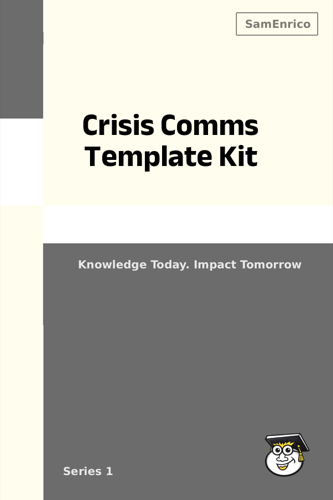
Crisis Comms Template Kit eBook
Fill-in-the-blank messages for employee exposure,
Fill-in-the-blank messages for employee exposure, shutdown, and reopening.
Formats
Free sample
Chapter 1: The 47-Minute Massacre...--The email arrived at 9:14 AM on a Tuesday. Sarah, the operations director of a 200-person logistics company, read it twice before the color drained from her face. One of her warehouse supervisors had tested positive for a highly contagious respiratory virus. He had worked three full shifts while symptomatic, standing shoulder-to-shoulder with forty-seven other employees. The email included a two-paragraph legal disclaimer, a suggestion to "monitor the situation," and a phone number for HR.
It did not include instructions, reassurance, or a timeline.By 9:47 AM—thirty-three minutes later—the warehouse floor had emptied. Not because Sarah had ordered a shutdown, but because employees had texted each other. By 10:12 AM, a screenshot of the email was on Reddit. By 10:45 AM, a regional news outlet had called for comment. By 11:30 AM, three employees had driven themselves to the emergency room in a panic, convinced they were already symptomatic.
By noon, Sarah's CEO was on a conference call with their largest client, who had heard about "a major outbreak" from a friend of a friend. The friend of a friend had never worked for the company. The story had mutated four times in three hours.Sarah had done nothing wrong. She had followed the protocol. She had notified the team.
But she had not notified them correctly. She had not notified them quickly enough. And she had not notified them with the right words. The cost of that failure: two lost clients, a workers' compensation claim from an employee who was never actually exposed, and three months of reputational repair work. All because the first message was too long, too late, and too useless.This chapter is about why that happens—and how to make sure it never happens to you.The Neuroscience of Panic: Why Smart People Write Dumb Messages Under Pressure Let us begin with a hard truth.
In a crisis, your brain becomes your enemy. Not your ally. Not your partner. Your active, aggressive, well-intentioned enemy.The human prefrontal cortex—the part of your brain responsible for complex writing, strategic thinking, impulse control, and forward planning—is the first system to shut down under acute stress. This is not a design flaw.
It is an evolutionary feature. When your ancient ancestors heard a predator in the bushes, their brains did not pause to draft a thoughtful risk assessment. Their brains flooded with cortisol, shut down non-essential functions (like nuanced writing), and redirected all energy to the amygdala—the fight-or-flight center. The result: fast reflexes, not good prose.The problem, of course, is that modern crises do not involve predators in bushes. They involve Slack messages, press statements, employee emails, and client calls.
These tasks require the prefrontal cortex. And yours will be offline precisely when you need it most.This phenomenon has a name in crisis communication research: "cognitive narrowing." Under high stress, your working memory capacity drops by as much as 50 percent. Your vocabulary shrinks to the most common 2,000 words. Your ability to sequence complex ideas collapses. You default to jargon, passive voice, and legalistic caveats—not because you are a bad writer, but because your brain is conserving energy for a physical threat that does not exist.The result is the "Crisis Email of Doom." You have received one.
You have probably written one. It is 400 words long. It begins with "As you may be aware." It contains the phrase "we are closely monitoring the situation." It uses the passive voice repeatedly ("It has been determined that..."). It includes a legal disclaimer in italics. It ends with "we will provide updates as appropriate." It says nothing useful.
It answers no questions. And it makes everyone more afraid than they were before they read it.This chapter exists to ensure you never write that email again.The 60-Minute Clock: Why Speed Is Not Just Speed—It Is Trust Before we discuss what to write, we must discuss when to write it. Because the most perfectly crafted message in the world is worthless if it arrives too late.Research on crisis communication timing is surprisingly consistent across industries, geographies, and crisis types. Stakeholders—whether employees, customers, investors, or the public—form their permanent opinion of your competence within 60 minutes of learning that a crisis exists. Not 24 hours.
Not 48 hours. Not "by end of day." Sixty minutes.This finding comes from multiple sources. The Journal of Crisis Communication published a 2019 meta-analysis of 47 crisis response studies and found that response time was the single strongest predictor of trust retention—stronger than apology content, stronger than compensation, stronger than prior reputation. A 2021 study by the Institute for Public Relations examined 112 workplace health crises and found that organizations that sent their first internal message within 60 minutes retained 94 percent of employee trust. Those that waited 2-3 hours retained only 62 percent.
Those that waited more than 4 hours retained 31 percent.Here is what happens minute by minute during the first hour of a crisis, based on actual incident data.Minute 0-5: The crisis occurs, or you receive confirmation. Your brain enters cognitive narrowing. You feel an urge to "gather more information." This urge is dangerous. Do not obey it.Minute 5-15: The first rumors begin. In any group of more than 10 people, someone will text someone else.
By minute 10, the rumor is already less accurate than reality. By minute 15, the rumor has mutated once. Your silence is not neutrality—it is a vote for the rumor.Minute 15-30: The rumor goes external. A screenshot, a text forwarded to a spouse, a post on social media. By minute 30, someone outside your organization knows something—probably incorrect—about your crisis.Minute 30-45: The first media or stakeholder inquiry arrives.
You are now in reactive mode. You have lost control of the narrative. You will spend the next three days correcting information that could have been prevented with a 30-word message at minute 15.Minute 45-60: The permanent opinion window closes. Anyone who has heard about your crisis—whether accurately or not—has now formed a judgment about your competence. That judgment is based entirely on silence or on whatever flawed information they have received from non-official sources.Minute 60-90: You are now in damage control.
Your first message will be received as late and defensive, regardless of its content. If you send it at minute 90, you must begin with an apology for the delay.Minute 90+: You have lost the trust of the majority of your stakeholders. Some will come back with sustained good behavior. Most will not.The practical implication is unforgiving but clear: You have 60 minutes from crisis confirmation to first message. Not 61.
Not "as soon as possible." Sixty. Set a timer. Move.But speed alone is not enough. A fast, useless message is worse than a slow, useful one. You need both speed and structure.
That is where the 27-9-3 Rule comes in.The 27-9-3 Rule: Writing for the Panicked Brain The first message in any crisis must obey three constraints. It must be short enough to read in nine seconds. It must contain no more than three core ideas. And it must target roughly 30-35 words—not because 27 is a magic number, but because research shows that messages longer than 40 words lose retention…
This is the end of the free sample. Get the eBook to keep going. Buy now
About this book
Details
- Author
- Roller Brendon
- Publisher
- SamEnrico
- Language
- English
- Genre
- Non-Fiction, Crisis Management, Communication
- Released
- 2026-06-09
- Pages (approx.)
- 159
- Available as
- eBook, Audiobook

Read better in the ZLOADR app
Your eBooks on your phone or tablet. Sign in with your SamEnrico account and start reading.
More by Roller Brendon
 Burnout Recovery Nutrition PlanRoller Brendon$11.99
 Pulsatile HGH Rhythm MasteryRoller Brendon$11.99
 Morning Affirmations That Rewire BrainsRoller Brendon$11.99
 Mindfulness for Difficult ConversationsRoller Brendon$11.99
 Operation Jericho Amiens PrisonRoller Brendon$11.99
 Financial Procrastination GuideRoller Brendon$11.99
 Child Birthday After DeathRoller Brendon$11.99
 The Madman of Caracas: A 19th-Century Hostage Crisis and the Insanity Defense That Shocked Latin AmericaRoller Brendon$11.99
 Echoes of the Ripper: How a Serial Killer Rewrote the ScriptRoller Brendon$11.99
 Growing Acinos (Calamint)Roller Brendon$11.99
 How to Produce Measuring and Analysing Instrument Design ServicesRoller Brendon$11.99
 A Collector's Handbook to the Nsu 1000Roller Brendon$11.99
You may also like
 Hong Kong Handover 1997Dunn Johnnie$11.99
 Zumba For Postnatal Recovery CourseNeal Christian$11.99
 Zumba for BeginnersLadner Nikia$11.99
 YouTube Comment Mining GuideHumes Pandora$12.99
 Worry Box MeditationCarlin Rudy$11.99
 Workplace Stress MeditationNguyen Lynn$11.99
 Workplace Stress and Sleep RepairHawley Ivory$11.99
 Workplace Perfectionism CureDelaney Jeffry$11.99
 Workplace Injustice Anger GuideWallen Isabelle$11.99
 Work Addiction and Burnout LinkGreenwood Ester$11.99
 Women in Yoga and WellnessBeattie Galina$11.99
 Women in Stand Up ComedyChun Evangeline$11.99