
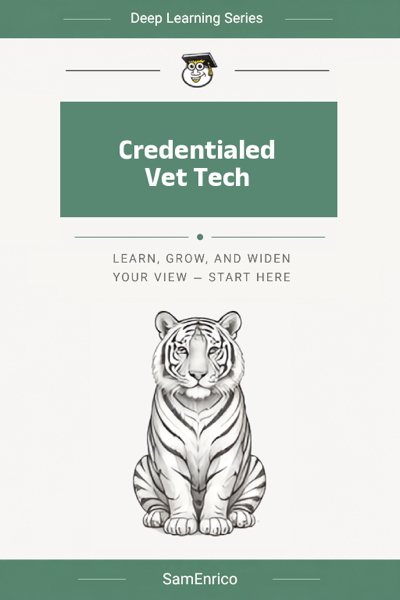
Credentialed Vet Tech
A Coursebook on Credentialed Vet Tech
A Coursebook on Credentialed Vet Tech
Formats
About this book
Free sample
Chapter 1: The Lines We Draw...--–- The first time you watch a veterinarian pronounce a patient dead, something shifts. Not dramatically—not with the thunderclap you might expect from a television drama. It is quieter than that. It is the sound of a stethoscope being coiled, the soft thud of a chart closing, the almost inaudible sigh of someone who has done this a hundred times before. And in that silence, you realize: you are no longer a spectator.
You are standing inside the circle of professional responsibility. The question is not whether you belong here—you have already been accepted into an AVMA-accredited veterinary technology program, or you are considering the leap—but rather what it means to belong. What are the lines you are allowed to cross? Which boundaries must you never approach? And who decides?This chapter is not an abstract exercise in professional ethics.
It is a practical map of the legal and moral terrain you will navigate every single day as a credentialed veterinary technician. The difference between an RVT, an LVT, and a CVT is not merely a matter of state abbreviations; it represents a hard-won credential that grants you the privilege to perform specific tasks under veterinary supervision. But privilege without understanding is dangerous. The veterinary technician who does not know the precise limits of her delegation is like an anesthetist who cannot read a capnograph—technically present, but functionally adrift.We will begin with the history of this profession, because you cannot know where you are going until you understand how the role of the veterinary technician was carved out of the shadows of mid-century animal husbandry. We will then dissect the legal architecture of the Veterinary Practice Acts—the state laws that answer the single most important question in clinical practice: who can do what to which patient, and under whose authority?
From there, we will examine the three models of veterinary supervision: direct, indirect, and immediate. These are not merely academic categories; they determine whether you may place an IV catheter in an unstable dog when the veterinarian is…
This is the end of the free sample. Get the eBook to keep going. Buy now
Contents
- Chapter 1
- Chapter 2
- Chapter 3
- Chapter 4
- Chapter 5
- Chapter 6
- Chapter 7
- Chapter 8
- Chapter 9
- Chapter 10
- Chapter 11
- Chapter 12
Details
- Author
- Lyman Esteban
- Publisher
- SamEnrico
- Language
- English
- Genre
- Non-Fiction, Informative, Educational
- Released
- 2026-06-03
- Pages (approx.)
- 160
- Available as
- eBook, Audiobook

Read better in the ZLOADR app
Your eBooks on your phone or tablet. Sign in with your SamEnrico account and start reading.
More by Lyman Esteban
 SEAL Fund Manager StoryLyman Esteban$11.99
 Arthur Ashe Gentle RevolutionaryLyman Esteban$11.99
 Academic Probation Shame Recovery CourseLyman Esteban$11.99
 Feedback Reception GuideLyman Esteban$11.99
 Equifax Security Team BlundersLyman Esteban$11.99
 Plastics at Sea: The Unseen Revolution of Oceanic ChemistryLyman Esteban$11.99
 Lugalbanda's Forgotten Flight: The Wind-Born King of UrukLyman Esteban$11.99
 ESL Beginner Chinese GuideLyman Esteban$12.99
 US Client Onboarding WorkbookLyman Esteban$12.99
 Understanding Garret–tripp SyndromeLyman Esteban$17.99
 How to Become a Director Of AdmissionsLyman Esteban$11.99