
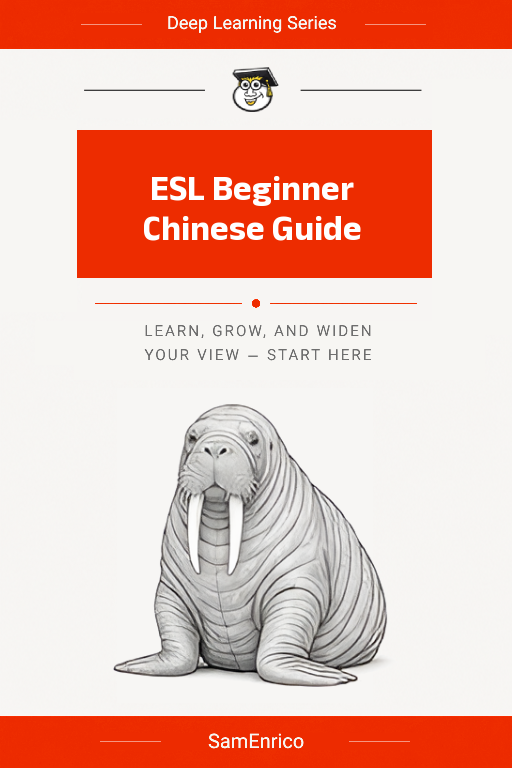
ESL Beginner Chinese Guide
Start absolute beginner Chinese students with basi
Start absolute beginner Chinese students with basic vocabulary and simple sentences.
Formats
About this book
Free sample
Chapter 1: The Sound Door...– Every language has a door. For most languages, that door swings open the moment you learn a few words and string them together. English? Walk right in. Spanish?
The door is already ajar. But Mandarin Chinese has a door that looks like a wall. Thousands of beginners walk up to it, touch the surface, assume there is no handle, and walk away. They tell themselves they have “no ear for tones.” They tell themselves Chinese is “too different.” They tell themselves they will learn characters first and “pick up the sounds later.” These are all lies. The door has a handle.
It is called Pinyin. And the key inside that handle is not memorization. It is not talent. It is the simple, physical act of teaching your mouth to make shapes it already knows how to make, and teaching your ears to hear a difference they have been ignoring since birth. This chapter is the handle.
Turn it.Why Your High School Spanish Teacher Failed You (And Why This Book Will Not)You learned Spanish vowels in ten minutes, right? A is ah, E is ay, I is ee, O is oh, U is oo. Done. You learned French nasal vowels in an afternoon. You learned German umlauts over a weekend.
Those are new sounds, but they are just variations on sounds you already have. Mandarin is different. Mandarin has no new sounds. Every consonant in Mandarin exists in English. Every vowel in Mandarin exists in English.
The problem is not that Mandarin sounds are hard to make. The problem is that Mandarin uses pitch direction—tones—to tell words apart, and English does not. Your brain has been trained for decades to ignore pitch direction as meaningless emotional coloring. “Really?” with rising pitch means surprise. “Really.” with falling pitch means agreement.
Same word, different feeling, but the dictionary meaning does not change. In Mandarin, changing the pitch changes the word. Your brain needs to flip a switch. This chapter is that switch.Most beginner Chinese textbooks dedicate two pages to pronunciation, mumble something about “four tones,”…
This is the end of the free sample. Get the eBook to keep going. Buy now
Contents
- Chapter 1
- Chapter 2
- Chapter 3
- Chapter 4
- Chapter 5
- Chapter 6
- Chapter 7
- Chapter 8
- Chapter 9
- Chapter 10
- Chapter 11
- Chapter 12
Details
- Author
- Lyman Esteban
- Publisher
- SamEnrico
- Language
- English
- Genre
- Non-Fiction, Side Hustle Architect, Beginner ESL
- Released
- 2026-05-30
- Pages (approx.)
- 156
- Available as
- eBook, Audiobook

Read better in the ZLOADR app
Your eBooks on your phone or tablet. Sign in with your SamEnrico account and start reading.
More by Lyman Esteban
 SEAL Fund Manager StoryLyman Esteban$11.99
 Arthur Ashe Gentle RevolutionaryLyman Esteban$11.99
 Academic Probation Shame Recovery CourseLyman Esteban$11.99
 Feedback Reception GuideLyman Esteban$11.99
 Equifax Security Team BlundersLyman Esteban$11.99
 Plastics at Sea: The Unseen Revolution of Oceanic ChemistryLyman Esteban$11.99
 Lugalbanda's Forgotten Flight: The Wind-Born King of UrukLyman Esteban$11.99
 Credentialed Vet TechLyman Esteban$11.99
 US Client Onboarding WorkbookLyman Esteban$12.99
 Understanding Garret–tripp SyndromeLyman Esteban$17.99
 How to Become a Director Of AdmissionsLyman Esteban$11.99