
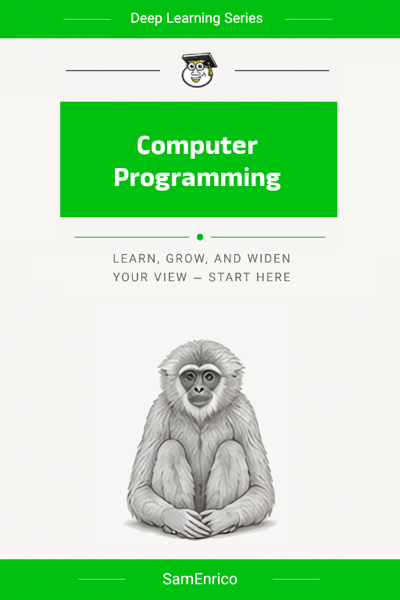
Computer Programming eBook
A Coursebook on Computer Programming
by Pugh Lexie
A Coursebook on Computer Programming
Formats
Free sample
Chapter 1: The Sandwich Algorithm...--–- Programming is not what you think it is. If you believe that programming is primarily about memorizing syntax, mastering arcane keyboard shortcuts, or speaking in cryptic languages filled with semicolons and curly braces, you have been misled. The tech industry has done a remarkable job of making programming look like a secret craft reserved for hoodie-wearing prodigies who type at impossible speeds while drinking energy drinks. That image is not only unhelpful—it is actively harmful. It scares away talented people who could become excellent programmers, and it distracts beginners from what actually matters.The truth is far simpler and far more accessible: Programming is the art of telling a computer exactly what to do, in the right order, without ambiguity. That is it. Everything else—every language, every framework, every tool—is just a different way of expressing those instructions. The hard part of programming has never been the syntax. The hard part is learning to think clearly enough that you can describe a solution so precisely that a machine, which has absolutely no common sense, can execute it flawlessly.This chapter will fundamentally shift how you think about programming. You will learn why most beginners fail not because they cannot learn syntax, but because they skip the most important step: designing before coding. You will discover the power of pseudocode and flowcharts—tools that let you solve problems without fighting with a programming language at the same time. And you will write your first algorithm, not in Python or Java Script, but in something far more universal: plain English (or your native language) structured as precise instructions. By the end of this chapter, you will have learned the single most important skill in programming: turning a messy real-world problem into a clear, step-by-step solution.The Great Misconception: Syntax vs. Problem-Solving Walk into any bookstore or scroll through any online learning platform, and you will find thousands of books and courses with titles like "Learn Python in 24 Hours" or "Java Script: The Good Parts." These resources are not wrong, but they are incomplete. They focus almost entirely on the what—what is a variable, what is a loop, what is a function—without spending enough time on the how and the why. The result is millions of people who can write a for loop but cannot solve a novel problem.Here is a truth that experienced programmers know but beginners rarely hear: You can be an expert in Python's syntax and still be unable to write a working program to sort a list of names by last name. Conversely, you can know only a handful of basic programming constructs and yet build useful, creative tools—if you know how to think algorithmically.Let me prove this to you. Consider the following instructions:"Make a peanut butter and jelly sandwich."If you gave that instruction to another human, they would likely succeed. They would infer the missing details: open the bread bag, take out two slices, find a knife, locate the peanut butter and jelly jars, spread the peanut butter on one slice, spread the jelly on the other, press them together, and clean up. Humans are brilliant at filling in gaps. They understand context. They know that "make a sandwich" implies dozens of unstated steps.Computers understand nothing. A computer is the most literal, unimaginative, and inflexible entity you will ever encounter. If you tell a computer to "make a sandwich," it will stare at you (metaphorically) and raise an error: Name Error: name 'sandwich' is not defined. It has no idea what "make" means, what "a" refers to, or what a sandwich is. Every single step must be spelled out in excruciating detail.This difference—between how humans communicate and how computers operate—is the source of virtually every bug, frustration, and failed program. Programming is the discipline of bridging that gap. It is learning to translate your human, fuzzy, intuitive understanding of a problem into a machine-readable, unambiguous, step-by-step procedure called an algorithm.What Is an Algorithm, Really?The word "algorithm" sounds intimidating. It conjures images of complex mathematics, artificial intelligence, and cryptographic secrets. But an algorithm is simply a finite sequence of well-defined instructions for solving a specific problem. You already know dozens of algorithms. A recipe for baking bread is an algorithm. The instructions for assembling IKEA furniture form an algorithm. The steps you take every morning to brush your teeth constitute an algorithm (open mouth, apply toothpaste, brush in circular motions, rinse, spit, close mouth).In programming, an algorithm must satisfy three properties:1. Finiteness: The algorithm must eventually terminate. It cannot run forever. If you write an infinite loop, you have failed to produce a valid algorithm.2. Definiteness: Each step must be precisely defined and unambiguous. "Add a pinch of salt" is ambiguous—how much is a pinch? "Add 0.5 grams of salt" is definite.3. Effectiveness: Each step must be doable. "Sort the universe" is not effective. "Compare two numbers and swap them if they are out of order" is effective.Every program you will ever write is an implementation of one or more algorithms. When you search for a name in a contact list, you are executing a search algorithm. When you sort your emails by date, you are running a sorting algorithm. When your GPS finds the fastest route, it is running a pathfinding algorithm. Algorithms are the invisible machinery of the digital world.The beautiful thing about algorithms is that they exist independently of programming languages. The algorithm for finding the largest number in a list is the same whether you write it in Python, Java, C++, or even on a napkin in a coffee shop. This is why learning to think algorithmically—to design algorithms before writing code—is the single highest-leverage skill you can develop as a programmer.The Problem Domain vs. The Solution Domain Before you can design an algorithm, you need to understand the territory. Every programming problem has two distinct realms:The Problem Domain: This is the real-world situation where the problem lives. It includes the people involved, the constraints, the desired outcomes, and all the messy, fuzzy details of reality. For example: "I have a list of student grades on paper, and I need to calculate the class average so I can decide whether to give a curve."The Solution Domain: This is the computational representation of the problem. It includes data structures (arrays, lists, dictionaries), operations (addition, comparison, sorting), and control flow (loops, conditionals). In the solution domain, the student grades become an array of numbers. The class average becomes a floating-point calculation. The decision about curving becomes an if statement.Novice programmers make a predictable mistake: they jump directly from the problem domain into writing code, skipping the critical step of mapping between domains. This is like trying to build a house without an architectural blueprint. You might eventually end up with something that stands, but it will be crooked, inefficient, and painful to build.Experienced programmers, by contrast, spend significant time in the problem domain first. They ask questions: What are the inputs? What are the outputs? What edge cases might exist? What should happen if the list is empty? What if there are negative grades? Only after answering these questions do they move to the solution domain and begin designing the algorithm.This chapter—indeed, this entire book—will…
This is the end of the free sample. Get the eBook to keep going. Buy now
About this book
Details
- Author
- Pugh Lexie
- Publisher
- SamEnrico
- Language
- English
- Genre
- Non-Fiction, Informative, Educational
- Released
- 2026-06-02
- Pages (approx.)
- 158
- Available as
- eBook, Audiobook

Read better in the ZLOADR app
Your eBooks on your phone or tablet. Sign in with your SamEnrico account and start reading.
More by Pugh Lexie
 Exam Anxiety Reduction WorkbookPugh Lexie$11.99
 Emotionally Immature Parents WorkbookPugh Lexie$11.99
 Reddit Forum Envy and Imposter SyndromePugh Lexie$11.99
 Assertive vs Aggressive at HomePugh Lexie$11.99
 Calf and Ankle Mobility GuidePugh Lexie$11.99
 The Maestro of Sound: Edison and the Birth of the PhonographPugh Lexie$11.99
 Broadcom SWOT LibraryPugh Lexie$12.99
 Citation Rules for STEM StudentsPugh Lexie$12.99
 How to Start a Calculating Instruments (non-electronic) Business (Beginners Guide)Pugh Lexie$11.99
 Understanding Myotonia AtrophicaPugh Lexie$17.99