
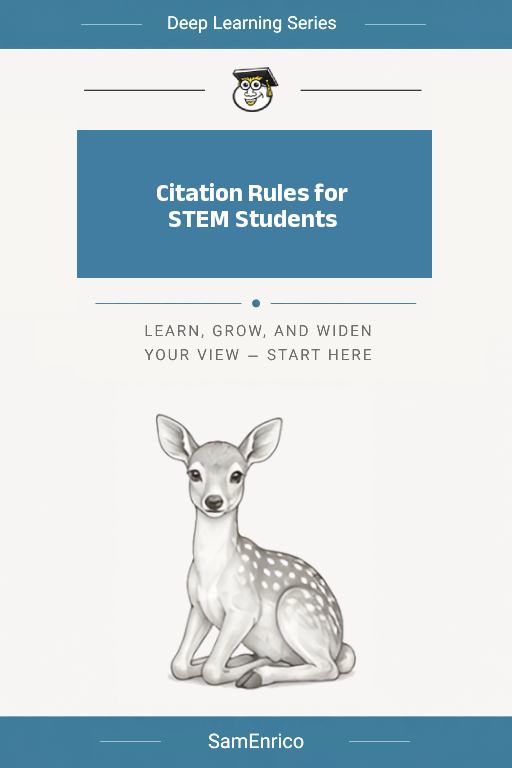
Citation Rules for STEM Students
Focus on CSE, IEEE, and numbered citation styles.
by Pugh Lexie
Focus on CSE, IEEE, and numbered citation styles. Includes citing lab manuals, data sets, and conference papers.
Formats
About this book
Free sample
Chapter 1: The Broken Experiment--–- Maria had just spent sixteen hours in the biochemistry lab. Her Western blot was beautiful—perfect bands, clean background, the kind of image that wins poster prizes. She wrote her lab report with care, citing eleven sources, including the crucial 2019 paper that established her assay protocol. She triple-checked every comma and bracket. Her professor returned the report with a grade of C-minus and a single comment scrawled in red: "Cannot locate source [7].
Citation error. See me."Maria’s story is not unusual. It happens every semester, in every STEM department, to students who work hard and intend to do the right thing. The problem is not laziness or dishonesty. The problem is a fundamental misunderstanding of what citations are for in science, technology, engineering, and mathematics.
Most students enter STEM fields believing that citation rules are arbitrary traps designed by professors to deduct points. That belief is wrong—and it is costing you grades, credibility, and eventually, professional reputation.This chapter dismantles that misconception. You will learn why STEM citation is fundamentally different from citation in English or history classes. You will understand the difference between primary and secondary sources—a distinction that can make or break a literature review. You will confront the ethics of citation errors, including why a misplaced bracket can be functionally equivalent to fabricated data in the eyes of a peer reviewer.
And you will leave with a field guide that helps you instantly recognize whether your assignment requires CSE or IEEE style.By the end of this chapter, you will never again think of citation as a hoop to jump through. You will see it for what it is: a tool for reproducibility, a chain of evidence, and a professional obligation to the researchers who come after you.The Great Misconception: Citation as Punishment Walk into any university library during finals week. Find the students who look most stressed. Ask them what they are struggling with. A shocking number will say "citations" or "formatting" or "the bibliography." Now ask them why citations matter.
Most will say something like "because the professor takes points off" or "because they want to see if you plagiarized."This…
This is the end of the free sample. Get the eBook to keep going. Buy now
Contents
- Chapter 1
- Chapter 2
- Chapter 3
- Chapter 4
- Chapter 5
- Chapter 6
- Chapter 7
- Chapter 8
- Chapter 9
- Chapter 10
- Chapter 11
- Chapter 12
Details
- Author
- Pugh Lexie
- Publisher
- SamEnrico
- Language
- English
- Genre
- Non-Fiction, STEM Guide, Technical Reference
- Released
- 2026-05-30
- Pages (approx.)
- 148
- Available as
- eBook, Audiobook

Read better in the ZLOADR app
Your eBooks on your phone or tablet. Sign in with your SamEnrico account and start reading.
More by Pugh Lexie
 Exam Anxiety Reduction WorkbookPugh Lexie$11.99
 Emotionally Immature Parents WorkbookPugh Lexie$11.99
 Reddit Forum Envy and Imposter SyndromePugh Lexie$11.99
 Assertive vs Aggressive at HomePugh Lexie$11.99
 Calf and Ankle Mobility GuidePugh Lexie$11.99
 The Maestro of Sound: Edison and the Birth of the PhonographPugh Lexie$11.99
 Computer ProgrammingPugh Lexie$11.99
 Broadcom SWOT LibraryPugh Lexie$12.99
 How to Start a Calculating Instruments (non-electronic) Business (Beginners Guide)Pugh Lexie$11.99
 Understanding Myotonia AtrophicaPugh Lexie$17.99