
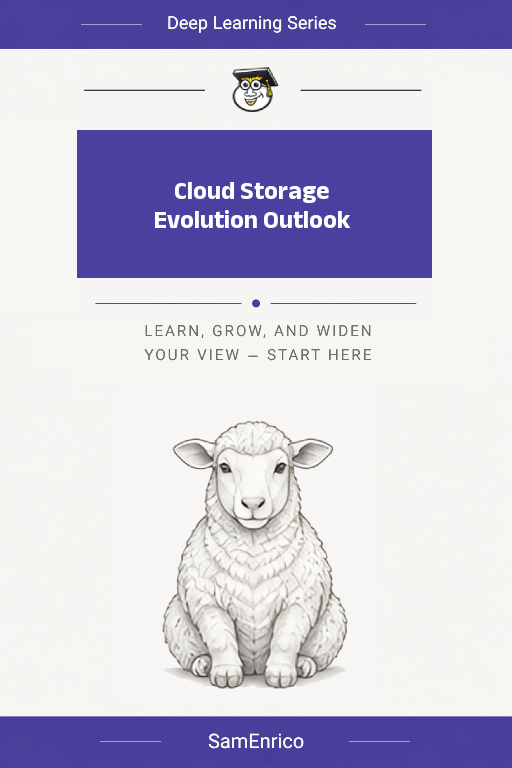
Non-FictionForecast & OutlookCloud Storage
Cloud Storage Evolution Outlook Audiobook
Forecast object storage, archival tier pricing, SS
Forecast object storage, archival tier pricing, SSD adoption, and storage class intelligence adoption through 2030.
Formats
Free sample
Chapter 1: The Gravity Trap...--–- At exactly 2:47 AM on a Tuesday, the lead site reliability engineer at a mid-sized streaming platform watched her monitoring dashboard turn from green to deep red. The company had done everything right—they had chosen a reputable cloud provider, provisioned ample block storage for their databases, and set up standard lifecycle policies. Yet when a viral moment triggered 40x their normal traffic, their storage architecture collapsed not because they ran out of capacity, but because their storage system could not fetch data fast enough from volumes spread across fragmented disks. The post-mortem revealed a painful truth: they had been optimizing for cost per gigabyte, not for data gravity. Their data had grown heavy, and the applications they needed to serve could no longer move to it quickly enough.This is not an isolated failure.
It is a warning.We are entering the most disruptive decade in the history of enterprise storage. By 2030, the world will generate nearly one zettabyte of new data every single day—a figure so large that it defies practical comprehension. To put it in perspective: one zettabyte is equivalent to streaming the entire Netflix library 50 million times over. By 2030, we will produce that much data every 24 hours. The question facing every CTO, cloud architect, and infrastructure leader is not whether your storage will scale.
It will. The question is whether your storage architecture will drown in its own weight or whether you will learn to harness data gravity before it traps you.This chapter introduces the foundational concept that will echo through every subsequent page of this book: Data Gravity. First coined by software engineer Dave Mc Crory in 2010, data gravity describes the principle that as data accumulates mass (volume, velocity, variety), it begins to attract applications, services, and even other data. Just as a planet’s gravity field grows stronger as its mass increases, a large dataset becomes increasingly difficult to move and increasingly attractive for applications to co-locate with it. The implications are profound and counterintuitive: adding more storage capacity can actually make your architecture less flexible, not more.
You do not manage storage. Storage manages you.We will explore why traditional storage paradigms—block and file systems designed for the era of relational databases and network-attached storage (NAS)—are fundamentally incompatible with the scale and velocity of modern workloads. We will quantify the coming data deluge, moving past the abstract…
This is the end of the free sample. Get the Audiobook to keep going. Buy now
About this book
Details
- Author
- Tilley Carina
- Publisher
- SamEnrico
- Language
- English
- Genre
- Non-Fiction, Forecast & Outlook, Cloud Storage
- Released
- 2026-06-01
- Pages (approx.)
- 153
- Available as
- eBook, Audiobook

Listen in the VoxFlicks app
Audiobooks and audio dramas wherever you go. Sign in with your SamEnrico account and press play.
More by Tilley Carina
 Falling Dreams And TraumaTilley Carina$11.99
 The Emotionally Exhausted Parent GuideTilley Carina$11.99
 Energy Renewal Micro BreaksTilley Carina$11.99
 Self Esteem After Betrayal GuideTilley Carina$11.99
 Frostbound: The Trolls of Dovre and the Curse of WinterTilley Carina$11.99
 The Whispering Walls of Damascus: Unlocking the Secrets of the Ottoman Medical ArchivesTilley Carina$11.99
 Understanding Hereditary Hemorrhagic TelangiectasiaTilley Carina$17.99
 How to Start a Pressing of Wearing Apparel on a Fee or Contract Basis Business (Beginners Guide)Tilley Carina$11.99
 Fintech Banking From Abroad PrimerTilley Carina$12.99
You may also like
 Hong Kong Handover 1997Dunn Johnnie$11.99
 Zumba For Postnatal Recovery CourseNeal Christian$11.99
 Zumba for BeginnersLadner Nikia$11.99
 YouTube Comment Mining GuideHumes Pandora$12.99
 Worry Box MeditationCarlin Rudy$11.99
 Workplace Stress MeditationNguyen Lynn$11.99
 Workplace Stress and Sleep RepairHawley Ivory$11.99
 Workplace Perfectionism CureDelaney Jeffry$11.99
 Workplace Injustice Anger GuideWallen Isabelle$11.99
 Work Addiction and Burnout LinkGreenwood Ester$11.99
 Women in Yoga and WellnessBeattie Galina$11.99
 Women in Stand Up ComedyChun Evangeline$11.99