
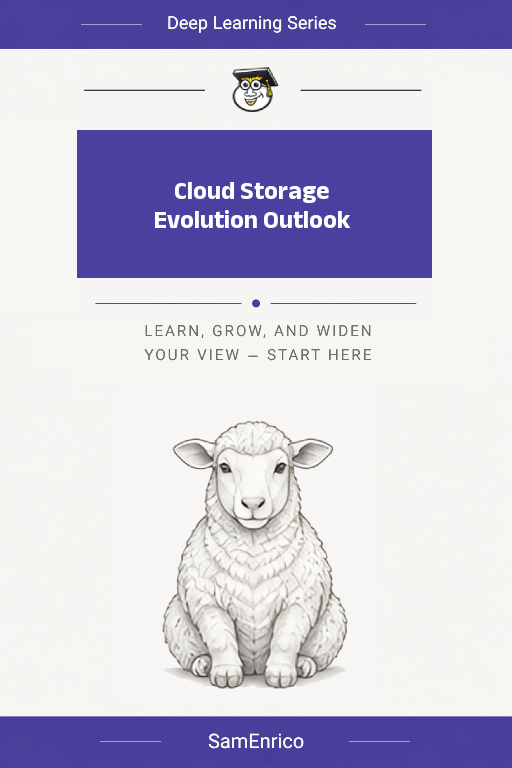
Non-FictionForecast & OutlookCloud Storage
Cloud Storage Evolution Outlook eBook
Forecast object storage, archival tier pricing, SS
Forecast object storage, archival tier pricing, SSD adoption, and storage class intelligence adoption through 2030.
Formats
Free sample
Chapter 1: The Gravity Trap...--–- At exactly 2:47 AM on a Tuesday, the lead site reliability engineer at a mid-sized streaming platform watched her monitoring dashboard turn from green to deep red. The company had done everything right—they had chosen a reputable cloud provider, provisioned ample block storage for their databases, and set up standard lifecycle policies. Yet when a viral moment triggered 40x their normal traffic, their storage architecture collapsed not because they ran out of capacity, but because their storage system could not fetch data fast enough from volumes spread across fragmented disks. The post-mortem revealed a painful truth: they had been optimizing for cost per gigabyte, not for data gravity. Their data had grown heavy, and the applications they needed to serve could no longer move to it quickly enough.This is not an isolated failure.
It is a warning.We are entering the most disruptive decade in the history of enterprise storage. By 2030, the world will generate nearly one zettabyte of new data every single day—a figure so large that it defies practical comprehension. To put it in perspective: one zettabyte is equivalent to streaming the entire Netflix library 50 million times over. By 2030, we will produce that much data every 24 hours. The question facing every CTO, cloud architect, and infrastructure leader is not whether your storage will scale.
It will. The question is whether your storage architecture will drown in its own weight or whether you will learn to harness data gravity before it traps you.This chapter introduces the foundational concept that will echo through every subsequent page of this book: Data Gravity. First coined by software engineer Dave Mc Crory in 2010, data gravity describes the principle that as data accumulates mass (volume, velocity, variety), it begins to attract applications, services, and even other data. Just as a planet’s gravity field grows stronger as its mass increases, a large dataset becomes increasingly difficult to move and increasingly attractive for applications to co-locate with it. The implications are profound and counterintuitive: adding more storage capacity can actually make your architecture less flexible, not more.
You do not manage storage. Storage manages you.We will explore why traditional storage paradigms—block and file systems designed for the era of relational databases and network-attached storage (NAS)—are fundamentally incompatible with the scale and velocity of modern workloads. We will quantify the coming data deluge, moving past the abstract "big data" chatter to concrete forecasts: 120 zettabytes generated in 2023, approaching 1,000 zettabytes by 2030. We will introduce the "copy ratio"—for every 1 gigabyte of source data created, the modern enterprise generates 20 gigabytes of replicas, backups, analytics copies, and test datasets. And we will demonstrate, through real-world case studies, why the shift from "cost per GB" to "cost per GB processed per second" is not a theoretical exercise but a survival imperative.By the end of this chapter, you will understand why 82% of enterprises have already moved to hybrid architectures, why object storage is growing at 25% annually while traditional storage stagnates, and why the next five years will force a complete re-evaluation of every storage efficiency metric you currently use.
Most importantly, you will recognize data gravity not as an abstract concept but as the single most important force shaping your storage strategy through 2030.The 120-Zettabyte Threshold: Beyond Human Scale Let us begin with a number that should terrify you: 120 zettabytes. That is the amount of data generated worldwide in 2023, according to IDC and Statista estimates. To understand what 120 ZB means, work through the following thought experiment: if you attempted to store 120 ZB on standard 12-terabyte hard disk drives, you would need 10 billion drives. Stacked vertically, each drive is roughly 1 inch thick. Ten billion inches is 157,828 miles—a column of hard drives reaching two-thirds of the way to the moon.
That was 2023. By 2030, IDC projects total data creation will approach 1,000 ZB, though some estimates from Seagate and the World Economic Forum suggest the figure could exceed 2,000 ZB when including synthetic data generated by AI systems.The growth rate itself tells a troubling story. Global data creation is doubling approximately every 18 to 24 months, following a trajectory that outpaces Moore’s Law. But unlike transistor density, which eventually hits physical limits, data creation faces no such constraints. Every sensor added to an industrial machine, every camera installed in a smart city, every user scrolling through a social media feed, and every AI model generating synthetic text and images adds to the accelerating torrent.This exponential growth has a hidden characteristic that most storage vendors do not want you to understand: storage does not scale linearly with data growth.
When you add 10 terabytes of data to a traditional file system or block storage array, you do not simply consume 10 terabytes of capacity. The metadata structures that enable you to find that data grow logarithmically at first, then superlinearly as indexes fragment. The network bandwidth required to back it up grows proportionally. The compute resources needed to scan it for compliance grow multiplicatively. The human time required to manage it grows unpredictably as operational complexity compounds.This is data gravity in its most basic form: as your data mass increases, the energy required to move it, manage it, or change its storage class increases nonlinearly.
Many organizations discover this only when they attempt a cloud migration, a storage tier transition, or a vendor change—and find that the projected six-month project stretches into three years.The Copy Ratio Explosion: Where Your Capacity Really Goes One of the most misunderstood dynamics in enterprise storage is the copy ratio—the multiplier by which source data expands into total stored bytes. In the era of tape backups and simple disaster recovery, a copy ratio of 2:1 or 3:1 was typical. You had production data, a backup, and perhaps a replica at a remote site. Today, the copy ratio has exploded.Based on analysis of enterprise storage environments by Net App, Cohesity, and Datadog, the average enterprise copy ratio in 2023 was between 10:1 and 12:1. By 2026, it will reach 15:1.
By 2030, the forecast presented throughout this book suggests a copy ratio of 20:1 or higher. Where does all that capacity go? Consider the lifecycle of a single customer transaction record in a modern e-commerce platform:Production source – The original write to the primary database (1 copy)Secondary index – The same data written to a search index like Elasticsearch (2nd copy)Analytics pipeline – Ingested into a data lake or warehouse (3rd copy)Backup – Daily full backup retained for 30 days (4th–34th copies depending on incrementals)Disaster recovery – Replicated to a secondary region (35th–36th copies)Test/development – Anonymized copy for engineering teams (37th–45th copies)Machine learning training – Feature store copy (46th copy)Compliance archive – Immutable copy for regulatory retention (47th copy)Audit log – Every access to the record generates log entries (multiplier effect)This explosion has a direct mathematical impact on storage economics. If your source data is 1 petabyte and your copy ratio is 20:1, you are paying for 20 petabytes of effective capacity. But the deeper problem is not cost—it is informational entropy.
As copies proliferate across different storage systems, in different formats, with different lifecycle policies, the ability to enforce consistent data governance, retention, and deletion collapses. Most enterprises have no accurate inventory of…
This is the end of the free sample. Get the eBook to keep going. Buy now
About this book
Details
- Author
- Tilley Carina
- Publisher
- SamEnrico
- Language
- English
- Genre
- Non-Fiction, Forecast & Outlook, Cloud Storage
- Released
- 2026-06-01
- Pages (approx.)
- 153
- Available as
- eBook, Audiobook

Read better in the ZLOADR app
Your eBooks on your phone or tablet. Sign in with your SamEnrico account and start reading.
More by Tilley Carina
 Falling Dreams And TraumaTilley Carina$11.99
 The Emotionally Exhausted Parent GuideTilley Carina$11.99
 Energy Renewal Micro BreaksTilley Carina$11.99
 Self Esteem After Betrayal GuideTilley Carina$11.99
 Frostbound: The Trolls of Dovre and the Curse of WinterTilley Carina$11.99
 The Whispering Walls of Damascus: Unlocking the Secrets of the Ottoman Medical ArchivesTilley Carina$11.99
 Understanding Hereditary Hemorrhagic TelangiectasiaTilley Carina$17.99
 How to Start a Pressing of Wearing Apparel on a Fee or Contract Basis Business (Beginners Guide)Tilley Carina$11.99
 Fintech Banking From Abroad PrimerTilley Carina$12.99
You may also like
 Hong Kong Handover 1997Dunn Johnnie$11.99
 Zumba For Postnatal Recovery CourseNeal Christian$11.99
 Zumba for BeginnersLadner Nikia$11.99
 YouTube Comment Mining GuideHumes Pandora$12.99
 Worry Box MeditationCarlin Rudy$11.99
 Workplace Stress MeditationNguyen Lynn$11.99
 Workplace Stress and Sleep RepairHawley Ivory$11.99
 Workplace Perfectionism CureDelaney Jeffry$11.99
 Workplace Injustice Anger GuideWallen Isabelle$11.99
 Work Addiction and Burnout LinkGreenwood Ester$11.99
 Women in Yoga and WellnessBeattie Galina$11.99
 Women in Stand Up ComedyChun Evangeline$11.99