
Non-FictionForecast & OutlookCloud DB
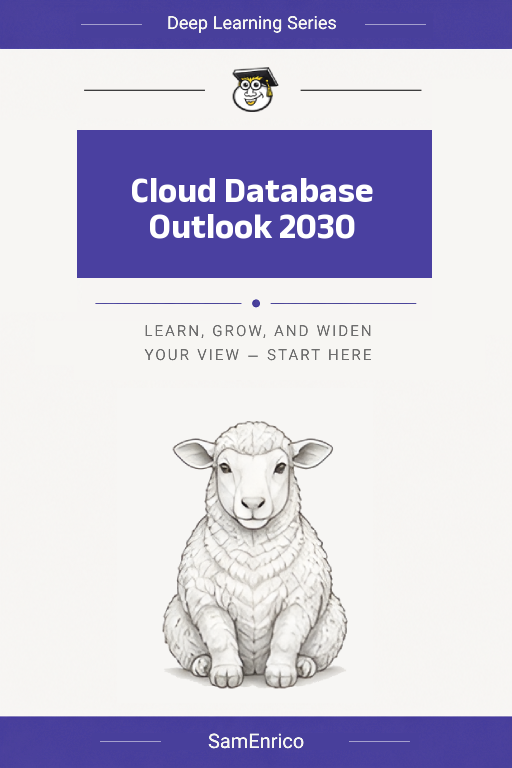
Cloud Database Outlook 2030 eBook
Project managed MySQL, PostgreSQL, NoSQL, and clou
Project managed MySQL, PostgreSQL, NoSQL, and cloud-native database adoption vs. on-premises through the decade.
Formats
Free sample
Chapter 1: The Fragility of Monoliths...–- In the early 2020s, the global economy ran on a handful of database engines that were never designed for the world they came to inhabit. Large enterprises—banks, insurers, retailers, logistics firms, government agencies—built their digital cores on monolithic, on-premise relational database management systems (RDBMS). The market was dominated by three names: Oracle, IBM DB2, and Microsoft SQL Server. These systems were engineering marvels of their era, offering rock-solid ACID transactions, sophisticated query optimizers, and robust security models. But they shared a fatal architectural flaw: they were designed to scale up, not out.When a database reached the limits of a single server—running out of CPU cycles, memory bandwidth, or I/O throughput—the only solution was to buy a bigger server.
More powerful processors. More RAM. Faster storage arrays. This approach, known as vertical scaling, worked reasonably well when data volumes grew at single-digit percentages annually and when application concurrency remained predictable. But the 2010s and early 2020s brought a different kind of growth: exponential, unpredictable, and global.The rise of web-scale applications at companies like Google, Amazon, Facebook, and Netflix changed everything.
These companies needed databases that could distribute data across hundreds or thousands of commodity servers, handle millions of concurrent users, and remain available even when entire data centers failed. Traditional RDBMS could not deliver this without astronomical cost and operational complexity. The result was a fundamental rupture in the database industry.The Cambrian Explosion The tension between the rigid scalability limits of monolithic RDBMS and the elastic demands of web-scale applications sparked what industry analysts later called the "Cambrian explosion" of specialized databases. Starting around 2010 and accelerating through 2020, dozens of new database engines emerged, each optimized for a specific access pattern or data model.Document stores like Mongo DB and Couch DB offered flexible schemas and JSON-native storage, appealing to developers who tired of rigid relational schemas. Key-value stores like Redis and Dynamo DB provided sub-millisecond lookups for caching, session management, and real-time bidding.
Wide-column stores like Cassandra and HBase were designed for write-heavy, time-series telemetry across hundreds of nodes. Time-series databases like Influx DB and Timescale DB added specialized compression and downsampling for Io T and monitoring data. Graph databases like Neo4j and Amazon Neptune optimized for traversing relationships in social networks and fraud detection networks.Each of these engines solved a specific problem brilliantly. Each also introduced a new problem: fragmentation.The Polyglot Persistence Trap By 2022, a typical digital-native company was running eight to twelve different database engines in production. A retail company might use Postgre SQL for its product catalog, Redis for shopping cart sessions, Mongo DB for user profiles, Cassandra for clickstream analytics, Elasticsearch for site search, and Neo4j for recommendation engines.
Each database had its own API, backup procedure, scaling logic, security model, and operational tooling. Each required specialized skills. Each added a new point of failure.This approach became known as polyglot persistence—a term borrowed from polyglot programming (using multiple programming languages in a single application). In theory, polyglot persistence offered the best tool for each job. In practice, it created immense operational overhead, skill silos, and vendor lock-in at the engine level.
The very agility that companies sought by adopting specialized databases was eroded by the complexity of managing them.Consider the operational reality of polyglot persistence. A single application might need to join data across a document store and a relational database—an operation that required application-side joins, data duplication, or complex ETL pipelines. Backups for eight different databases required eight different procedures, each with its own recovery time objectives. Security patching meant tracking CVEs across multiple codebases and vendors. Failover testing required understanding the high-availability semantics of each engine.
Staff training was a nightmare: a team of five DBAs could not realistically master a dozen different database systems.The industry had solved the scale problem but created a complexity crisis.The Open Source Tipping Point Amid this fragmentation, a quieter but more consequential shift was underway. Open-source databases—led by Postgre SQL, My SQL, and Mongo DB—were steadily displacing commercial RDBMS in new application deployments. By 2025, open-source databases powered over 70% of new application deployments, signaling the effective death of commercial RDBMS dominance for net-new workloads.The reasons were straightforward. Open-source databases eliminated licensing costs, which at Oracle or Microsoft could reach millions of dollars annually for large deployments. They offered transparent codebases, allowing organizations to audit security and understand behavior.
They benefited from massive community ecosystems, with thousands of contributors fixing bugs and adding features. And they ran on commodity hardware, breaking the hardware lock-in that proprietary vendors often enforced.But the open-source victory was pyrrhic. Enterprises had escaped the prison of monolithic RDBMS only to find themselves wandering a maze of specialized engines. The industry needed a new direction: consolidation around a small number of powerful, cloud-native platforms that could handle multiple data models without fragmentation.The Unspoken Truth About Monoliths Before we explore the solution, we must confront an uncomfortable truth. Monolithic RDBMS were not without virtues.
They offered ACID transactions, which remain the gold standard for data integrity. They provided sophisticated query optimizers that could rewrite poorly written queries into efficient execution plans. They supported declarative constraints (foreign keys, check constraints) that preserved data quality. And they offered mature tooling for backup, recovery, monitoring, and auditing.The problem was not that monolithic RDBMS were bad. The problem was that they were designed for a world that no longer exists—a world of predictable growth, stable schemas, and on-premise infrastructure controlled entirely by the enterprise.
The web-scale, cloud-native world demanded horizontal scalability, elastic capacity, and global distribution. Monolithic RDBMS could not deliver these without heroic engineering efforts that most organizations could not afford.The industry's response—polyglot persistence—was a necessary reaction to the limitations of the old guard. But it went too far. In solving the scale problem, it created a complexity problem that now demands its own solution.What This Book Will Teach You The remainder of this book provides a strategic roadmap for navigating the 2025-2030 database landscape. We will cover:Chapter 2: The Economics of Data – A detailed financial framework comparing on-premise CAPEX to cloud OPEX, including the specific workloads where each model wins.Part II (Chapters 3-5): The Great Migration – How to choose between SQL and No SQL, when to adopt distributed SQL, and how autonomous databases are transforming the DBA role.Part III (Chapters 6-8): The Engine Landscape – Deep dives into Postgre SQL's rise as the "Linux of databases," the enduring use cases for My SQL and No SQL, and why DBaa S becomes the default.Part IV (Chapters 9-10): Strategic Integration – Zero-ETL, data fabrics, and databases as the memory layer for generative AI.Part V (Chapters 11-12): Future & Governance – Hybrid cloud, sovereignty, edge computing, and the unified data platforms that will dominate by 2030.A Note on the 2030 Outlook This book is not a prediction.
It is a projection based on observable trends in 2024-2026, synthesized from market research, analyst reports, and real-world adoption patterns. The database industry moves slowly—legacy systems take years to replace, and operational practices change incrementally. The trends we identify are already underway; we…
This is the end of the free sample. Get the eBook to keep going. Buy now
About this book
Details
- Author
- Trammell Sherryl
- Publisher
- SamEnrico
- Language
- English
- Genre
- Non-Fiction, Forecast & Outlook, Cloud DB
- Released
- 2026-05-30
- Pages (approx.)
- 140
- Available as
- eBook, Audiobook

Read better in the ZLOADR app
Your eBooks on your phone or tablet. Sign in with your SamEnrico account and start reading.
More by Trammell Sherryl
 Parenting Stress And Adult ChildrenTrammell Sherryl$11.99
 Naked Dreams Trauma GuideTrammell Sherryl$11.99
 Cognitive Energy ProtectionTrammell Sherryl$11.99
 Attachment Styles Self Esteem GuideTrammell Sherryl$11.99
 Operation Black Tide: The Fall of the Sinaloa Cartel's Golden TriangleTrammell Sherryl$11.99
 Seams of Power: The Invisible Threads of the Silk RoadTrammell Sherryl$11.99
 International Founder Banking ManualTrammell Sherryl$12.99
 Understanding Hereditary HyperuricemiaTrammell Sherryl$17.99
 How to Start a Pressing of Base Metal Business (Beginners Guide)Trammell Sherryl$11.99
 Bread BakerTrammell Sherryl$11.99
You may also like
 Hong Kong Handover 1997Dunn Johnnie$11.99
 Zumba For Postnatal Recovery CourseNeal Christian$11.99
 Zumba for BeginnersLadner Nikia$11.99
 YouTube Comment Mining GuideHumes Pandora$12.99
 Worry Box MeditationCarlin Rudy$11.99
 Workplace Stress MeditationNguyen Lynn$11.99
 Workplace Stress and Sleep RepairHawley Ivory$11.99
 Workplace Perfectionism CureDelaney Jeffry$11.99
 Workplace Injustice Anger GuideWallen Isabelle$11.99
 Work Addiction and Burnout LinkGreenwood Ester$11.99
 Women in Yoga and WellnessBeattie Galina$11.99
 Women in Stand Up ComedyChun Evangeline$11.99