
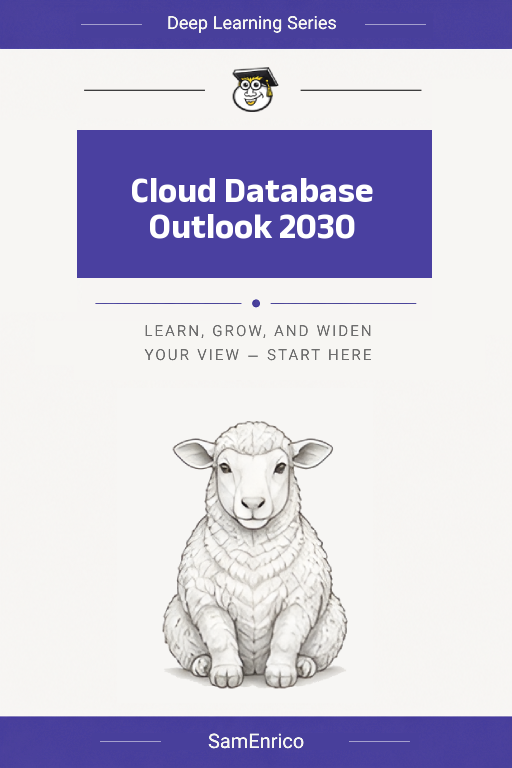
Non-FictionForecast & OutlookCloud DB
Cloud Database Outlook 2030 Audiobook
Project managed MySQL, PostgreSQL, NoSQL, and clou
Project managed MySQL, PostgreSQL, NoSQL, and cloud-native database adoption vs. on-premises through the decade.
Formats
Free sample
Chapter 1: The Fragility of Monoliths...–- In the early 2020s, the global economy ran on a handful of database engines that were never designed for the world they came to inhabit. Large enterprises—banks, insurers, retailers, logistics firms, government agencies—built their digital cores on monolithic, on-premise relational database management systems (RDBMS). The market was dominated by three names: Oracle, IBM DB2, and Microsoft SQL Server. These systems were engineering marvels of their era, offering rock-solid ACID transactions, sophisticated query optimizers, and robust security models. But they shared a fatal architectural flaw: they were designed to scale up, not out.When a database reached the limits of a single server—running out of CPU cycles, memory bandwidth, or I/O throughput—the only solution was to buy a bigger server.
More powerful processors. More RAM. Faster storage arrays. This approach, known as vertical scaling, worked reasonably well when data volumes grew at single-digit percentages annually and when application concurrency remained predictable. But the 2010s and early 2020s brought a different kind of growth: exponential, unpredictable, and global.The rise of web-scale applications at companies like Google, Amazon, Facebook, and Netflix changed everything.
These companies needed databases that could distribute data across hundreds or thousands of commodity servers, handle millions of concurrent users, and remain available even when entire data centers failed. Traditional RDBMS could not deliver this without astronomical cost and operational complexity. The result was a fundamental rupture in the database industry.The Cambrian Explosion The tension between the rigid scalability limits of monolithic RDBMS and the elastic demands of web-scale applications sparked what industry analysts later called the "Cambrian explosion" of specialized databases. Starting around 2010 and accelerating through 2020, dozens of new database engines emerged, each optimized for a specific access pattern or data model.Document stores like Mongo DB and Couch DB offered flexible schemas and JSON-native storage, appealing to developers who tired of rigid relational schemas. Key-value stores like Redis and Dynamo DB provided sub-millisecond lookups for caching, session management, and real-time bidding.
Wide-column stores like Cassandra and HBase were designed for write-heavy, time-series telemetry across hundreds of nodes. Time-series databases like Influx DB and Timescale DB added specialized compression and downsampling for Io T and monitoring data. Graph databases like Neo4j and Amazon Neptune optimized for traversing relationships in social networks and fraud detection networks.Each of these engines solved a specific problem brilliantly. Each also introduced…
This is the end of the free sample. Get the Audiobook to keep going. Buy now
About this book
Details
- Author
- Trammell Sherryl
- Publisher
- SamEnrico
- Language
- English
- Genre
- Non-Fiction, Forecast & Outlook, Cloud DB
- Released
- 2026-05-30
- Pages (approx.)
- 140
- Available as
- eBook, Audiobook

Listen in the VoxFlicks app
Audiobooks and audio dramas wherever you go. Sign in with your SamEnrico account and press play.
More by Trammell Sherryl
 Parenting Stress And Adult ChildrenTrammell Sherryl$11.99
 Naked Dreams Trauma GuideTrammell Sherryl$11.99
 Cognitive Energy ProtectionTrammell Sherryl$11.99
 Attachment Styles Self Esteem GuideTrammell Sherryl$11.99
 Operation Black Tide: The Fall of the Sinaloa Cartel's Golden TriangleTrammell Sherryl$11.99
 Seams of Power: The Invisible Threads of the Silk RoadTrammell Sherryl$11.99
 International Founder Banking ManualTrammell Sherryl$12.99
 Understanding Hereditary HyperuricemiaTrammell Sherryl$17.99
 How to Start a Pressing of Base Metal Business (Beginners Guide)Trammell Sherryl$11.99
 Bread BakerTrammell Sherryl$11.99
You may also like
 Hong Kong Handover 1997Dunn Johnnie$11.99
 Zumba For Postnatal Recovery CourseNeal Christian$11.99
 Zumba for BeginnersLadner Nikia$11.99
 YouTube Comment Mining GuideHumes Pandora$12.99
 Worry Box MeditationCarlin Rudy$11.99
 Workplace Stress MeditationNguyen Lynn$11.99
 Workplace Stress and Sleep RepairHawley Ivory$11.99
 Workplace Perfectionism CureDelaney Jeffry$11.99
 Workplace Injustice Anger GuideWallen Isabelle$11.99
 Work Addiction and Burnout LinkGreenwood Ester$11.99
 Women in Yoga and WellnessBeattie Galina$11.99
 Women in Stand Up ComedyChun Evangeline$11.99