
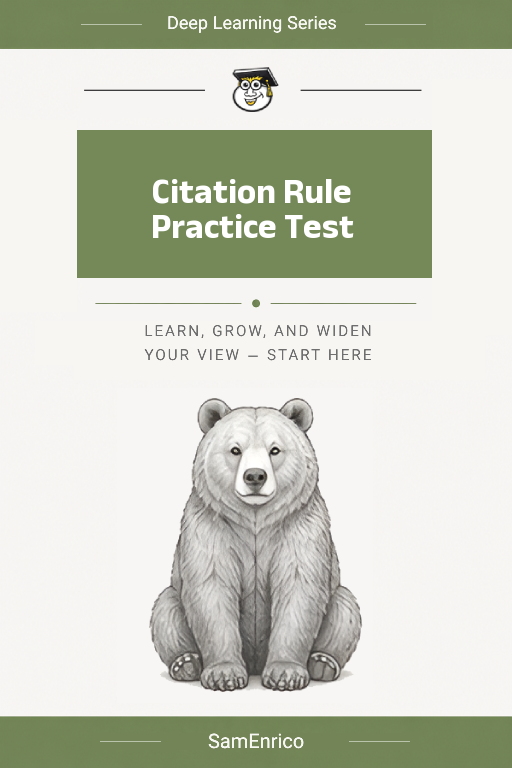
Non-FictionSelf-AssessmentPractice Test
Citation Rule Practice Test eBook
Test your citation knowledge with realistic scenar
Test your citation knowledge with realistic scenarios. Self-assessment with detailed answer explanations.
Formats
Free sample
Chapter 1: The Citation Trap--Every student has felt it. That sinking moment when a paper comes back, and in the margin, next to a sentence you spent twenty minutes crafting, is a single word in red ink: “Citation?” Or worse: “Source?” Or the one that stings most because it feels like an accusation of laziness or dishonesty: “Plagiarism?”You read the sentence again. You know you didn’t copy it. You wrote those words yourself. You even paraphrased the idea from a book you read last week.
So why is your professor treating you like you tried to cheat?This is the Citation Trap.The Citation Trap is not about ignorance. It is not about laziness. It is not even about plagiarism in the ethical sense—the deliberate act of stealing someone else’s work and calling it your own. The Citation Trap is something far more common, far more frustrating, and far more misunderstood. It is the gap between what you think needs a citation and what your professor expects to see cited.
It is the space where “common knowledge” becomes a battlefield. It is where otherwise excellent students lose points, lose confidence, and sometimes even lose academic standing, all because they misjudged when to give credit.This book exists to pull you out of that trap. And Chapter 1 is where we set the snare in plain view so you can learn to avoid it forever.Let us start with a story. Not a hypothetical textbook example, but a real scenario drawn from hundreds of actual student papers. The names have been changed, but the citation errors are, unfortunately, timeless.The Scenario: A Student Paper That Did Everything Right (Except One Thing)Maria was a junior majoring in political science.
She had a 3.7 GPA. She had never been accused of academic dishonesty. For her final paper in a course on the American Revolution, she chose to write about the economic causes of the war. She read eight books, took meticulous notes, and wrote a twelve-page paper that her roommate called “the best thing you’ve ever written.”Here is one paragraph from Maria’s paper:*“The American Revolution began in 1775. For decades leading up to the war, the British government imposed a series of taxes on the colonies, including the Stamp Act of 1765 and the Townshend Acts of 1767.
These taxes were deeply unpopular. Many colonists believed they should not be taxed without representation in Parliament. The economic causes of the Revolution were primarily debt-related. After the French and Indian War, Britain needed to raise revenue to pay off its war debts, so it looked to the American colonies as a source of income.”*Maria submitted the paper. She received a B-minus.
And in the margin next to that paragraph, her professor had written: “Where is your citation for the claim about economic causes being primarily debt-related? This is not common knowledge at this level.”Maria was furious. “But I wrote that sentence myself,” she told her friend. “I didn’t copy it from anywhere. I read it in three different books and then put it in my own words.
That’s allowed, right?”This is the Citation Trap.Let us analyze what Maria did right and what she did wrong.What Maria Did Right First, Maria read extensively. She did not rely on a single source. She consulted eight books, which is admirable for an undergraduate paper.Second, Maria paraphrased. She did not copy sentences verbatim. She took ideas from her reading and expressed them in her own language.
This is exactly what professors want students to do—to synthesize information and restate it in a way that demonstrates understanding.Third, Maria did not intentionally plagiarize. She had no malicious intent. She was not trying to pass off someone else’s work as her own.What Maria Did Wrong Maria failed to cite a specific claim that her professor considered non-obvious. The statement “The economic causes of the Revolution were primarily debt-related” is not a universal fact. It is an interpretation.
It is an argument that historians have made, supported by evidence, and debated. By presenting it as if it were a simple fact—on par with “The American Revolution began in 1775”—Maria inadvertently misled her reader. She made it look like she was offering her own original interpretation when, in fact, she was borrowing the interpretation of others.The professor’s comment—“This is not common knowledge at this level”—is the key. At a high school level, maybe the economic causes of the Revolution are taught as fact. At a university level, they are understood as scholarly arguments that require attribution.This is why the Citation Trap is so dangerous.
It is not about right and wrong in a moral sense. It is about context, expectation, and the unspoken rules of academic discourse.The Three Purposes of Citation (Why You Cite, Even When You Paraphrase)Before we go any further, we need to establish the foundation upon which this entire book rests. Citation is not a punishment. It is not a bureaucratic hurdle designed to make your life harder. Citation serves three essential purposes in academic writing, and understanding these purposes will transform how you think about every citation decision you make.Purpose One: Avoiding Plagiarism (The Legal Function)This is the one everyone knows.
When you use someone else’s words, ideas, data, or creative work without giving them credit, you are plagiarizing. Plagiarism can get you failed from a course, suspended from a university, or even expelled. In professional contexts, plagiarism can end careers.But here is what most people misunderstand: plagiarism does not require intention. You can plagiarize accidentally. You can plagiarize by forgetting to add a citation.
You can plagiarize by paraphrasing too closely. You can even plagiarize by citing the wrong source. The academic definition of plagiarism focuses on the act, not the intent.This is why “I didn’t mean to” is never a defense. Your professor does not read your mind. They read your paper.
If the paper fails to credit a source, that is a citation error—and if the error is significant enough, it is plagiarism, regardless of whether you meant to do it.Purpose Two: Establishing Scholarly Credibility (The Rhetorical Function)This purpose is subtler but equally important. When you cite sources appropriately, you are doing more than avoiding punishment. You are building your own credibility as a writer and researcher.Think about it from a reader’s perspective. If you read an article that makes a bold claim—“Social media use causes depression in teenagers”—and the author provides no citation, what do you think? You might think the author is guessing.
You might think the author is presenting a personal opinion. You certainly would not trust the claim as authoritative.Now imagine the same claim followed by a citation to a large-scale longitudinal study published in a peer-reviewed journal. Suddenly, the claim carries weight. The author has done their homework. The author can point to evidence.
The author has earned your trust.Citations are the currency of academic credibility. Every time you cite a source, you are saying to your reader: “I am not making this up.…
This is the end of the free sample. Get the eBook to keep going. Buy now
About this book
Details
- Author
- Tipton Annamaria
- Publisher
- SamEnrico
- Language
- English
- Genre
- Non-Fiction, Self-Assessment, Practice Test
- Released
- 2026-06-01
- Pages (approx.)
- 140
- Available as
- eBook, Audiobook

Read better in the ZLOADR app
Your eBooks on your phone or tablet. Sign in with your SamEnrico account and start reading.
More by Tipton Annamaria
 Attempt Survivor Aftermath GuideTipton Annamaria$11.99
 Stretching for Tennis GuideTipton Annamaria$11.99
 TWIN Identity Differentiation GuideTipton Annamaria$11.99
 Assertive Communication for MusiciansTipton Annamaria$11.99
 The Music Industry Instagram TrapTipton Annamaria$11.99
 The Siege of Beslan: 53 Hours of Terror in a Russian SchoolTipton Annamaria$11.99
 Drive Thru OperatorTipton Annamaria$11.99
 Customer Success Promotion KitTipton Annamaria$12.99
 Understanding Nanism Due to Growth Hormone Isolated Deficiency With X-linked HypogammaglobulinemiaTipton Annamaria$17.99
 How to Start a Calculating Machine Business (Beginners Guide)Tipton Annamaria$11.99
You may also like
 Hong Kong Handover 1997Dunn Johnnie$11.99
 Zumba For Postnatal Recovery CourseNeal Christian$11.99
 Zumba for BeginnersLadner Nikia$11.99
 YouTube Comment Mining GuideHumes Pandora$12.99
 Worry Box MeditationCarlin Rudy$11.99
 Workplace Stress MeditationNguyen Lynn$11.99
 Workplace Stress and Sleep RepairHawley Ivory$11.99
 Workplace Perfectionism CureDelaney Jeffry$11.99
 Workplace Injustice Anger GuideWallen Isabelle$11.99
 Work Addiction and Burnout LinkGreenwood Ester$11.99
 Women in Yoga and WellnessBeattie Galina$11.99
 Women in Stand Up ComedyChun Evangeline$11.99