
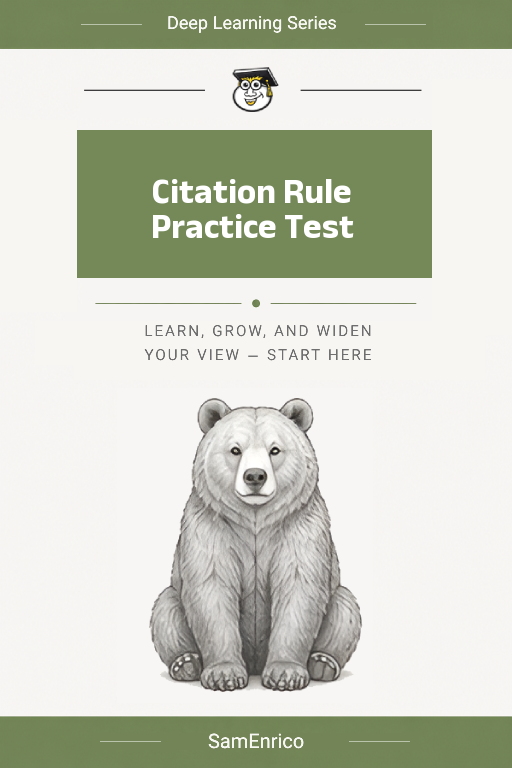
Non-FictionSelf-AssessmentPractice Test
Citation Rule Practice Test Audiobook
Test your citation knowledge with realistic scenar
Test your citation knowledge with realistic scenarios. Self-assessment with detailed answer explanations.
Formats
Free sample
Chapter 1: The Citation Trap--Every student has felt it. That sinking moment when a paper comes back, and in the margin, next to a sentence you spent twenty minutes crafting, is a single word in red ink: “Citation?” Or worse: “Source?” Or the one that stings most because it feels like an accusation of laziness or dishonesty: “Plagiarism?”You read the sentence again. You know you didn’t copy it. You wrote those words yourself. You even paraphrased the idea from a book you read last week.
So why is your professor treating you like you tried to cheat?This is the Citation Trap.The Citation Trap is not about ignorance. It is not about laziness. It is not even about plagiarism in the ethical sense—the deliberate act of stealing someone else’s work and calling it your own. The Citation Trap is something far more common, far more frustrating, and far more misunderstood. It is the gap between what you think needs a citation and what your professor expects to see cited.
It is the space where “common knowledge” becomes a battlefield. It is where otherwise excellent students lose points, lose confidence, and sometimes even lose academic standing, all because they misjudged when to give credit.This book exists to pull you out of that trap. And Chapter 1 is where we set the snare in plain view so you can learn to avoid it forever.Let us start with a story. Not a hypothetical textbook example, but a real scenario drawn from hundreds of actual student papers. The names have been changed, but the citation errors are, unfortunately, timeless.The Scenario: A Student Paper That Did Everything Right (Except One Thing)Maria was a junior majoring in political science.
She had a 3.7 GPA. She had never been accused of academic dishonesty. For her final paper in a course on the American Revolution, she chose to write about the economic causes of the war. She read eight books, took meticulous notes, and wrote a twelve-page paper that her roommate called “the best thing you’ve ever written.”Here is one paragraph from Maria’s paper:*“The American Revolution began in 1775. For decades leading up to the war, the British government imposed a series of taxes on the colonies, including the Stamp Act of 1765 and the Townshend Acts of 1767.
These taxes were deeply unpopular. Many colonists believed they should not be taxed without representation in Parliament. The economic causes…
This is the end of the free sample. Get the Audiobook to keep going. Buy now
About this book
Details
- Author
- Tipton Annamaria
- Publisher
- SamEnrico
- Language
- English
- Genre
- Non-Fiction, Self-Assessment, Practice Test
- Released
- 2026-06-01
- Pages (approx.)
- 140
- Available as
- eBook, Audiobook

Listen in the VoxFlicks app
Audiobooks and audio dramas wherever you go. Sign in with your SamEnrico account and press play.
More by Tipton Annamaria
 Attempt Survivor Aftermath GuideTipton Annamaria$11.99
 Stretching for Tennis GuideTipton Annamaria$11.99
 TWIN Identity Differentiation GuideTipton Annamaria$11.99
 Assertive Communication for MusiciansTipton Annamaria$11.99
 The Music Industry Instagram TrapTipton Annamaria$11.99
 The Siege of Beslan: 53 Hours of Terror in a Russian SchoolTipton Annamaria$11.99
 Drive Thru OperatorTipton Annamaria$11.99
 Customer Success Promotion KitTipton Annamaria$12.99
 Understanding Nanism Due to Growth Hormone Isolated Deficiency With X-linked HypogammaglobulinemiaTipton Annamaria$17.99
 How to Start a Calculating Machine Business (Beginners Guide)Tipton Annamaria$11.99
You may also like
 Hong Kong Handover 1997Dunn Johnnie$11.99
 Zumba For Postnatal Recovery CourseNeal Christian$11.99
 Zumba for BeginnersLadner Nikia$11.99
 YouTube Comment Mining GuideHumes Pandora$12.99
 Worry Box MeditationCarlin Rudy$11.99
 Workplace Stress MeditationNguyen Lynn$11.99
 Workplace Stress and Sleep RepairHawley Ivory$11.99
 Workplace Perfectionism CureDelaney Jeffry$11.99
 Workplace Injustice Anger GuideWallen Isabelle$11.99
 Work Addiction and Burnout LinkGreenwood Ester$11.99
 Women in Yoga and WellnessBeattie Galina$11.99
 Women in Stand Up ComedyChun Evangeline$11.99