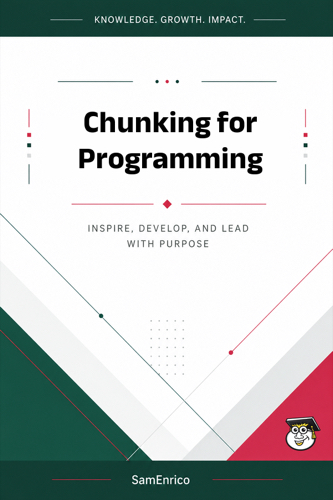
Chunking for Programming eBook
Remember code syntax and algorithms by grouping co
Remember code syntax and algorithms by grouping commands into functional blocks.
Formats
Free sample
Chapter 1: The 17-Token Trap--–- It is 11:47 PM on a Tuesday. You are staring at a function you wrote yourself three weeks ago. The code is familiar—you recognize every keyword, every variable name, every semicolon. You understand each line in isolation. But together, these fifteen lines form a brick wall.
You close the file. You open Twitter. And somewhere in the back of your mind, a small voice whispers: Maybe I am just not cut out for this.That voice is wrong. But to understand why, you must first understand something that most programming books never mention: the severe, unchangeable, biological limit of your working memory.The Magical Number That Ruins Your Focus In 1956, a cognitive psychologist named George Miller published one of the most cited papers in psychology: "The Magical Number Seven, Plus or Minus Two." His finding was simple and devastating. The average human brain can hold approximately seven objects—plus or minus two—in conscious working memory at any given moment.
That is it. Five to nine items. That is the entire capacity of your mental scratchpad.Here is what that means for programmers. Look at this line of code:for (int i = 0; i < 10; i++)Count the tokens. I will count them with you: for (1), ( (2), int (3), i (4), = (5), 0 (6), ; (7), i (8), < (9), 10 (10), ; (11), i++ (12), ) (13), { (14).
Fourteen tokens. Fourteen separate items your brain must track just to understand what the loop is, before you have even written what the loop does.You have not even started the loop body yet. Already you are holding fourteen items. Your maximum capacity is nine. Something has to drop.And something always does.The Three Types of Failure (And Why You Have Been Blaming the Wrong One)When you cannot understand a piece of code, there are exactly three possible explanations.
Most programmers assume they are experiencing the first two. Almost always, they are experiencing the third.Type One: Lack of Information This is when you do not know a command exists. You have never seen itertools.groupby in Python. You do not know that Java Script has a ?. optional chaining operator.
The solution is trivial: Google it. Search, read, learn, move on. This is not a cognitive failure. It is a documentation gap.Type Two: Lack of Knowledge This is when you know a command exists but you have not yet understood the concept behind it. You know what a closure is called, but you cannot explain how it captures its environment.
You know what monad means, but you could not implement bind. The solution is study: read a book, watch a lecture, write practice code. This takes time but is entirely solvable.Type Three: Lack of Processing Power This is the silent killer. You know every keyword. You understand every concept.
You have all the information and all the knowledge. And you still cannot hold the code in your head. Why? Because there are too many moving parts. Your brain is a CPU, not a hard drive.
You can have infinite storage (long-term memory) but if your working memory is overloaded, you freeze. The solution is not more information. The solution is not more knowledge. The solution is chunking—the art of grouping individual items into single mental units.Here is the painful truth that most programmers never hear: You are not stupid. Your working memory is just full.The Processor Analogy: Why RAM Is Not Enough Let me give you a metaphor that will stick with you for the rest of your career.
Imagine your brain as a computer with three components.Sensory memory is the input buffer. It holds whatever your eyes just saw, your ears just heard—for about 200 to 500 milliseconds. Long enough to decide whether to pay attention. When you glance at a screen, you are using sensory memory.Short-term memory is the RAM. It holds whatever you are currently thinking about.
But RAM has two brutal limitations. First, it is tiny: about seven items. Second, items decay in seconds unless you refresh them. That is why you forget a phone number the moment you stop repeating it.Long-term memory is the hard drive. It is enormous.
You can store decades of experience, thousands of syntax rules, hundreds of algorithms. But here is the catch: accessing long-term memory is slow. It takes conscious effort to retrieve something from the hard drive into RAM.Working memory is the CPU. It is the active processor that manipulates whatever is currently in RAM. And the CPU has a hard limit: it can only operate on about seven items at once.Here is the insight that changes everything.
You can have infinite hard drive space. You can have memorized every function in the standard library. You can have read every book on algorithms. But if your working memory is overwhelmed by too many RAM items, you will freeze just as badly as a beginner.The problem is not your hard drive. The problem is not your RAM.
The problem is that you are trying to load too many items into the CPU at once.The 17-Token Trap: A Walkthrough Let me show you exactly how this plays out with real code. Consider this three-line function:text Copy Downloaddef calculate_average(numbers): total = sum(numbers) return total / len(numbers)You have probably written this function a hundred times. It feels trivial. But watch what happens in your brain when you read it for the first time.First, your eyes hit def. One token.
Then calculate_average. Two. The open parenthesis, three. numbers, four. The close parenthesis, five.
The colon, six. Already you are holding six items before the function body begins.Then the next line: total = sum(numbers). That is total (seven), = (eight), sum (nine), open parenthesis (ten), numbers (eleven), close parenthesis (twelve). You are now at twelve items. Your max is nine.
Something has already been pushed out.Then the return line: return total / len(numbers). You add return (thirteen), total (fourteen), / (fifteen), len (sixteen), numbers (seventeen). Seventeen tokens. You are trying to hold seventeen items in a workspace designed for seven.Of course you lose track. Of course you get confused.
Of course you feel stupid. You are not stupid. You are asking your brain to do the cognitive equivalent of carrying seventeen plates up a flight of stairs.Now watch what happens when you chunk the same function:Chunk One: The function definition def calculate_average(numbers):Chunk Two: The accumulation total = sum(numbers)Chunk Three: The division return total / len(numbers)Three chunks. Three items in working memory. You can hold three items effortlessly.That is chunking.
That is the entire premise of this book. You cannot change the capacity of your working memory—seven plus or minus two is a biological limit, not a skill issue. But you can change what counts as one item. You can compress seventeen tokens into three chunks. And that compression is the difference between struggling and flowing.A Brief Note on Token Definitions Before we go further, a quick clarification.
Throughout this book, when I count "tokens," I am using a practical, cognition-oriented definition rather than a strict compiler's tokenization. For example, i++ counts as one token because your brain processes it as a single…
This is the end of the free sample. Get the eBook to keep going. Buy now
About this book
Details
- Author
- Escalante Tatum
- Publisher
- SamEnrico
- Language
- English
- Genre
- Non-Fiction, Self-Help, Coding
- Released
- 2026-06-07
- Pages (approx.)
- 134
- Available as
- eBook, Audiobook

Read better in the ZLOADR app
Your eBooks on your phone or tablet. Sign in with your SamEnrico account and start reading.
More by Escalante Tatum
 Resume Latin America GuideEscalante Tatum$11.99
 Cocaine Recovery Yoga GuideEscalante Tatum$11.99
 Aurora Borealis NightEscalante Tatum$11.99
 Forgiveness After Addiction HarmEscalante Tatum$11.99
 Benzo Withdrawal Insomnia Solutions CourseEscalante Tatum$11.99
 CRE Construction Loan GuideEscalante Tatum$11.99
 Sergey Brin FlyingEscalante Tatum$11.99
 Woman in Special ForcesEscalante Tatum$11.99
 The Troll King's Last BargainEscalante Tatum$11.99
 The Silk Road Gambit: How an Ancient Trader Built the World's First Casino EmpireEscalante Tatum$11.99
 The Green Book of Wealth: How Black America’s Secret Financial Networks Built EmpiresEscalante Tatum$11.99
 How to Become a Ammonium-nitrate CrystallizerEscalante Tatum$11.99