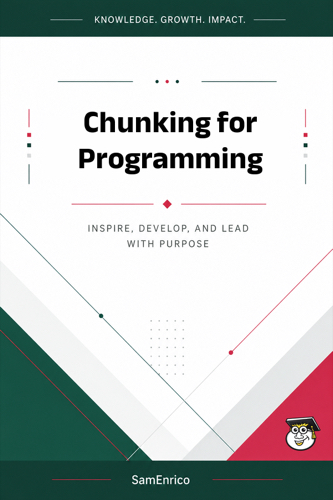
Chunking for Programming Audiobook
Remember code syntax and algorithms by grouping co
Remember code syntax and algorithms by grouping commands into functional blocks.
Formats
Free sample
Chapter 1: The 17-Token Trap--–- It is 11:47 PM on a Tuesday. You are staring at a function you wrote yourself three weeks ago. The code is familiar—you recognize every keyword, every variable name, every semicolon. You understand each line in isolation. But together, these fifteen lines form a brick wall.
You close the file. You open Twitter. And somewhere in the back of your mind, a small voice whispers: Maybe I am just not cut out for this.That voice is wrong. But to understand why, you must first understand something that most programming books never mention: the severe, unchangeable, biological limit of your working memory.The Magical Number That Ruins Your Focus In 1956, a cognitive psychologist named George Miller published one of the most cited papers in psychology: "The Magical Number Seven, Plus or Minus Two." His finding was simple and devastating. The average human brain can hold approximately seven objects—plus or minus two—in conscious working memory at any given moment.
That is it. Five to nine items. That is the entire capacity of your mental scratchpad.Here is what that means for programmers. Look at this line of code:for (int i = 0; i < 10; i++)Count the tokens. I will count them with you: for (1), ( (2), int (3), i (4), = (5), 0 (6), ; (7), i (8), < (9), 10 (10), ; (11), i++ (12), ) (13), { (14).
Fourteen tokens. Fourteen separate items your brain must track just to understand what the loop is, before you have even written what the loop does.You have not even started the loop body yet. Already you are holding fourteen items. Your maximum capacity is nine. Something has to drop.And something always does.The Three Types of Failure (And Why You Have Been Blaming the Wrong One)When you cannot understand a piece of code, there are exactly three possible explanations.
Most programmers assume they are experiencing the first two. Almost always, they are experiencing the third.Type One: Lack of Information This is when you do not know a command exists. You have never seen itertools.groupby in Python. You do not know that Java Script has a ?. optional chaining operator.
The solution is trivial: Google it. Search, read, learn, move on. This is not a cognitive failure. It is a documentation gap.Type Two: Lack of Knowledge This is when you know a command exists but you have not yet understood the concept behind it. You know what a closure is called, but you cannot explain…
This is the end of the free sample. Get the Audiobook to keep going. Buy now
About this book
Details
- Author
- Escalante Tatum
- Publisher
- SamEnrico
- Language
- English
- Genre
- Non-Fiction, Self-Help, Coding
- Released
- 2026-06-07
- Pages (approx.)
- 134
- Available as
- eBook, Audiobook

Listen in the VoxFlicks app
Audiobooks and audio dramas wherever you go. Sign in with your SamEnrico account and press play.
More by Escalante Tatum
 Resume Latin America GuideEscalante Tatum$11.99
 Cocaine Recovery Yoga GuideEscalante Tatum$11.99
 Aurora Borealis NightEscalante Tatum$11.99
 Forgiveness After Addiction HarmEscalante Tatum$11.99
 Benzo Withdrawal Insomnia Solutions CourseEscalante Tatum$11.99
 CRE Construction Loan GuideEscalante Tatum$11.99
 Sergey Brin FlyingEscalante Tatum$11.99
 Woman in Special ForcesEscalante Tatum$11.99
 The Troll King's Last BargainEscalante Tatum$11.99
 The Silk Road Gambit: How an Ancient Trader Built the World's First Casino EmpireEscalante Tatum$11.99
 The Green Book of Wealth: How Black America’s Secret Financial Networks Built EmpiresEscalante Tatum$11.99
 How to Become a Ammonium-nitrate CrystallizerEscalante Tatum$11.99