
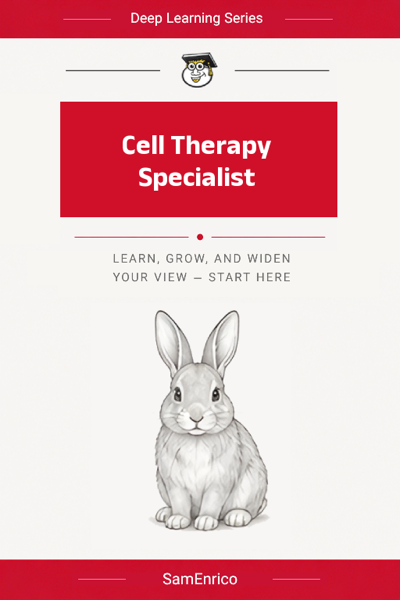
Non-FictionInformativeEducational
Cell Therapy Specialist
A Coursebook on Cell Therapy Specialist
by Manns Lillia
A Coursebook on Cell Therapy Specialist
Formats
About this book
Free sample
Chapter 1: The Living Drug...--–- The first time Samantha Chen watched a patient receive her own engineered cells, she nearly dropped the infusion bag. It was not the weight of the plastic—barely 150 milliliters of milky fluid—but the weight of the moment. Those cells, harvested from the patient’s blood three weeks earlier, had been flown across three states, processed in a cleanroom the size of a walk-in closet, genetically reprogrammed to recognize cancer, multiplied from a few million into a hundred million soldiers, and then frozen, shipped back, thawed at the bedside, and now hung from a metal pole like a common bag of saline. But this was not saline. This was a living drug.
And as the bag emptied into the patient’s central line, Samantha realized she was witnessing something that would have been considered science fiction when she started her nursing career a decade ago. The patient, a 54-year-old father of two with relapsed lymphoma that had already failed three chemotherapy regimens, would either experience a complete remission within 30 days or die from cytokine release syndrome before the week was out. There was no middle ground. That binary outcome—cure or catastrophe—is what makes cell therapy unlike any other medical intervention ever devised.This chapter establishes the conceptual and historical foundation for everything that follows in this book. It begins by distinguishing cell therapy from conventional small molecule drugs and gene therapy—a distinction that shapes regulatory pathways, manufacturing requirements, and clinical expectations.
It then traces the evolution of cell therapy from the first bone marrow transplants in the 1950s to the explosion of chimeric antigen receptor (CAR)-T cell therapies that received FDA approval beginning in 2017, and finally to the emerging frontier of induced pluripotent stem cells (i PSCs) and allogeneic “off-the-shelf” products. Core definitions are introduced with a unified reference table, including the critical distinction between autologous (patient’s own cells) and allogeneic (donor-derived) products—a distinction that will appear only as shorthand references in later chapters, having been fully defined here. The concept of mechanism of action (Mo A) is explained using…
This is the end of the free sample. Get the eBook to keep going. Buy now
Contents
- Chapter 1
- Chapter 2
- Chapter 3
- Chapter 4
- Chapter 5
- Chapter 6
- Chapter 7
- Chapter 8
- Chapter 9
- Chapter 10
- Chapter 11
- Chapter 12
Details
- Author
- Manns Lillia
- Publisher
- SamEnrico
- Language
- English
- Genre
- Non-Fiction, Informative, Educational
- Released
- 2026-05-18
- Pages (approx.)
- 160
- Available as
- eBook, Audiobook

Read better in the ZLOADR app
Your eBooks on your phone or tablet. Sign in with your SamEnrico account and start reading.
More by Manns Lillia
 Work Addiction and Social IsolationManns Lillia$11.99
 Jacques Louis David GuideManns Lillia$11.99
 Cultural Differences ValidationManns Lillia$11.99
 Beyond The Pill HandbookManns Lillia$11.99
 Sara Facio: The Lens That Captured Latin America's SoulManns Lillia$11.99
 US Gender Pay Gap NegotiationManns Lillia$12.99
 How to Produce Barbed WireManns Lillia$11.99
 How to Become a Gill-box TenderManns Lillia$11.99
You may also like
 Hong Kong Handover 1997Dunn Johnnie$11.99
 Zumba For Postnatal Recovery CourseNeal Christian$11.99
 Zumba for BeginnersLadner Nikia$11.99
 YouTube Comment Mining GuideHumes Pandora$12.99
 Worry Box MeditationCarlin Rudy$11.99
 Workplace Stress MeditationNguyen Lynn$11.99
 Workplace Stress and Sleep RepairHawley Ivory$11.99
 Workplace Perfectionism CureDelaney Jeffry$11.99
 Workplace Injustice Anger GuideWallen Isabelle$11.99
 Work Addiction and Burnout LinkGreenwood Ester$11.99
 Women in Yoga and WellnessBeattie Galina$11.99
 Women in Stand Up ComedyChun Evangeline$11.99