
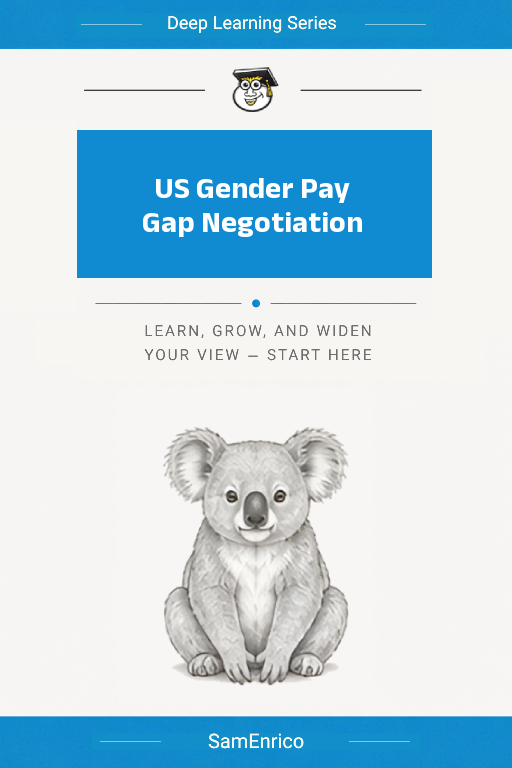
Non-FictionProfessional's Cheat SheetEquity
US Gender Pay Gap Negotiation
Use salary transparency laws and pay range disclos
by Manns Lillia
Use salary transparency laws and pay range disclosures to close gender gaps in US. Practice negotiating techniques that reduce bias and raise outcomes.
Formats
About this book
Free sample
Chapter 1: The Transparency Trap...-- The first time Sara saw a salary range of "130,000–130,000 – 130,000–500,000" on a job posting, she felt something unexpected. It wasn't excitement. It was dread. She was a senior product manager with twelve years of experience, stellar performance reviews, and a track record of launching three profitable products. By every objective measure, she was an ideal candidate.
But that range—that impossibly wide, almost absurdly ambiguous range—stopped her cold. "What am I supposed to do with that?" she thought. "If I ask for 300,000,they′llthink I′marrogant.If Iaskfor300,000, they'll think I'm arrogant. If I ask for 300,000,they′llthink I′marrogant.If Iaskfor150,000, I'm leaving half a million on the table over five years. Maybe I'll just keep looking."Sara did not apply for that job.
She found a different posting with a narrower range—180,000to180,000 to 180,000to220,000—and applied there instead. She got the job, negotiated to 210,000,andconsideredherselfsuccessful.Buthereisthetrap:thejobwiththe210,000, and considered herself successful. But here is the trap: the job with the 210,000,andconsideredherselfsuccessful.Buthereisthetrap:thejobwiththe130,000 to 500,000rangehadarealbudgetof500,000 range had a real budget of 500,000rangehadarealbudgetof350,000 for someone with her experience. She never knew. She never asked.
She self-selected out of a role that would have paid her nearly twice as much, simply because the ambiguity triggered her risk aversion.This is the Transparency Trap.Pay transparency laws were designed to close the gender pay gap. And in many ways, they have succeeded. The uncontrolled gap—the raw difference between what men and women earn across all jobs—has narrowed from 0.77to0.77 to 0.77to0.82 on the dollar over the past decade. But the controlled gap—the difference between men and women in the same role, same location, same experience—has stubbornly stalled at $0.99. That last one percent is the hardest to close.
And paradoxically, pay transparency laws have introduced a new cognitive bias that may be keeping it stuck.This chapter will dismantle the Transparency Trap: the hidden psychological mechanism that causes women to avoid jobs with wide salary ranges, thereby perpetuating the very gap transparency was meant to solve. You will learn why wide ranges hurt…
This is the end of the free sample. Get the eBook to keep going. Buy now
Contents
- Chapter 1
- Chapter 2
- Chapter 3
- Chapter 4
- Chapter 5
- Chapter 6
- Chapter 7
- Chapter 8
- Chapter 9
- Chapter 10
- Chapter 11
- Chapter 12
Details
- Author
- Manns Lillia
- Publisher
- SamEnrico
- Language
- English
- Genre
- Non-Fiction, Professional's Cheat Sheet, Equity
- Released
- 2026-06-01
- Pages (approx.)
- 152
- Available as
- eBook, Audiobook

Read better in the ZLOADR app
Your eBooks on your phone or tablet. Sign in with your SamEnrico account and start reading.
More by Manns Lillia
 Work Addiction and Social IsolationManns Lillia$11.99
 Jacques Louis David GuideManns Lillia$11.99
 Cultural Differences ValidationManns Lillia$11.99
 Beyond The Pill HandbookManns Lillia$11.99
 Sara Facio: The Lens That Captured Latin America's SoulManns Lillia$11.99
 Cell Therapy SpecialistManns Lillia$11.99
 How to Produce Barbed WireManns Lillia$11.99
 How to Become a Gill-box TenderManns Lillia$11.99
You may also like
 Hong Kong Handover 1997Dunn Johnnie$11.99
 Zumba For Postnatal Recovery CourseNeal Christian$11.99
 Zumba for BeginnersLadner Nikia$11.99
 YouTube Comment Mining GuideHumes Pandora$12.99
 Worry Box MeditationCarlin Rudy$11.99
 Workplace Stress MeditationNguyen Lynn$11.99
 Workplace Stress and Sleep RepairHawley Ivory$11.99
 Workplace Perfectionism CureDelaney Jeffry$11.99
 Workplace Injustice Anger GuideWallen Isabelle$11.99
 Work Addiction and Burnout LinkGreenwood Ester$11.99
 Women in Yoga and WellnessBeattie Galina$11.99
 Women in Stand Up ComedyChun Evangeline$11.99