
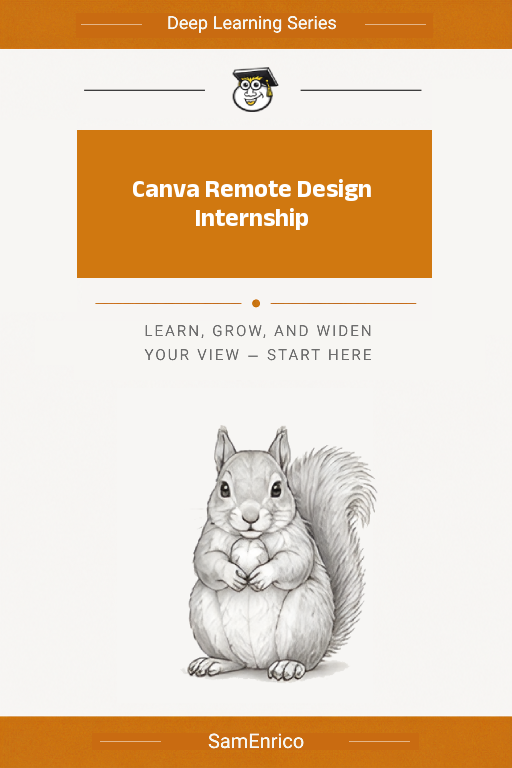
Non-FictionStudent's ShortcutDesign InternshipCanva Careers
Canva Remote Design Internship eBook
Join Canva's virtual internship for graphic design
Join Canva's virtual internship for graphic design template creation and brand identity projects from anywhere.
Formats
Free sample
Chapter 1: The Asynchronous Revolution--–- The email arrived at 11:47 PM on a Tuesday. Maya, a 22-year-old community college graduate from rural Arkansas, was half-asleep on her secondhand couch, her cracked laptop balanced on a stack of textbooks. She had applied to 47 design jobs in the past six months. Forty-two had rejected her. Five had never replied.
Her portfolio—filled with posters for imaginary bands and album covers for songs that didn’t exist—had generated exactly zero interviews. She was days away from accepting a shift manager position at a local grocery store.The email was from Canva.Not a rejection. Not a generic “we’ll keep your resume on file.” It was an invitation to interview for their remote design internship. Maya read it three times. Then she cried.
Then she opened her laptop and started researching everything she could about Canva’s “Virtual First” culture—a phrase she’d never heard before but would soon come to know better than her own phone number.This chapter is for everyone who has ever felt like Maya. It is for the self-taught designer who thinks their lack of a degree disqualifies them. It is for the career-changer who believes their age is a liability. It is for the remote work skeptic who wonders if “virtual internship” is just a fancy way of saying “unpaid busywork.” By the time you finish this chapter, you will understand not just what Canva is, but how to think like a Canva intern before you ever submit an application.What Is Canva, Really?If you ask most people what Canva is, they’ll say “a design tool” or “like Photoshop but easier.” Both answers are wrong—not factually, but strategically. Canva is not a tool.
It is a philosophy encoded in software.Founded in 2013 in Perth, Australia, Canva grew from a simple idea: design should not require a four-year degree. At the time, the industry standard was Adobe Creative Cloud—powerful, expensive, and notoriously difficult to learn. Canva’s founders, Melanie Perkins, Cliff Obrecht, and Cameron Adams, bet everything on a contrarian belief. They believed that templates could replace technical skill. They believed that drag-and-drop could replace layers and masks.
And they believed that a 12.95monthlysubscriptioncoulddemocratizeanindustrybuilton12.95 monthly subscription could democratize an industry built on 12.95monthlysubscriptioncoulddemocratizeanindustrybuilton600 software licenses.They were right. By 2025, Canva had over 185 million monthly active users, a valuation exceeding $40 billion, and a suite of products that included not just design but video editing, AI image generation, presentation software, and social media management. But the most important milestone for our purposes came during the pandemic. When the world went remote in 2020, Canva didn’t scramble to adapt—it doubled down. In 2021, the company announced its “Virtual First” policy: no employee would ever be required to return to an office.
Remote work wasn’t a temporary accommodation. It was the default.For interns, this was seismic. Traditional internships meant relocating to expensive cities, sleeping on couches, and competing for coffee-fetching duties. Canva’s virtual internship meant you could work from your childhood bedroom, your local library, or a coffee shop in a town without a traffic light. The only requirement was a laptop, an internet connection, and the ability to thrive without someone looking over your shoulder.But here’s what most applicants never understand: Canva’s Virtual First culture is not just about where you work.
It is about how you work. And if you try to replicate an office environment online, you will fail. This chapter will teach you why.The Virtual First Mindset: Unlearning the Office Before we talk about tools, let’s talk about psychology. Most of us were trained—by school, by previous jobs, by cultural osmosis—to equate presence with productivity. If your boss could see you at your desk, you were working.
If they couldn’t, you were slacking. This is called “presenteeism,” and it is the enemy of remote work.Canva’s Virtual First culture rejects presenteeism entirely. In its place are three core principles: intentionality, documentation, and asynchronous trust. Let’s break each down.Intentionality means every meeting, every message, every decision has a clear purpose. In an office, you might ask a coworker a question because you saw them walk by.
In a remote setting, you ask because you’ve already checked the documentation, searched Slack, and determined that a human is the only solution. Intentionality is the opposite of “let’s hop on a quick call”—a phrase that should make you wince.Documentation means writing everything down. Not just important decisions, but processes, preferences, and context. In an office, you can point at a whiteboard. In a remote setting, you need a shared source of truth.
The best remote interns document obsessively—not because anyone asked, but because documentation is how you scale yourself.Asynchronous trust is the hardest principle for most people to internalize. It means believing that your colleagues are working even when you cannot see them working. It means sending a message and not expecting an immediate reply. It means measuring output, not hours logged. Asynchronous work is the superpower of Virtual First companies, but it requires a level of trust that office culture actively erodes.Take a moment to assess yourself against these three principles.
Are you the kind of person who needs constant check-ins to stay focused? Do you feel anxious when a message goes unanswered for more than an hour? Do you prefer talking through problems rather than writing them down? If yes, you are not a bad candidate. You are simply trained for an office.
And like Maya, you can unlearn that training.The Communication Toolkit: When to Use What Canva uses a specific set of tools for communication. Knowing which tool to use—and when—is the difference between being seen as a professional and being seen as a nuisance. Let’s walk through the primary tools and the decision framework that governs them.Slack is for status updates, quick questions, and watercooler chat. Slack channels in Canva are organized by project, team, and interest. You will join channels like #design-requests, #template-feedback, and #random-pets.
The key rule of Slack: assume everyone is busy. Use threads to keep conversations contained. Use emoji reactions instead of “thanks for sharing” messages. And never, ever use Slack for urgent requests unless you have explicitly agreed on an emergency protocol with your team.Loom is for design walkthroughs, asynchronous feedback, and anything that benefits from visual explanation. Loom allows you to record your screen, your face, or both, and generate a shareable link.
A three-minute Loom can replace a fifteen-minute meeting. The best remote interns use Loom constantly—to explain a design decision, to request clarification on a brief, to document a process for future interns. Loom respects other people’s time because they can watch your recording at 2x speed, on their own schedule.Zoom is for meetings that genuinely require real-time interaction. In Virtual First companies, Zoom is the exception, not the rule. Use Zoom for weekly team stand-ups, one-on-one check-ins with your host, and cross-functional brainstorming sessions.
Never use Zoom for something that could have been a Loom or a Slack message. As a rule of thumb…
This is the end of the free sample. Get the eBook to keep going. Buy now
About this book
Details
- Author
- Russell Janet
- Publisher
- SamEnrico
- Language
- English
- Genre
- Non-Fiction, Student's Shortcut, Design Internship, Canva Careers
- Released
- 2026-05-29
- Pages (approx.)
- 153
- Available as
- eBook, Audiobook

Read better in the ZLOADR app
Your eBooks on your phone or tablet. Sign in with your SamEnrico account and start reading.
More by Russell Janet
 Rabbi Yitzchak HutnerRussell Janet$11.99
 Benzo Taper Doctor CommunicationRussell Janet$11.99
 Journalist Captive TaleRussell Janet$11.99
 Twelve Step Alternatives ComparedRussell Janet$11.99
 Murdoch Rebekah Brooks AllianceRussell Janet$11.99
 The Cursed Shield: Achilles' Last StandRussell Janet$11.99
 Whispers in the Dark: The Lost Language of the Voynich ManuscriptRussell Janet$11.99
 Scaling Remote Teams Poland GuideRussell Janet$12.99
 Understanding Boucher–neuhauser SyndromeRussell Janet$17.99
 Carob HarvestingRussell Janet$11.99
 How to Start a Hobby in HydroponicsRussell Janet$11.99
You may also like
 Hong Kong Handover 1997Dunn Johnnie$11.99
 Zumba For Postnatal Recovery CourseNeal Christian$11.99
 Zumba for BeginnersLadner Nikia$11.99
 YouTube Comment Mining GuideHumes Pandora$12.99
 Worry Box MeditationCarlin Rudy$11.99
 Workplace Stress MeditationNguyen Lynn$11.99
 Workplace Stress and Sleep RepairHawley Ivory$11.99
 Workplace Perfectionism CureDelaney Jeffry$11.99
 Workplace Injustice Anger GuideWallen Isabelle$11.99
 Work Addiction and Burnout LinkGreenwood Ester$11.99
 Women in Yoga and WellnessBeattie Galina$11.99
 Women in Stand Up ComedyChun Evangeline$11.99