
Non-FictionInformativeEducational
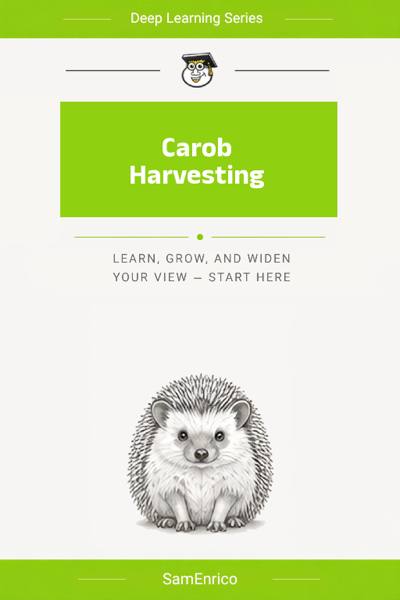
Carob Harvesting
A Coursebook on Carob Harvesting
A Coursebook on Carob Harvesting
Formats
About this book
Free sample
Chapter 1: The Thousand-Year Wait--–- The first time Maria Kostas watched her grandfather harvest carob pods on the hills above Kyrenia, she was seven years old and deeply unimpressed. The trees were ancient, gnarled things that looked like they had been twisted by the sea wind into shapes of quiet agony. Her grandfather, Elias, moved slowly between them with a long wooden pole and a canvas sheet spread beneath the branches. When he struck the limbs, a cascade of brown pods fell like dark rain. Maria remembered thinking that chocolate fell from trees in stories.
This was not chocolate. This was hard, leathery, and when she bit into one, it tasted like sweet dirt. Forty years later, Maria owns two hundred hectares of carob orchard in Crete, and she laughs at that memory. “I didn’t know I was watching the most profitable hour of my grandfather’s year,” she says. “I only knew I wanted to go back to the house and eat real sugar.”Carob has always been the patient farmer’s crop.
It does not rush. It does not demand. It waits. The carob tree Ceratonia siliqua L. belongs to the Fabaceae family—the legumes—which means it shares ancestry with peas and lentils, not with the cocoa tree that its pods superficially resemble.
This botanical fact is the first of many surprises for new growers. Unlike chocolate, which comes from the seeds of Theobroma cacao, carob’s edible portion is the entire pod: both the sweet pulp on the outside and the hard seeds within. And unlike cocoa, which demands equatorial humidity and shade, carob thrives where other crops fail—on rocky limestone slopes, in deep calcareous soils, under a blazing Mediterranean sun that would wilt an olive tree. It is drought-tolerant, salt-tolerant, and once established, it can outlive the farmer who plants it by a century or more.That longevity is both a blessing and a trap. Plant a carob tree today, and your grandchildren will harvest from it.
But plant it poorly—in the wrong soil, with the wrong sex ratio, without understanding its peculiar reproductive biology—and you will…
This is the end of the free sample. Get the eBook to keep going. Buy now
Contents
- Chapter 1
- Chapter 2
- Chapter 3
- Chapter 4
- Chapter 5
- Chapter 6
- Chapter 7
- Chapter 8
- Chapter 9
- Chapter 10
- Chapter 11
- Chapter 12
Details
- Author
- Russell Janet
- Publisher
- SamEnrico
- Language
- English
- Genre
- Non-Fiction, Informative, Educational
- Released
- 2026-05-07
- Pages (approx.)
- 151
- Available as
- eBook, Audiobook

Read better in the ZLOADR app
Your eBooks on your phone or tablet. Sign in with your SamEnrico account and start reading.
More by Russell Janet
 Rabbi Yitzchak HutnerRussell Janet$11.99
 Benzo Taper Doctor CommunicationRussell Janet$11.99
 Journalist Captive TaleRussell Janet$11.99
 Twelve Step Alternatives ComparedRussell Janet$11.99
 Murdoch Rebekah Brooks AllianceRussell Janet$11.99
 The Cursed Shield: Achilles' Last StandRussell Janet$11.99
 Whispers in the Dark: The Lost Language of the Voynich ManuscriptRussell Janet$11.99
 Canva Remote Design InternshipRussell Janet$12.99
 Scaling Remote Teams Poland GuideRussell Janet$12.99
 Understanding Boucher–neuhauser SyndromeRussell Janet$17.99
 How to Start a Hobby in HydroponicsRussell Janet$11.99
You may also like
 Hong Kong Handover 1997Dunn Johnnie$11.99
 Zumba For Postnatal Recovery CourseNeal Christian$11.99
 Zumba for BeginnersLadner Nikia$11.99
 YouTube Comment Mining GuideHumes Pandora$12.99
 Worry Box MeditationCarlin Rudy$11.99
 Workplace Stress MeditationNguyen Lynn$11.99
 Workplace Stress and Sleep RepairHawley Ivory$11.99
 Workplace Perfectionism CureDelaney Jeffry$11.99
 Workplace Injustice Anger GuideWallen Isabelle$11.99
 Work Addiction and Burnout LinkGreenwood Ester$11.99
 Women in Yoga and WellnessBeattie Galina$11.99
 Women in Stand Up ComedyChun Evangeline$11.99