
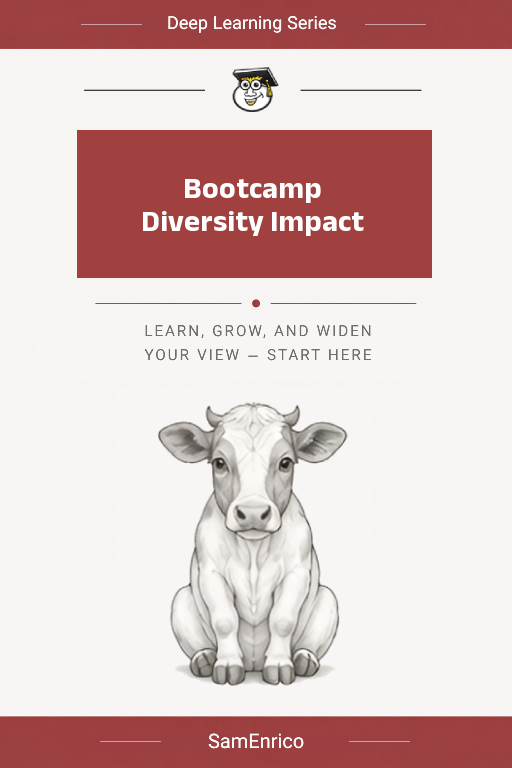
Non-FictionStudent's ShortcutDiversity Analytics
Bootcamp Diversity Impact eBook
Examine how bootcamps improve tech workforce diver
Examine how bootcamps improve tech workforce diversity compared to university CS programs for women and underrepresented groups.
Formats
Free sample
Chapter 1: The $120,000 Paperweight...--It is a quiet Thursday afternoon in the computer science building at a well-respected public university. In Lecture Hall B, a professor stands at the front of a room designed for two hundred students. Today, only ninety-three have shown up. By the final exam in three weeks, only sixty-two will remain enrolled. By the time this cohort graduates in four years, the data science predicts that exactly eleven of the original two hundred will earn a CS degree.
Forty-three of the dropouts will be women. Thirty-one will be Black or Latinx. And almost none of them will ever take another computer science course.This is not a failure of individual effort. This is a design.The American university computer science degree has become the most expensive, most inefficient, and most exclusionary gateway to middle-class prosperity ever devised. It costs more than a house in many parts of the country.
It takes four years at a moment when the half-life of a technical skill is eighteen months. And it systematically filters out precisely the populations the tech industry claims it desperately wants to hire: women, Black and Latinx students, first-generation college students, and anyone who does not arrive on campus already speaking the dialect of competitive, masculine, isolationist coding culture.The numbers are not ambiguous. According to the National Center for Education Statistics, women earned only 19 percent of computer science bachelor's degrees in the United States in 2022. That number is actually down from 37 percent in 1985, before the personal computer revolution turned CS into a boys' club. Black students earned 7 percent of CS degrees despite being 14 percent of the college-aged population.
Latinx students earned 11 percent despite being 19 percent of that demographic. First-generation college students—the very definition of the "nontraditional" talent pool bootcamps would later target—drop out of CS majors at nearly three times the rate of their peers whose parents hold degrees.The bootcamp, by contrast, has no lecture hall built for two hundred. It has a room built for twenty-five. It has no tenure-track professor who has not written production code in a decade. It has an industry veteran who left Google six months ago because she wanted to teach.
It has no four-year timeline. It has twelve weeks. And its students—women, career-changers, people of color, parents, veterans, formerly incarcerated individuals—succeed at rates that should embarrass every CS department in America.This book is about that contrast. It is about why the $120,000 paperweight called the traditional CS degree has failed at diversity, why the twelve-week bootcamp has unexpectedly succeeded, and what happens when the two models finally collide. But before we can understand the solution, we must understand the depth of the problem.
And the problem begins, as it does for so many students, on that quiet Thursday afternoon in Lecture Hall B.The Invention of the Weed-Out Culture The term "weed-out course" appears nowhere in any university mission statement. No dean has ever stood before a faculty meeting and said, "Our goal is to eliminate 70 percent of our students by the end of the sophomore year." And yet, weed-out culture is not an accident. It is a deliberate, inherited, and fiercely defended pedagogical tradition that dates back to the post-Sputnik era, when American universities raced to produce a technocratic elite capable of beating the Soviets in aerospace and computing.The logic was simple and, in its original context, not entirely unreasonable: if you have limited faculty, limited lab space, and a national imperative to produce the very best engineers, you use introductory courses as a filter. You make them brutally hard. You grade on a curve so that only a fixed percentage can receive A's and B's.
You assign problem sets that take twenty hours a week. And you watch to see who survives. Those who do, you assume, have the "grit" and "aptitude" to become engineers. Those who do not, you have efficiently sorted out of the pipeline.This model worked, if by "worked" you mean "produced a mostly white, mostly male, mostly upper-middle-class cohort of engineers who staffed the defense industry and early Silicon Valley." It did not work, and was never designed to work, for anyone else.Coleen Carrigan, an anthropologist of technology and author of Cracking the Bro Code, spent five years embedded in university computer science departments. What she documented was a culture in which weed-out courses function not as educational experiences but as initiation rituals.
"Students learn very quickly," she writes, "that the goal is not to understand the material but to survive the curve. Collaboration is punished as cheating. Asking for help is a sign of weakness. And the students who already know how to code—almost always the ones who had private tutors, expensive summer camps, and parents in tech—dominate the curve, compressing everyone else into the failing tail."The result is a self-perpetuating aristocracy. Students who arrive with prior coding experience (disproportionately white, male, and wealthy) are rewarded.
Students who arrive without it (disproportionately women, underrepresented minorities, and first-generation) are punished. The course does not teach them to code. It teaches them that they do not belong.The Leaky Pipeline: Where Diversity Goes to Die The metaphor of the "leaky pipeline" has been used in tech diversity discourse for nearly two decades. The idea is simple: women and underrepresented minorities enter the tech education pipeline at various points (high school, college, first job) and then leak out at each subsequent stage. The problem with the metaphor is that it implies passivity.
Leaks happen. Pipes crack. No one is to blame.This book rejects that framing. The CS degree is not a leaky pipe. It is an active filtration system.Consider the data.
Of every one hundred women who declare a CS major as first-year students, only thirty-eight will graduate with that degree. For Black students, the number is thirty-one. For Latinx students, it is thirty-three. For white male students whose parents have college degrees, it is sixty-two. That gap—nearly thirty percentage points—does not appear because women and minorities are less capable.
It appears because the environment is actively hostile.The mechanisms of that hostility are well-documented. In one study of undergraduate CS programs, 74 percent of women reported experiencing "stereotype threat"—the anxiety of confirming a negative stereotype about their group—during exams and problem set reviews. Fifty-two percent reported being excluded from study groups by male peers. Thirty-eight percent reported hearing professors make jokes about women's coding abilities. Nineteen percent reported unwanted sexual advances from male students in lab settings.
And these numbers, it is worth noting, come from a survey conducted after the #Me Too movement and after decades of diversity training.The "tech bro" culture of university CS departments is not an incidental side effect. It is the primary mechanism of filtration. When a male student tells a female student that she "only got that internship because of diversity hiring," he is not just being rude. He is executing the filtration system. When a professor calls on male students three times as often as female students during lectures, he is executing the filtration system.
When a teaching assistant rolls his eyes at a Black student's question about a basic concept, he is executing the…
This is the end of the free sample. Get the eBook to keep going. Buy now
About this book
Details
- Author
- Clemons Jacinta
- Publisher
- SamEnrico
- Language
- English
- Genre
- Non-Fiction, Student's Shortcut, Diversity Analytics
- Released
- 2026-06-01
- Pages (approx.)
- 148
- Available as
- eBook, Audiobook

Read better in the ZLOADR app
Your eBooks on your phone or tablet. Sign in with your SamEnrico account and start reading.
More by Clemons Jacinta
 The Rambam Life and WorksClemons Jacinta$11.99
 Prioritization for EntrepreneursClemons Jacinta$11.99
 Newspaper Empire Building GuideClemons Jacinta$11.99
 DBT Emotional Regulation WorkbookClemons Jacinta$11.99
 Recovery Chip and Milestone GuideClemons Jacinta$11.99
 Frozen Hearts: The Tragic Love of the Arctic’s Forgotten PioneersClemons Jacinta$11.99
 The Unfinished Symphony: How a Forgotten Literary Movement Shaped Modern ProtestClemons Jacinta$11.99
 Sprint Planning FacilitatorClemons Jacinta$11.99
 How to Start a Powdered Sugar Business (Beginners Guide)Clemons Jacinta$11.99
 Return Policy Showdown GuideClemons Jacinta$12.99
 Understanding Blepharo Cheilo Dontic SyndromeClemons Jacinta$17.99
You may also like
 Hong Kong Handover 1997Dunn Johnnie$11.99
 Zumba For Postnatal Recovery CourseNeal Christian$11.99
 Zumba for BeginnersLadner Nikia$11.99
 YouTube Comment Mining GuideHumes Pandora$12.99
 Worry Box MeditationCarlin Rudy$11.99
 Workplace Stress MeditationNguyen Lynn$11.99
 Workplace Stress and Sleep RepairHawley Ivory$11.99
 Workplace Perfectionism CureDelaney Jeffry$11.99
 Workplace Injustice Anger GuideWallen Isabelle$11.99
 Work Addiction and Burnout LinkGreenwood Ester$11.99
 Women in Yoga and WellnessBeattie Galina$11.99
 Women in Stand Up ComedyChun Evangeline$11.99