
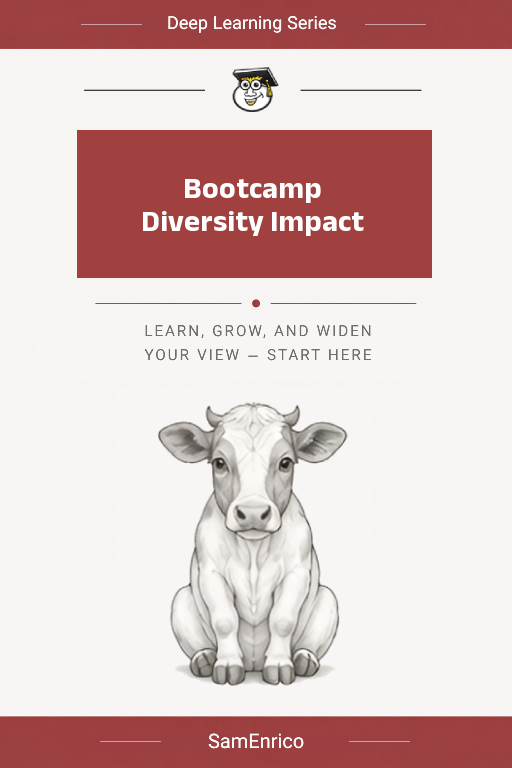
Non-FictionStudent's ShortcutDiversity Analytics
Bootcamp Diversity Impact Audiobook
Examine how bootcamps improve tech workforce diver
Examine how bootcamps improve tech workforce diversity compared to university CS programs for women and underrepresented groups.
Formats
Free sample
Chapter 1: The $120,000 Paperweight...--It is a quiet Thursday afternoon in the computer science building at a well-respected public university. In Lecture Hall B, a professor stands at the front of a room designed for two hundred students. Today, only ninety-three have shown up. By the final exam in three weeks, only sixty-two will remain enrolled. By the time this cohort graduates in four years, the data science predicts that exactly eleven of the original two hundred will earn a CS degree.
Forty-three of the dropouts will be women. Thirty-one will be Black or Latinx. And almost none of them will ever take another computer science course.This is not a failure of individual effort. This is a design.The American university computer science degree has become the most expensive, most inefficient, and most exclusionary gateway to middle-class prosperity ever devised. It costs more than a house in many parts of the country.
It takes four years at a moment when the half-life of a technical skill is eighteen months. And it systematically filters out precisely the populations the tech industry claims it desperately wants to hire: women, Black and Latinx students, first-generation college students, and anyone who does not arrive on campus already speaking the dialect of competitive, masculine, isolationist coding culture.The numbers are not ambiguous. According to the National Center for Education Statistics, women earned only 19 percent of computer science bachelor's degrees in the United States in 2022. That number is actually down from 37 percent in 1985, before the personal computer revolution turned CS into a boys' club. Black students earned 7 percent of CS degrees despite being 14 percent of the college-aged population.
Latinx students earned 11 percent despite being 19 percent of that demographic. First-generation college students—the very definition of the "nontraditional" talent pool bootcamps would later target—drop out of CS majors at nearly three times the rate of their peers whose parents hold degrees.The bootcamp, by contrast, has no lecture hall built for two hundred. It has a room built for twenty-five. It has no tenure-track professor who has not written production code in a decade. It has an industry veteran who left Google six months ago because she wanted to teach.
It has no four-year timeline. It has twelve weeks. And its students—women, career-changers, people of color, parents, veterans, formerly incarcerated individuals—succeed at rates that should embarrass every CS department in America.This book is about that contrast.…
This is the end of the free sample. Get the Audiobook to keep going. Buy now
About this book
Details
- Author
- Clemons Jacinta
- Publisher
- SamEnrico
- Language
- English
- Genre
- Non-Fiction, Student's Shortcut, Diversity Analytics
- Released
- 2026-06-01
- Pages (approx.)
- 148
- Available as
- eBook, Audiobook

Listen in the VoxFlicks app
Audiobooks and audio dramas wherever you go. Sign in with your SamEnrico account and press play.
More by Clemons Jacinta
 The Rambam Life and WorksClemons Jacinta$11.99
 Prioritization for EntrepreneursClemons Jacinta$11.99
 Newspaper Empire Building GuideClemons Jacinta$11.99
 DBT Emotional Regulation WorkbookClemons Jacinta$11.99
 Recovery Chip and Milestone GuideClemons Jacinta$11.99
 Frozen Hearts: The Tragic Love of the Arctic’s Forgotten PioneersClemons Jacinta$11.99
 The Unfinished Symphony: How a Forgotten Literary Movement Shaped Modern ProtestClemons Jacinta$11.99
 Sprint Planning FacilitatorClemons Jacinta$11.99
 How to Start a Powdered Sugar Business (Beginners Guide)Clemons Jacinta$11.99
 Return Policy Showdown GuideClemons Jacinta$12.99
 Understanding Blepharo Cheilo Dontic SyndromeClemons Jacinta$17.99
You may also like
 Hong Kong Handover 1997Dunn Johnnie$11.99
 Zumba For Postnatal Recovery CourseNeal Christian$11.99
 Zumba for BeginnersLadner Nikia$11.99
 YouTube Comment Mining GuideHumes Pandora$12.99
 Worry Box MeditationCarlin Rudy$11.99
 Workplace Stress MeditationNguyen Lynn$11.99
 Workplace Stress and Sleep RepairHawley Ivory$11.99
 Workplace Perfectionism CureDelaney Jeffry$11.99
 Workplace Injustice Anger GuideWallen Isabelle$11.99
 Work Addiction and Burnout LinkGreenwood Ester$11.99
 Women in Yoga and WellnessBeattie Galina$11.99
 Women in Stand Up ComedyChun Evangeline$11.99