
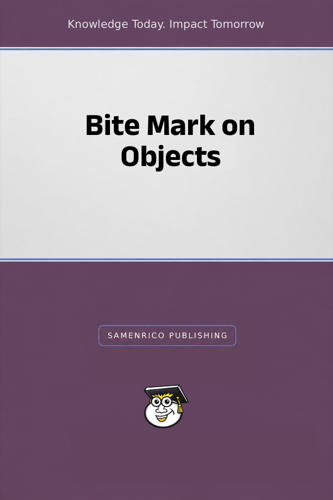
About this book
Free sample
Chapter 1: The Cheese That Changed Everything...-- In 1984, a burglar broke into a kitchen in Yorkshire, England. He stole some money, rifled through drawers, and before fleeing, he helped himself to a piece of cheese from the refrigerator. He took a single bite, then dropped the remainder on the floor. That half-moon-shaped impression of human teeth, preserved in cold cheddar, would become one of the most debated pieces of forensic evidence in British legal history. The bite mark on that cheese did not just help convict a man.
It ignited a decades-long controversy about whether teeth can ever truly tell the truth.For most of human history, a bite mark was simply a wound. It was something to bandage, to heal, to ignore. But in the late nineteenth century, forensic investigators began to notice something peculiar: no two sets of teeth are exactly alike. The same ridges and grooves that make a fingerprint unique also appear, in their own way, on the incisors, canines, and premolars that sink into skin, fruit, or Styrofoam. The idea that teeth could leave behind an identifiable signature took root slowly.
In 1892, Dr. Oscar Amoëdo, a Cuban dentist often called the father of forensic odontology, published the first systematic analysis of bite marks as evidence. He argued that dental arches, tooth rotations, gaps, wear patterns, and even the microscopic irregularities of biting edges could, in principle, distinguish one person from another. But for nearly a century, bite mark evidence remained a niche curiosity, more often used in civil disputes over dog attacks than in criminal murder trials.That changed in the 1970s and 1980s, when forensic odontology experienced what some called its golden age. High-profile cases—most famously the trial of serial killer Ted Bundy, whose bite mark on a murder victim's body was used to convict him—catapulted bite mark analysis into the mainstream.
Courts, hungry for scientific certainty in an era of rising violent crime, embraced the testimony of odontologists with remarkable enthusiasm. Jurors found bite mark evidence intuitively compelling: if fingerprints could identify a person, why not teeth? The visual nature…
This is the end of the free sample. Get the eBook to keep going. Buy now
Contents
- Chapter 1
- Chapter 2
- Chapter 3
- Chapter 4
- Chapter 5
- Chapter 6
- Chapter 7
- Chapter 8
- Chapter 9
- Chapter 10
- Chapter 11
- Chapter 12
Details
- Author
- Greenfield Janean
- Publisher
- SamEnrico
- Language
- English
- Genre
- Non-Fiction, True Crime / Object Marks
- Released
- 2026-06-06
- Pages (approx.)
- 143
- Available as
- eBook, Audiobook

Read better in the ZLOADR app
Your eBooks on your phone or tablet. Sign in with your SamEnrico account and start reading.
More by Greenfield Janean
 SCAMPER Group Technique CourseGreenfield Janean$11.99
 Skill Challenge Balance GuideGreenfield Janean$11.99
 Senior Grief and Self WorthGreenfield Janean$11.99
 Acupuncture for Digestive HealthGreenfield Janean$11.99
 Melatonin Dosage GuideGreenfield Janean$11.99
 Geriatric MassageGreenfield Janean$11.99
 Self Hypnosis for Financial AnxietyGreenfield Janean$11.99
 The Battle of the Bulge: Hitler's Last Roll of the Dice (1944-45)Greenfield Janean$11.99
 The Codebreaker and the Machine: Alan Turing’s Forgotten WarGreenfield Janean$11.99
 Sea Urchins: Spiky EchinodermGreenfield Janean$11.99
 How to Produce Deep FryersGreenfield Janean$11.99
 A Collector's Handbook to the Volvo 123gtGreenfield Janean$11.99