
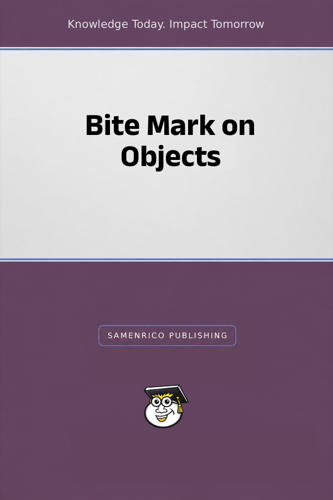
Free sample
Chapter 1: The Cheese That Changed Everything...-- In 1984, a burglar broke into a kitchen in Yorkshire, England. He stole some money, rifled through drawers, and before fleeing, he helped himself to a piece of cheese from the refrigerator. He took a single bite, then dropped the remainder on the floor. That half-moon-shaped impression of human teeth, preserved in cold cheddar, would become one of the most debated pieces of forensic evidence in British legal history. The bite mark on that cheese did not just help convict a man.
It ignited a decades-long controversy about whether teeth can ever truly tell the truth.For most of human history, a bite mark was simply a wound. It was something to bandage, to heal, to ignore. But in the late nineteenth century, forensic investigators began to notice something peculiar: no two sets of teeth are exactly alike. The same ridges and grooves that make a fingerprint unique also appear, in their own way, on the incisors, canines, and premolars that sink into skin, fruit, or Styrofoam. The idea that teeth could leave behind an identifiable signature took root slowly.
In 1892, Dr. Oscar Amoëdo, a Cuban dentist often called the father of forensic odontology, published the first systematic analysis of bite marks as evidence. He argued that dental arches, tooth rotations, gaps, wear patterns, and even the microscopic irregularities of biting edges could, in principle, distinguish one person from another. But for nearly a century, bite mark evidence remained a niche curiosity, more often used in civil disputes over dog attacks than in criminal murder trials.That changed in the 1970s and 1980s, when forensic odontology experienced what some called its golden age. High-profile cases—most famously the trial of serial killer Ted Bundy, whose bite mark on a murder victim's body was used to convict him—catapulted bite mark analysis into the mainstream.
Courts, hungry for scientific certainty in an era of rising violent crime, embraced the testimony of odontologists with remarkable enthusiasm. Jurors found bite mark evidence intuitively compelling: if fingerprints could identify a person, why not teeth? The visual nature of a bite mark—a direct impression of the suspect's body part on the victim or object—seemed almost like a photograph left behind at the crime scene.But there was a problem. Most bite marks in those early cases were on human skin. And human skin is a terrible recording device.The Problem with Skin Skin is elastic, curved, and alive.
When a person bites another person, the skin stretches, recoils, swells, bruises, and changes color over time. A bite mark on a living victim, photographed two hours after the assault, looks different from the same mark photographed twenty-four hours later. The body's inflammatory response distorts the original pattern. Sweat, blood, and bacteria contaminate the wound. If the victim is deceased, post-mortem changes—drying, bloating, discoloration—further alter the appearance.
A forensic odontologist in the 1980s might have claimed with confidence that a particular bite mark matched a particular suspect's teeth, but critics began to ask a troubling question: how could anyone be sure, given that the mark itself was changing even as it was being examined?This uncertainty led to wrongful convictions. The case of Ray Krone, known as the "Snaggletooth Killer," became a cautionary tale. Krone was convicted of murder in 1992 largely on the basis of a bite mark on the victim's breast. A forensic odontologist testified that the mark matched Krone's "unique" snaggletooth—a rotated lateral incisor. Krone spent ten years on death row before DNA evidence exonerated him.
The real killer was identified through genetic testing. The bite mark that sent Krone to death row turned out to be a classic example of overstatement, confirmation bias, and the inherent unreliability of skin as a substrate.It was against this backdrop of scandal, exoneration, and scientific soul-searching that a small group of forensic odontologists began to ask a different question: what if we stopped looking at skin altogether?The Object Revolution Bite marks on inanimate objects are not new. Criminals have bitten into apples, cheese, chocolate bars, pens, Styrofoam cups, pencils, soap bars, leather belts, plastic bags, and even wooden window frames for as long as there have been crimes. But for decades, these object-based bite marks were treated as secondary evidence, interesting curiosities that might corroborate other findings but rarely the centerpiece of a prosecution. The Yorkshire cheese case of 1984 was an early exception.
The burglar's bite left a crisp, undistorted impression because cheese, unlike skin, does not stretch, swell, or heal. The police photographed the cheese, made a dental cast of the suspect's teeth, and presented the comparison at trial. The jury convicted. The bite mark on the cheese was arguably more reliable than any bite mark on skin could ever be.What makes objects superior to skin? Three properties stand out.
First, objects are non-elastic. When you bite into an apple, the apple does not stretch away from your teeth and then snap back. It records the exact dimensions of your dental arch at the moment of the bite. Second, objects are static. Once the bite is made, the mark does not change over time unless the object decays or is damaged.
There is no inflammatory response, no swelling, no healing. Third, objects can often be preserved indefinitely under proper conditions. A bitten Styrofoam cup stored in a cool, dark evidence room will show the same pattern years later. A piece of bitten cheese can be frozen. A bitten pencil can sit in an evidence bag for decades.These advantages are not merely theoretical.
In 2015, a cold case from the 1970s was reopened in Florida. The only physical evidence linking the suspect to the crime scene was a bite mark on a half-eaten apple found near the victim's body. The apple had been frozen for forty years. When forensic odontologists finally thawed it and scanned it with modern 3D technology, they obtained a clear, undistorted impression of the biter's teeth. The suspect, long deceased, was posthumously linked to the crime.
No skin-based bite mark from the 1970s could have survived in a comparable state.The Shifting Legal Landscape Despite these advantages, object-based bite mark evidence has faced the same legal headwinds as its skin-based counterpart. In the United States, the 2009 National Academy of Sciences report Strengthening Forensic Science in the United States delivered a devastating critique of bite mark analysis in general. The report found that the scientific basis for bitemark identification was weak, that error rates were unknown, and that the field lacked standardized protocols. In 2016, the President's Council of Advisors on Science and Technology (PCAST) went further, concluding that bitemark analysis did not meet the basic standards of scientific validity required for admissibility under the Daubert standard, which governs the introduction of expert evidence in federal courts.These reports did not distinguish between skin-based and object-based bite marks. They treated all bitemark evidence as a single category.
This has created a strange situation: a bite mark on a Styrofoam cup, which can be scanned in 3D with sub-millimeter accuracy and compared to a digital model of a suspect's teeth using objective algorithms, is legally treated the same as a blurry photograph…
This is the end of the free sample. Get the eBook to keep going. Buy now
About this book
Details
- Author
- Greenfield Janean
- Publisher
- SamEnrico
- Language
- English
- Genre
- Non-Fiction, True Crime / Object Marks
- Released
- 2026-06-06
- Pages (approx.)
- 143
- Available as
- eBook, Audiobook

Read better in the ZLOADR app
Your eBooks on your phone or tablet. Sign in with your SamEnrico account and start reading.
More by Greenfield Janean
 SCAMPER Group Technique CourseGreenfield Janean$11.99
 Skill Challenge Balance GuideGreenfield Janean$11.99
 Senior Grief and Self WorthGreenfield Janean$11.99
 Acupuncture for Digestive HealthGreenfield Janean$11.99
 Melatonin Dosage GuideGreenfield Janean$11.99
 Geriatric MassageGreenfield Janean$11.99
 Self Hypnosis for Financial AnxietyGreenfield Janean$11.99
 The Battle of the Bulge: Hitler's Last Roll of the Dice (1944-45)Greenfield Janean$11.99
 The Codebreaker and the Machine: Alan Turing’s Forgotten WarGreenfield Janean$11.99
 Sea Urchins: Spiky EchinodermGreenfield Janean$11.99
 How to Produce Deep FryersGreenfield Janean$11.99
 A Collector's Handbook to the Volvo 123gtGreenfield Janean$11.99